
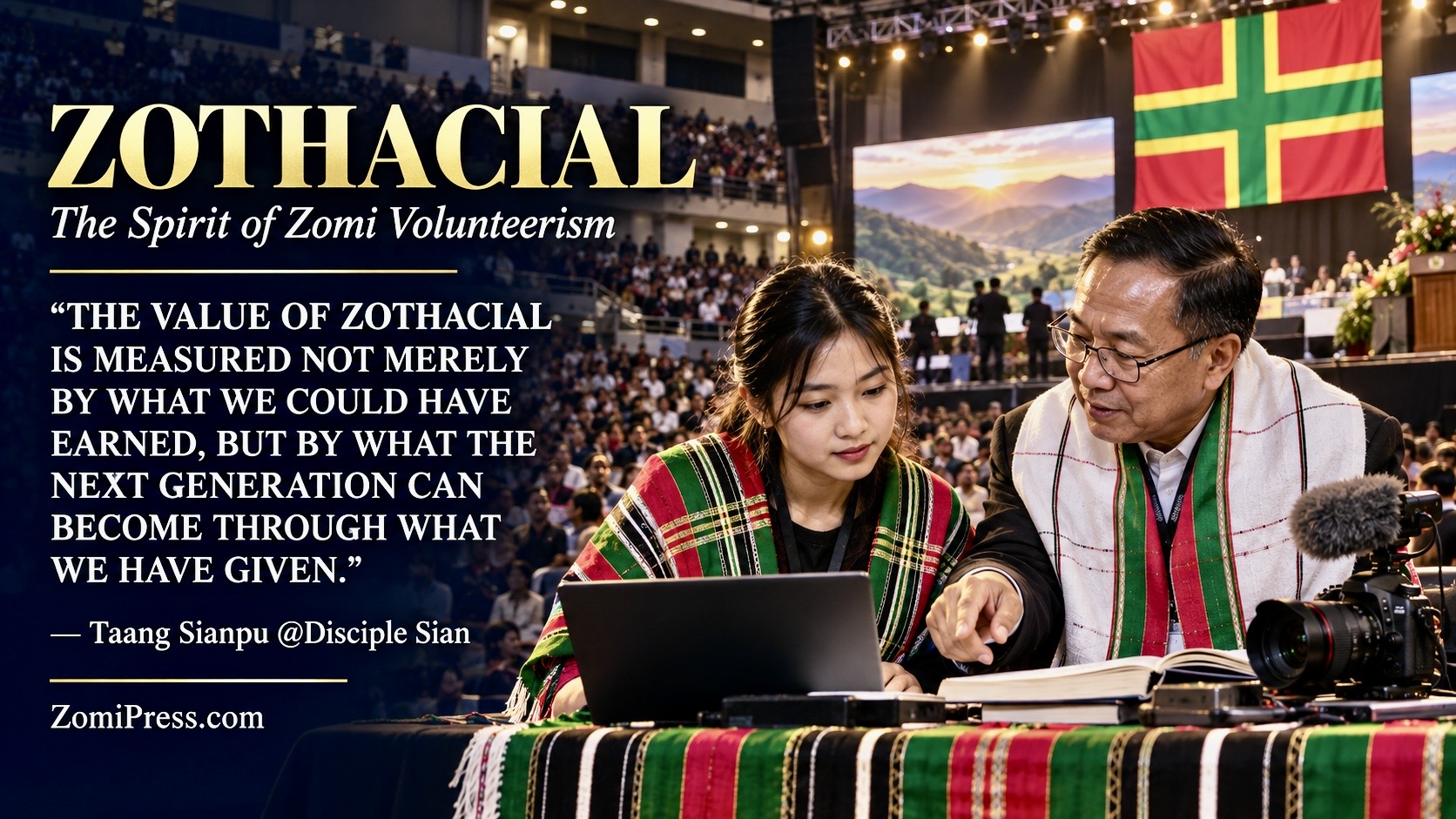
Download: Zothacial: The Enduring Spirit of Zomi Volunteerism
Love in Service, Excellence in Sacrifice, and an Investment in the Next Generation
By Taang Sianpu @Disciple Sian
People are remembered not only by the monuments they build, the wealth they accumulate, or the celebrations they organize. They are remembered by the values they preserve and pass on.
Among the Zomi people, one such enduring value is Zothacial, also known as the Zomi Taang Thacial—the Zomi spirit of volunteerism. It is the voluntary offering of one’s time, labor, knowledge, talent, professional skill, influence, and resources for the collective well-being of the Zomi community.
Zothacial is more than unpaid work. It is not merely helping when convenient, nor is it simply performing a service without sending an invoice. It is a cultural ethic rooted in love, sacrifice, generosity, belonging, and responsibility toward one’s people.
Its true worth cannot be determined by a monetary calculation alone. Its greater value must be measured by the lives it touches, the opportunities it creates, the culture it preserves, and the generations it strengthens.
The value of Zothacial is measured not merely by what the contributor could have earned, but by what the next generation can become through what the contributor has given.
The Meaning of Zothacial
Zothacial may be defined as:
The voluntary contribution of one’s time, strength, knowledge, skills, profession, influence, or resources, motivated by love and a shared responsibility for the unity, development, preservation, and future well-being of the Zomi people.

At its heart, Zothacial expresses a deeply communal understanding of life: a person’s gifts are not intended for personal advancement alone. Knowledge becomes more valuable when it is shared. Professional achievement becomes more meaningful when it opens a path for others. Cultural knowledge remains alive only when it is practiced, taught, demonstrated, documented, and entrusted to the next generation.
Zothacial can be seen in the artist who performs for the community, the elder who teaches traditional wisdom, the professional who mentors a beginner, the young person who helps arrange chairs, the family that prepares food, the technician who manages a livestream, and the volunteer who remains after everyone else has left to clean the venue.
It can be expressed through:
- Teaching the Zomi language, history, literature, music, and traditional arts
- Performing at a Zomi cultural or national celebration
- Mentoring young artists, professionals, and community leaders
- Providing media, legal, medical, educational, technical, or organizational expertise
- Designing publications and promotional materials
- Operating cameras, sound systems, livestreams, and digital platforms
- Preparing food, arranging facilities, welcoming guests, and assisting elders
- Offering transportation, equipment, accommodation, financial support, or professional services
- Creating opportunities for beginners to participate and develop
- Serving faithfully in the community over many years
Every contribution has dignity. The person serving behind the curtain and the person standing under the spotlight are participating in the same cultural mission.

A Value Greater Than a Price
Modern professional life usually measures services through contracts, fees, wages, and established market rates. Such arrangements are legitimate and necessary. A professional fee represents years of education, disciplined practice, experience, preparation, travel, equipment, and personal investment.
Zothacial does not deny the value of professional compensation. It does not teach that Zomi artists, workers, technicians, educators, cultural experts, or other professionals should always work without pay. Nor should it be used to suggest that professional work has no financial worth.
Instead, Zothacial introduces a second and often greater dimension of value.
A professional artist may ordinarily earn thousands of dollars for a single appearance. A musician, journalist, designer, interpreter, photographer, filmmaker, educator, technology developer, or cultural specialist may also command a substantial professional fee. When such professionals voluntarily contribute their abilities to a Zomi event, the value of their work does not disappear because they receive no fixed fee—or accept less than their regular professional rate.
The value is not erased. It is transformed into a cultural and generational contribution.
Their service becomes:
- A gift of excellence to the Zomi community
- A public example of humility and responsibility
- A source of inspiration for emerging talent
- A transfer of professional knowledge
- A bridge between experience and aspiration
- An investment in cultural continuity
- A living lesson in Zomi patriotism
Money can measure the immediate market price of a service. It cannot fully measure the confidence awakened in a child, the ambition stirred in a young artist, the knowledge transferred to a student, or the cultural pride restored in a generation.
That is why Zothacial must be evaluated not only economically, but culturally, educationally, relationally, and generationally.
Zothacial Is Not Exploitation
A responsible understanding of Zothacial must protect both the spirit of volunteerism and the dignity of professional work.
Zothacial does not necessarily mean “free.” It should never be used as an excuse to exploit artists, workers, professionals, young people, or faithful community volunteers. It should not pressure people into donating what they cannot afford to give. Neither culture nor patriotism should be used to shame someone into uncompensated labor.
True Zothacial must arise from freedom, love, trust, mutual respect, and a shared community purpose.
Organizers may raise funds, receive donations, reimburse travel and other expenses, provide accommodation, present honoraria, or financially recognize those who render valuable services. Such appreciation does not contradict Zothacial.
A commercial contract generally fixes a price for a defined service. Zothacial begins with a person’s voluntary willingness to contribute to the community, while leaving room for the community to respond generously according to its ability and the nature of the service.
In one situation, a contributor may donate an entire service. In another, the individual may donate part of a professional fee. Someone else may offer several hours of mentoring, lend equipment, provide technical consultation, or train emerging volunteers. Another may receive travel expenses, accommodation, an honorarium, or substantial financial appreciation raised by the community.
The form may vary. The spirit remains the same.
There is no cultural virtue in forcing a professional into financial hardship. Likewise, receiving an honorarium does not automatically remove the spirit of Zothacial.
The essential questions are:
- Was the contribution freely and honorably given?
- Was the contributor treated with dignity?
- Did the service benefit the community?
- Was knowledge or opportunity passed forward?
- Were financial expectations and arrangements transparent?
- Did the contribution strengthen relationships rather than exploit them?
- Did it help prepare others to serve in the future?
Zothacial is not defined merely by the absence of money. It is defined by the presence of love, sacrifice, responsibility, generosity, and a genuine concern for the future of the Zomi people.

The Zomi Cultural Stage: A Place of Shared Opportunity
The annual Zomi National Day on February 20, the Zomi Khuado Festival, Zomi harvest celebrations, national conferences, community gatherings, church programs, musical events, and cultural exhibitions bring together Zomi people from different communities and walks of life.
On the same occasion, one may see:
- A child appearing before an audience for the first time
- A beginning singer still learning confidence and stage presence
- A student discovering a talent
- An emerging musician refining a skill
- An experienced cultural practitioner
- An elder carrying traditional knowledge and historical memory
- A respected artist with professional experience
- A cultural ambassador recognized across communities
- A technical professional working quietly behind the scenes
At some of the largest Zomi gatherings, more than 6,000 people may assemble in one venue, while livestreams and social-media broadcasts bring the combined audience to approximately 10,000 or more around the world.
On such a stage, a beginner may appear in the same program as an accomplished professional. A child may perform where a respected artist has just stood. A young media volunteer may work beside an experienced producer. An elder may transmit traditional knowledge while a young technologist helps preserve and broadcast it digitally to the world.
Few cultural spaces offer such a visible meeting of generations, experiences, and abilities. It is one of the clearest and most beautiful expressions of Zothacial.
This shared platform does not mean that professional experience is unimportant, nor does equal opportunity mean that every person must receive the same role. Excellence, preparation, suitability, and responsibility still matter. Rather, it means that no one should be dismissed simply because he or she is a beginner.
Emerging talents should be trained, prepared, guided, and given appropriate opportunities to grow.
The professional brings excellence.
The elder brings memory.
The beginner brings possibility.
The young person brings continuity.
The volunteer brings love.
Together, they carry the Zomi people forward.
The Donation of Professional Knowledge
One of the highest expressions of Zothacial is the voluntary transfer of professional knowledge and experience.
A singer gives more than a song when a young person is inspired to practice. A musician gives more than a performance when a beginner learns how excellence is achieved. A journalist gives more than a story when a young volunteer learns to document the life of the community responsibly. A language teacher gives more than a lesson when a child begins to value and speak the Zomi language with confidence.
Likewise, a cultural expert gives more than a presentation when traditional knowledge is preserved. A photographer gives more than an image when a student learns how to document Zomi history. An IT or AI developer gives more than a digital product when young Zomi people learn to build technologies for their language and community.
A professional donation may include:
- Sharing a stage with emerging performers
- Teaching skills during rehearsals
- Offering workshops or practical training
- Allowing young volunteers to observe professional work
- Giving constructive feedback and career guidance
- Lending equipment or technical resources
- Developing cultural or educational materials
- Documenting language, history, and traditional knowledge
- Creating internships, apprenticeships, or mentoring relationships
- Helping community startups establish professional standards
- Using professional networks to create opportunities for others
A person may spend decades developing a profession. When part of that accumulated knowledge is entrusted to the next generation, something far greater than a few hours of labor is being donated.
It is a donation of experience.
It is a donation of discipline.
It is a donation of wisdom.
It is a donation of opportunity.
It is a donation of the future.
Zothacial as Generational Investment
The deepest value of Zothacial is revealed through its long-term impact.
Its success should not be judged merely by how much money an event saved. Saving money may be helpful, but it is not the highest purpose of Zomi volunteerism.
The greater purpose is to develop people.
A healthy culture of Zothacial creates a generational cycle:
- A beginner is welcomed.
- The beginner observes experienced contributors.
- The learner receives an opportunity to practice.
- Practice develops into competence.
- Competence grows into professional excellence.
- The professional returns to mentor another beginner.
When this cycle continues, a community does more than organize successful events. It cultivates artists, educators, cultural ambassadors, journalists, technicians, professionals, and leaders.
The highest achievement of Zothacial is not obtaining the greatest amount of free labor. It is raising capable people who will eventually use their abilities to strengthen others.
Zothacial reaches its fullest meaning when today’s recipient becomes tomorrow’s contributor, and today’s beginner becomes the mentor of the next generation.
Zothacial as a Lifelong Commitment
Some acts of Zothacial last for a few hours. Others become a lifelong calling.
A young person may begin by carrying equipment, distributing programs, preparing a room, assisting an elder, helping with cleanup, or volunteering backstage. With guidance and opportunity, that same individual may eventually become a coordinator, artist, cultural ambassador, professional, board member, community developer, or institutional leader.
This progression is important because communities are not sustained by events alone. They are sustained by people who are gradually formed through responsibility.
Zothacial therefore teaches that no honorable task is too small. What matters is not the visibility of the role, but the faithfulness of the service and the good it produces.
Much of the labor that sustains Zomi cultural and community life is never visible from the stage. Volunteers travel long distances, sacrifice working hours, prepare late into the night, use personal equipment, rehearse repeatedly, solve unexpected problems, and remain after the celebration has ended.
Some contributions receive public recognition. Many do not.
Yet visible and invisible service are equally necessary. The success seen on the stage is made possible by sacrifices made beyond it.

Zothacial and Zomi Patriotism
Zomi patriotism is not expressed only through words, slogans, flags, songs, or public declarations. Genuine patriotism is demonstrated through responsibility.
To love the Zomi people is to help develop Zomi people.
To honor Zomi culture is to preserve it accurately.
To value the Zomi language is to speak, teach, document, and develop it.
To celebrate Zomi identity is to prepare the next generation to carry it forward.
Zothacial turns patriotic sentiment into practical service.
It asks not only, “What do I feel about my people?” but also:
- What knowledge can I share?
- What skill can I teach?
- What opportunity can I create?
- What burden can I help carry?
- What institution can I strengthen?
- What cultural inheritance can I preserve?
- Whom can I prepare to take my place?
Patriotism without service can become performance. Service rooted in love becomes nation-building.
For a people living across different countries and communities, Zothacial is especially important. It allows the Zomi people to remain connected through shared responsibility, even when separated by geography. It turns cultural gatherings into places of reunion, education, preservation, development, and collective renewal.
Zothacial and the Mission of ZIUSA
The spirit of Zothacial aligns closely with the founding purposes of Zomi Innkuan USA—also known as Zomi Community USA or ZIUSA.
ZIUSA exists to promote cooperation, integration, unity, mutual support, development, and the preservation of Zomi identity. These commitments may be understood through three foundational values: unity, development, and preservation.
Unity
Zothacial brings together people of different ages, professions, economic circumstances, churches, regions, and backgrounds around a shared community purpose. People do not have to be identical in order to serve together. They need a common commitment to the well-being of the Zomi people.
Development
Volunteerism becomes community development when it builds skills, confidence, leadership, institutions, professional networks, and opportunities. Zothacial should not merely complete today’s work; it should develop the people who will carry tomorrow’s responsibilities.
Preservation
Zomi language, music, literature, traditional knowledge, dress, history, stories, customs, and cultural celebrations cannot be preserved through annual display alone. They must be taught, practiced, documented, interpreted, and transferred.
When this happens, cultural celebration becomes cultural education, and cultural education becomes cultural continuity.
Responsibilities of Community Organizers
For Zothacial to remain healthy, honorable, and sustainable, community organizations and event organizers must practice it responsibly.
They should:
- Explain responsibilities and expectations clearly
- Distinguish volunteer contributions from contracted professional services
- Avoid pressuring or shaming people into unpaid work
- Reimburse reasonable expenses whenever resources permit
- Provide honoraria or fair compensation when fundraising makes it possible
- Recognize contributors publicly and accurately
- Respect professional ownership and creative credit
- Protect volunteers from excessive or unsafe workloads
- Create structured opportunities for children, youth, and beginners
- Pair emerging participants with experienced mentors
- Maintain appropriate professional and cultural standards
- Use donated funds transparently
- Evaluate success by the people developed, not only by the program completed
A community that asks for sacrifice must also practice gratitude. Zothacial cannot flourish where contributors are ignored, exploited, or treated as replaceable labor.
Recognition does not always need to be expensive. A sincere expression of gratitude, proper public credit, a certificate of appreciation, reimbursement of expenses, an honorarium, or a future professional opportunity can communicate that the community values both the contribution and the contributor.
Responsibilities of Zomi Professionals
Professionals who participate in Zothacial carry a special responsibility. Their calling is not merely to display excellence but to make excellence visible, teachable, and attainable.
They can:
- Model discipline and preparation
- Treat beginners with dignity
- Explain professional standards
- Share practical knowledge
- Offer constructive feedback
- Encourage emerging talent
- Create pathways for future participation
- Protect cultural accuracy and integrity
- Demonstrate humility alongside excellence
- Return regularly to invest in developing leaders
True professionalism is not threatened by helping a beginner. It is strengthened when excellence becomes an inheritance rather than a private possession.
The greatest Zomi professionals will not be remembered only for what they achieved personally. They will also be remembered for how many people they inspired, trained, encouraged, and prepared.
Taang Sianpu
Responsibilities of Emerging Participants
Equal opportunity must also be received with responsibility.
Being given a platform before hundreds or thousands of people is both a privilege and a commitment. Beginners and emerging professionals should prepare seriously, respect organizers, learn from experienced contributors, receive correction with humility, and honor the cultural significance of the occasion.
Zothacial does not require the lowering of standards. It creates a compassionate and responsible pathway toward higher standards.
Young participants should not see community events merely as opportunities for visibility. They should see them as places to learn, serve, grow, and eventually give back.
Those who receive an opportunity today should prepare to create opportunities for others tomorrow.
The Greater Measure of Success
A cultural event may be considered successful because thousands attended, distinguished guests participated, the performances were impressive, or the program reached an international audience. These are meaningful achievements, but they are not the complete measure of success.
We must also ask:
- Did a child discover a gift?
- Did a young person gain confidence?
- Did an emerging artist receive guidance?
- Did an elder’s knowledge reach another generation?
- Did a professional mentor someone still learning?
- Did the gathering strengthen Zomi unity?
- Did it preserve something that might otherwise be lost?
- Did it inspire the use of the Zomi language?
- Did today’s celebration prepare tomorrow’s leaders?
If the answer is yes, Zothacial has produced a return that no immediate financial calculation can fully capture.
The most successful Zomi gathering is not merely one that fills a venue. It is one that fills a generation with vision.

Preserving the Spirit in a Modern World
The future of the Zomi people requires strong institutions, professional standards, responsible financial systems, transparent agreements, advanced technology, cultural education, and capable leadership. Modern organizational practices should be embraced wherever they improve quality, fairness, transparency, and sustainability.
Yet modernization must not erase the cultural spirit that teaches us to give.
The Zomi community needs both professionalism and Zothacial.
Professionalism protects quality, accountability, and human dignity. Zothacial protects love, belonging, generosity, shared responsibility, and generational continuity.
The two are not enemies. They should strengthen one another.
A healthy Zomi community compensates professional work fairly when resources permit. It honors voluntary contributions when they are freely offered. It raises funds transparently, recognizes sacrifice sincerely, protects people from exploitation, and ensures that every major gathering becomes an opportunity to develop new talent.
Zothacial must evolve without losing its soul. It should become more organized, more transparent, more educational, and more sustainable—while remaining rooted in the Zomi values of love, generosity, humility, courage, and responsibility.
What We Give Lives Beyond Us
Zothacial is one of the Zomi people’s greatest forms of cultural wealth.
Its value is found not only in the hours served, the money donated, or the expenses saved. Its enduring worth is found in the lives touched and the future made possible.
When an elder teaches, memory survives.
When a professional mentors, excellence continues.
When an artist inspires, imagination awakens.
When a volunteer serves, community becomes visible.
When a child is given an opportunity, the future begins.
When one generation gives faithfully, the next generation rises confidently.
Therefore, the ultimate value of Zothacial is not measured by how cheaply an event was organized. It is measured by how deeply a generation was strengthened.
Zothacial is love translated into service, professional excellence transformed into inheritance, and personal sacrifice invested in the future of the Zomi people.
It is not simply service without a price. It is a contribution whose full value may not become visible until years later—when the beginner becomes a professional, the student becomes a teacher, the recipient becomes a contributor, and the young volunteer becomes a leader.
That is the Zomi way of giving.
That is the Zomi way of preserving.
That is the Zomi way of developing.
That is the Zomi way of moving forward together.
That is Zothacial—the enduring spirit of the Zomi Tacial.