
Zomi Press Policy Explainer | Immigration & U.S. Policy
August 8, 2026
WASHINGTON — Temporary Protected Status (TPS) for nationals of Burma (Myanmar) and South Sudan has officially ended following months of litigation that temporarily prevented the U.S. Department of Homeland Security (DHS) from implementing earlier termination decisions.
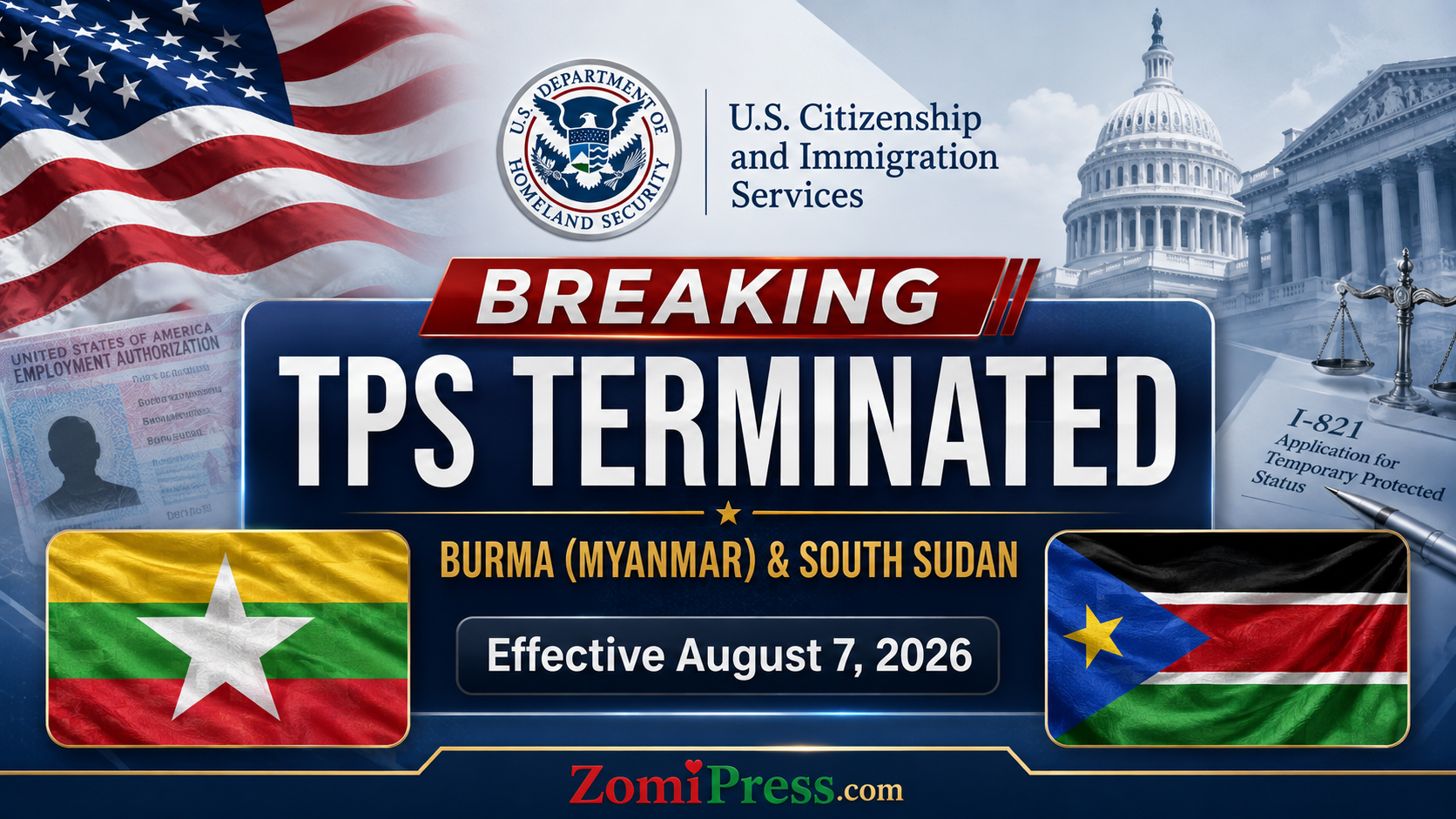
According to the latest guidance from U.S. Citizenship and Immigration Services (USCIS), the TPS designations for both Burma (Myanmar) and South Sudan are terminated effective August 7, 2026.
The change affects approximately 3,969 approved Burma TPS beneficiaries and approximately 232 approved South Sudan TPS beneficiaries, according to DHS estimates published during the termination process.
For individuals whose legal protection and employment authorization depended exclusively on TPS, the consequences are immediate: TPS protection from removal has ended, and Employment Authorization Documents (EADs) issued specifically on the basis of these TPS designations under categories A12 or C19 are no longer valid.
However, termination of TPS does not automatically mean every affected person is immediately deportable or must immediately leave the United States. Individuals may have separate immigration status, asylum applications, other humanitarian protection, independent employment authorization, or another lawful basis for remaining in the country.
What Changed on August 7?
DHS originally announced the termination of the two TPS programs in late 2025.
For South Sudan, DHS published its termination notice on November 6, 2025. The designation was originally scheduled to terminate on January 5, 2026.
For Burma, DHS published its termination notice on November 25, 2025, with termination originally scheduled for January 26, 2026.
Federal courts subsequently blocked or postponed implementation of both decisions while legal challenges proceeded.
That is why TPS did not actually disappear for beneficiaries in January.
The situation changed significantly following a major U.S. Supreme Court ruling on June 25, 2026.
The Supreme Court Decision Behind the Change
In Mullin v. Doe, a case involving TPS terminations for Syria and Haiti, the U.S. Supreme Court substantially limited judicial review of DHS TPS termination decisions.
The Court held that the TPS statute’s judicial-review provision bars review of the types of nonconstitutional claims presented in those cases. The Court also concluded that the Haitian plaintiffs had not demonstrated entitlement to interim relief on their equal-protection claim.
The ruling had consequences beyond Haiti and Syria.
Federal courts handling the Burma and South Sudan cases subsequently reconsidered the orders that had been preserving TPS protections.
By August 7, USCIS formally announced that both TPS terminations were effective.
BURMA (MYANMAR): Nearly 4,000 TPS Holders Affected
Burma was originally designated for TPS in 2021 following the military coup and deteriorating conditions in the country.
The designation was subsequently extended and redesignated, including 18 months running through November 25, 2025.
In its November 2025 termination decision, DHS concluded that Burma no longer continued to meet the conditions required for TPS and also relied heavily on U.S. national-interest considerations.
DHS estimated that 3,969 people had approved TPS under the Burma designation, with another 236 applications pending at the time of its assessment.
The termination was challenged in federal court in Aung Doe v. Noem.
On January 23, 2026, U.S. District Judge Matthew F. Kennelly postponed implementation of the termination. The court raised significant questions about the government’s decision-making process and whether DHS’s stated justification reflected a genuine assessment of conditions in Burma.
After the Supreme Court’s June 25 decision in Mullin v. Doe, however, the legal basis for maintaining the earlier postponement was substantially narrowed.
The Burma litigation has not necessarily ended completely. Constitutional claims concerning alleged discrimination may continue.
But there is currently no court order keeping Burma TPS in effect.
Therefore, as of August 7:
- Burma TPS protection is no longer active.
- TPS-based protection from removal has ended.
- TPS-based A12/C19 employment authorization is no longer valid.
- The underlying litigation may continue, but it currently does not preserve TPS benefits.
A Major Policy Question: Is Burma Safe for Return?
The termination presents an important policy tension.
DHS determined that Burma no longer satisfied the requirements for continued TPS and cited national-interest considerations.
Yet another branch of the U.S. government continues to issue its strongest possible warning about conditions inside Burma.
The U.S. Department of State currently classifies Burma:
LEVEL 4 — DO NOT TRAVEL
Its May 8, 2026 advisory warns against travel to Burma because of armed conflict, civil unrest, arbitrary enforcement of laws, poor health infrastructure, landmines, unexploded ordnance, and crime.
The State Department states that armed conflicts continue throughout Burma and warns that circumstances can change without notice.
Its current guidance also discusses:
- continuing conflict between the military regime and opposition forces;
- artillery and airstrikes;
- arbitrary arrests and detention;
- reports of torture and serious human-rights violations;
- military conscription;
- landmines and unexploded ordnance;
- restrictions on freedom of expression and religion;
- violence affecting ethnic minorities.
This does not automatically make DHS’s TPS termination legally invalid. TPS determinations and State Department travel advisories are governed by different standards and serve different purposes.
Nevertheless, the contrast raises a legitimate public-policy question:
How can Burma cease qualifying for humanitarian protection for people already living in the United States while the U.S. government simultaneously advises Americans not to travel there because of armed conflict and serious safety risks?
That question remains particularly important for political activists, journalists, religious minorities, ethnic communities and other individuals who may face individualized risks if returned.
What This Means for the Zomi Community
The decision is particularly significant for Zomi and other communities from Burma living in the United States.
Public DHS statistics identify beneficiaries by country, not ethnicity. Therefore, there is currently no reliable official figure showing how many of the approximately 4,000 Burma TPS holders are Zomi.
Individual circumstances also vary significantly.
A Zomi TPS holder who fears persecution because of ethnicity, religion, political opinion, pro-democracy activity, or another protected ground should not assume that termination of TPS automatically resolves his or her immigration case.
TPS and asylum are legally different protections.
SOUTH SUDAN: More Than 200 Beneficiaries Affected
South Sudan has had TPS protection since 2011 because of armed conflict and extraordinary conditions.
DHS estimated that 232 individuals had approved South Sudan TPS, with 73 additional applications pending as of October 2025.
DHS concluded in November 2025 that South Sudan no longer met the statutory requirements for continued designation.
The government cited improvements in civilian safety, displacement trends, infrastructure and governance. It also concluded that continued TPS was contrary to U.S. national-interest considerations.
The decision was challenged in African Communities Together v. Noem, and federal courts temporarily prevented the termination from taking effect.
Following the Supreme Court’s June decision and subsequent proceedings, those protections no longer prevent DHS from implementing the termination.
USCIS now lists South Sudan TPS as terminated effective August 7, 2026.
South Sudan Also Remains Under a Level 4 Warning
As with Burma, there is a significant distinction between the TPS determination and the State Department’s assessment of risks for American travelers.
The State Department’s May 17, 2026 advisory places South Sudan at:
LEVEL 4 — DO NOT TRAVEL
The advisory warns of unrest, crime, kidnapping, landmines and serious health risks.
Again, a travel advisory does not legally determine whether a country qualifies for TPS. But the simultaneous existence of a Level 4 warning and a TPS termination will likely remain an important subject of policy debate.
Does Losing TPS Mean Automatic Deportation?
No.
This distinction is essential.
TPS provides a particular form of temporary protection. When TPS ends, the person loses the immigration benefits provided specifically by TPS.
That does not necessarily mean every former beneficiary immediately becomes removable.
An affected person may separately have:
- lawful permanent resident status;
- another valid immigration status;
- a pending or approved asylum claim;
- withholding of removal;
- protection under the Convention Against Torture;
- another humanitarian immigration benefit;
- another independent basis for employment authorization;
- a family- or employment-based immigration case;
- another form of relief available in immigration proceedings.
TPS termination also is not itself an individual deportation order.
The legal situation of each individual depends on that person’s immigration history and circumstances.
Important Information About Asylum
For former Burma or South Sudan TPS holders who genuinely fear persecution or serious harm if returned, asylum and related humanitarian protections should be evaluated separately from TPS.
Normally, an asylum application must be filed within one year after arriving in the United States unless an exception applies.
USCIS specifically recognizes that having and maintaining TPS until a reasonable period before filing for asylum may qualify as an “extraordinary circumstance” relating to the one-year filing deadline.
That does not guarantee asylum eligibility or approval, but it can be extremely important for longtime TPS beneficiaries.
Anyone affected should obtain qualified, individualized immigration legal advice as soon as possible.
TPS-Based Employment Authorization Has Ended
USCIS’s August 7 guidance is particularly important for employees and employers.
USCIS states that Forms I-766 Employment Authorization Documents issued under Burma or South Sudan TPS with category codes A12 or C19 are no longer valid on the basis of these TPS designations.
An individual who has employment authorization under a completely separate immigration category may be treated differently.
Employers and employees should therefore verify the specific immigration and employment-authorization basis involved rather than assuming that every affected national has lost the right to work.
Burma, South Sudan and Sudan Are Different TPS Designations
Another important clarification:
South Sudan and Sudan are not interchangeable.
The August 7 termination discussed here applies to South Sudan.
Sudan has a separate TPS designation and should not be reported as part of the South Sudan termination.
Zomi Press Analysis
The August 7 termination represents more than an administrative expiration of immigration benefits.
It illustrates a major change in U.S. TPS policy and, following Mullin v. Doe, a significant narrowing of the ability of federal courts to stop TPS termination decisions through nonconstitutional legal challenges.
For approximately 4,000 people from Burma and more than 200 from South Sudan, the immediate consequences are serious: TPS-based protection from removal and TPS-based employment authorization have ended.
At the same time, the governments of both Burma and South Sudan continue to face serious security and humanitarian challenges, and the U.S. State Department currently maintains its highest Level 4 — Do Not Travel warning for both countries.
For affected families, the most important message is therefore neither panic nor complacency:
TPS has ended, but TPS is not necessarily the entirety of an individual’s immigration case.
Former beneficiaries should immediately review their individual immigration circumstances with a qualified immigration attorney or accredited legal representative, particularly if they fear persecution, detention, torture or other serious harm upon return.
OFFICIAL SOURCES & REFERENCES
U.S. Citizenship and Immigration Services (USCIS)
Temporary Protected Status:
https://www.uscis.gov/humanitarian/temporary-protected-status
USCIS — Burma TPS Termination, Aug. 7, 2026
https://www.uscis.gov/save/current-user-agencies/news-alerts/termination-of-temporary-protected-status-for-burma-release-aug-7-2026
USCIS — South Sudan TPS Termination, Aug. 7, 2026
https://www.uscis.gov/save/current-user-agencies/news-alerts/termination-of-temporary-protected-status-for-south-sudan-release-aug-07-2026
Federal Register — Termination of Burma (Myanmar) TPS
90 Fed. Reg. 53378, Nov. 25, 2025
https://www.federalregister.gov/documents/2025/11/25/2025-21069/termination-of-the-designation-of-burma-myanmar-for-temporary-protected-status
Federal Register — Termination of South Sudan TPS
90 Fed. Reg. 50484, Nov. 6, 2025
https://www.federalregister.gov/documents/2025/11/06/2025-19800/termination-of-the-designation-of-south-sudan-for-temporary-protected-status
U.S. Supreme Court — Mullin v. Doe, No. 25-1083
Decision issued June 25, 2026
https://www.supremecourt.gov/docket/docketfiles/html/public/25-1083.html
U.S. Department of State — Burma Travel Advisory
Level 4 — Do Not Travel
https://travel.state.gov/en/international-travel/travel-advisories/burma.html
U.S. Department of State — South Sudan Travel Advisory
Level 4 — Do Not Travel
https://travel.state.gov/en/international-travel/travel-advisories/south-sudan.html
This Zomi Press Policy Explainer is provided for news and public-information purposes and does not constitute individual legal advice.
© 2026 Zomi Press | ZomiPress.com