
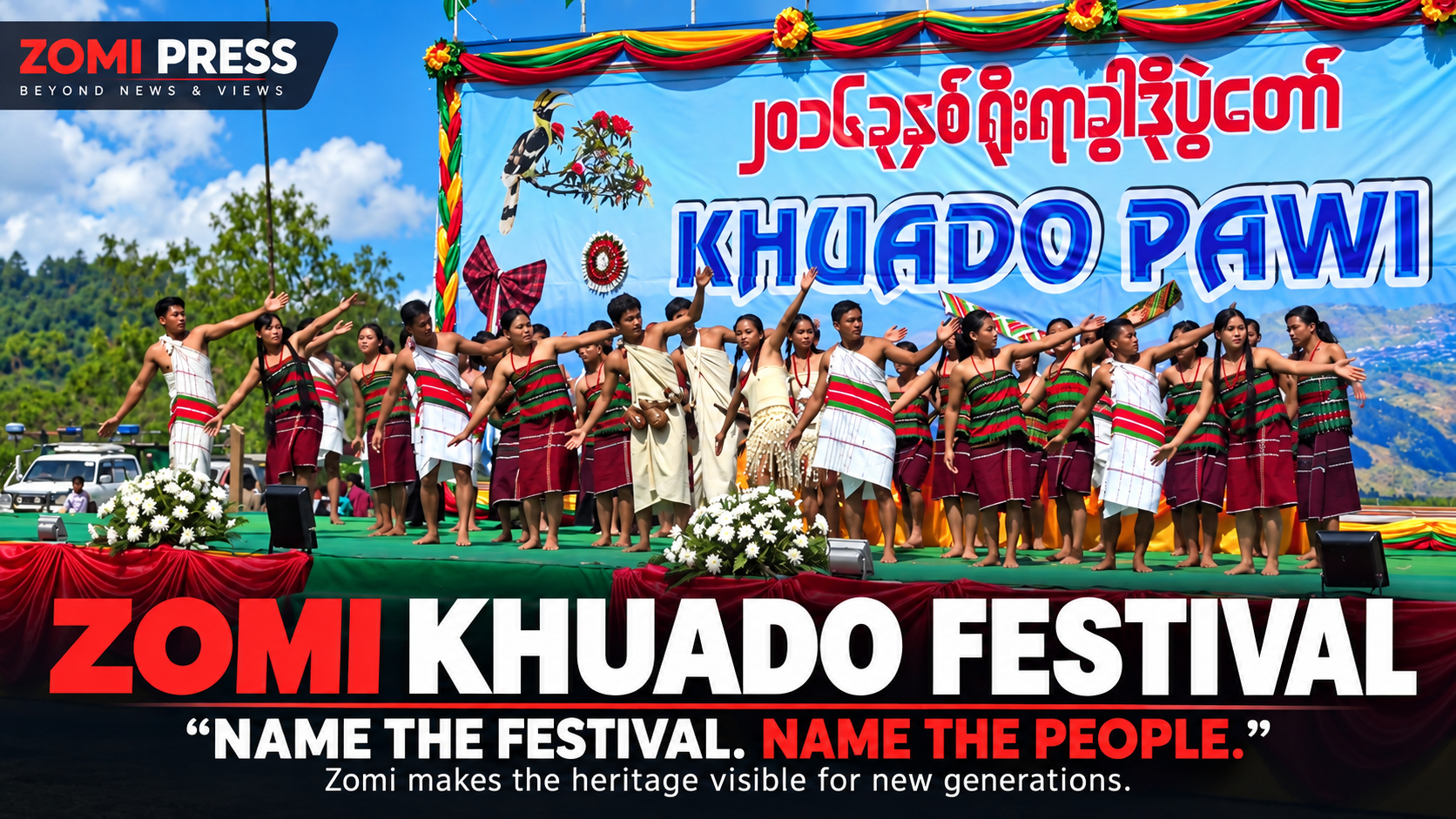
Download: Name the Festival, Name the People: Why “Zomi Khuado Pawi” Matters
Using the title Zomi Khuado Pawi or Zomi Khuado Festival explicitly identifies both the harvest tradition and the community that sustains it. While the traditional name Khuado Pawi remains familiar internally, adding Zomi helps public and diaspora audiences recognize the cultural origin of the celebration.
This naming practice supports cultural transmission for younger generations in multicultural settings. Context determines when to use each form, with the expanded title serving as an accessible entry point in public notices, leaving the shorter traditional name for familiar or Zomi-language contexts.
What a Festival Name Carries
“Khuado Pawi” is a familiar and meaningful name among Zomi people. It evokes the harvest season, communal celebration, and practices remembered across generations. Some therefore question the need to add Zomi. If Khuado Pawi is already known in Chin State and beyond, what purpose does “Zomi Khuado Pawi” serve?
The answer begins with a distinction. “Khuado Pawi” names the celebration. “Zomi Khuado Pawi” names the celebration and the people whose cultural life sustains it. The fuller form does not displace the inherited name. It makes the community visible when the tradition is presented to children, diaspora audiences, public institutions, and people encountering it for the first time.
This is an argument for purposeful public naming. Zomi communities should use “Zomi Khuado Pawi”, or “Zomi Khuado Festival” in English-facing settings, when presenting their own celebrations. The shorter Khuado Pawi remains natural in conversation and in writing once its context has been established.
1. Recognition of a Festival Is Not Recognition of Its People
The objection to adding Zomi assumes that because an audience recognizes the words Khuado Pawi, it also knows whose festival it is. That assumption may hold among people who already share the tradition. It is less reliable on a school calendar in the United States, a public program in Australia, or a social media post that travels beyond the community.
A reader unfamiliar with the subject may have two questions: What is Khuado? Who are the Zomi? “Zomi Khuado Festival” gives that reader an entry point to both. The name alone cannot provide a complete cultural education, but it can prevent people from disappearing behind the event.
Different forms serve different purposes:
Linguistically, Zomi is a community identifier in the fuller name. It does not change the words Khuado Pawi or assert that every historical observance bore this expanded title. It supplies context for an audience that may otherwise lack it.
This practice is already visible in reporting. In an account of an Australian celebration, Democratic Voice of Burma identified the Zomi community and named its celebration Khuado Pawi. Both pieces of information helped introduce the event to readers outside the immediate community.^1 english.dvb.no
2. Naming Supports the Work of Cultural Transmission
A living tradition survives through practice: people gather, remember, teach, adapt, and pass on what they have received. A title cannot perform those tasks for them. Yet the words placed on an invitation, in an archive, or in a news headline influence whether a new audience can find the community and learn its account of the tradition.
UNESCO’s framework for intangible cultural heritage emphasizes practices recognized and transmitted by communities, as well as the primary role of communities in safeguarding their heritage.^2 This framework does not direct Zomi people to use a particular festival title. It does affirm the importance of the people who carry and interpret a living practice. ich.unesco.org
Zomi Press has described Khuado as an opportunity for diaspora communities to reconnect with their roots and pass cultural heritage to younger generations.^3 That work becomes clearer when public materials name both Khuado and Zomi. A program can then move beyond performance to explain vocabulary, oral memory, family practices, historical change, and the meaning the celebration holds for participants today. zomipress.com
The Zomi Political Coordination Council offers a further Zomi-language perspective on the importance of continued practice. In an article addressed to Zomi people living away from their homeland, it includes Khuado Pawi among valued communal observances that should continue to be held and developed.^4 Its point concerns the practice of cultural life rather than a prescribed English title. It nevertheless reinforces the central responsibility behind this argument: Zomi communities must actively carry their traditions into the places where they now live. Zomi Political Coordination Council
3. The Fuller Name Has Particular Value in the Diaspora
In a place where Khuado has long been observed, much of its context may be understood without explanation. Elders, relatives, language, and shared memory surround the event. A child growing up in Tulsa, Melbourne, or Nelson may encounter it through a different setting: a stage performance, a community meal, a photograph, or a brief annual program.
That child deserves more than the chance to attend. The child deserves to know: This is part of Zomi cultural life, and I can learn the stories and language associated with it. For neighbors and classmates who know neither Khuado nor Zomi, the fuller name is equally useful. It gives them words with which to ask respectful questions and continue learning.
The wording is already in documented public use. An independent review of community projects in Nelson, New Zealand, lists “Zomi Khuado Pawi 2023” as a festival organized by New Zealand Zomi Innkuan (Nelson) Inc.^5 Here, the full name preserved Khuado Pawi while identifying the community in a multicultural public record. www.multiculturalnt.co.nz
Consistent naming can strengthen a new generation’s sense of belonging. It connects what young people see and celebrate with the name of their people. That connection must be supported through Zomi-language teaching, elders’ accounts, writing, and participation; otherwise, even the strongest title remains only a label.
4. Different Audiences Need Different Introductions
Using the fuller name publicly does not require correcting every person who says Khuado Pawi. In a family conversation or a Zomi-language program, the shorter form may convey everything the audience needs. In an English-language headline, school notice, exhibition, or first reference in an article, more context is valuable.
A practical first mention is:
Afterward, a writer can use Khuado Pawi or simply Khuado. This approach introduces newcomers while retaining the inherited wording throughout the account.
Other editorial choices can also work when they provide context elsewhere. The Institute of Chin Studies uses the shorter title “The Khuado Festival Revisited” and supplies a community description in its text.^6 A reader who opens the full article receives that context. A festival poster or headline shared on its own may not have the same opportunity. For such materials, the fuller name communicates more at first sight. The Institute of Chin Studies
5. Naming Ourselves Requires Historical Care
Advocating “Zomi Khuado Pawi” should be done with precision. The argument is not that every historical gathering used these exact words, or that every community associated with a related celebration uses identical terminology. The claim is that Zomi people have good reason to identify themselves when presenting their own Khuado celebrations today.
That distinction protects both cultural integrity and scholarly credibility. We can preserve inherited language without freezing it. We can use a fuller public title without inventing a historical one. We can affirm Zomi identity while accurately acknowledging variation in local practices and descriptions.
Keep the Tradition and Its People in View
“Khuado Pawi” and “Zomi Khuado Pawi” need not compete. One is the familiar festival name; the other carries that name into settings where its people may not yet be known. In diaspora communities especially, the fuller form can help children connect celebration with belonging and help newcomers discover the Zomi voices best placed to explain it.
The name cannot keep a culture alive by itself. Zomi people do that by gathering, speaking, writing, teaching, and remembering together. But public naming is part of that work. It determines whether an audience encounters Khuado as an isolated festival or as a living expression of Zomi cultural life.
Name the festival. Name the people. Teach the generations what connects them.
References
- Democratic Voice of Burma, “Zomi Community Celebrates Khuado Pawi in Australia,” October 11, 2023, https://english.dvb.no/zomi-community-celebrates-khaudo-pawi-in-australia.
- UNESCO, Convention for the Safeguarding of the Intangible Cultural Heritage, adopted October 17, 2003, arts. 2 and 15, https://ich.unesco.org/doc/src/15164-EN.pdf; UNESCO, “Ethics and Intangible Cultural Heritage,” accessed September 25, 2026, https://ich.unesco.org/en/ethics-and-ich-00866.
- Zomi Press, “Khuado Festival: Celebrating the Zomi Heritage,” https://zomipress.com/khuado-festival-celebrating-the-zomi-heritage/.
- Zomi Political Coordination Council, “Gamdang Tung Zomite’ Ading Ka Deihsak Thu Pawlkhat,” accessed September 25, 2026, https://zpcc.net/gamdang-tung-zomite-ading-ka-deihsak-thu-pawlkhat/.
- Shared Communities Initiative: Independent Review of Initial Phase (October 2024), appendix 2, 43, https://www.multiculturalnt.co.nz/assets/Shared-Communities-Initiative-Independent-Review-of-Initial-Phase-October-2024-smaller-file.pdf.
- Henry Lyan, “The Khuado Festival Revisited,” Institute of Chin Studies, September 13, 2024, https://www.ichins.org/posts/the-khuado-festival.