
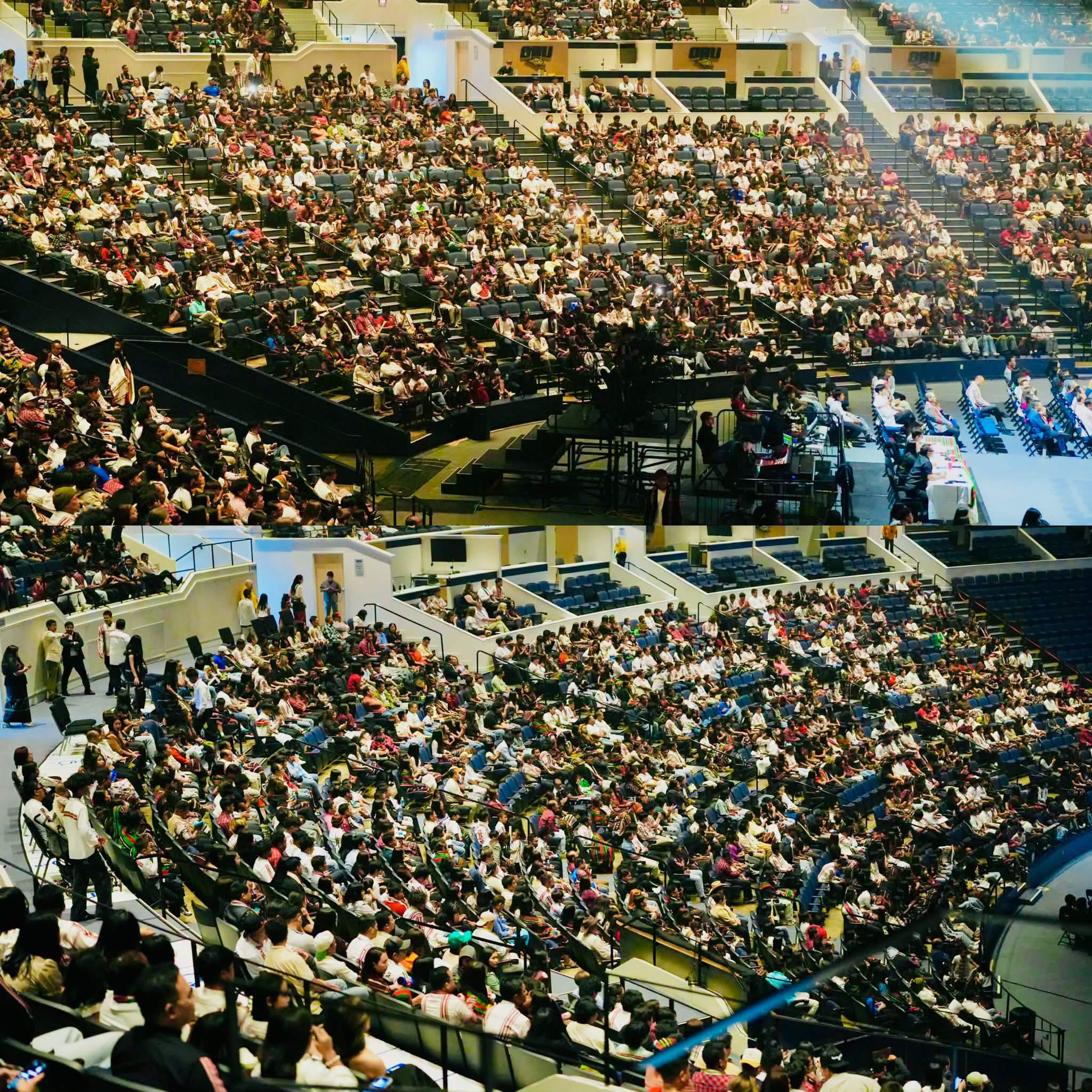
More than 6,000 people gather in Tulsa as Zomi families from across the United States and overseas celebrate faith, family, language, culture, and community development
TULSA, Oklahoma | September 8, 2026
More than 6,000 people gathered in Tulsa, Oklahoma, from September 4–6 for the Zomi National Conference USA 2026, popularly known as Zomi Khawmpi USA 2026, making it one of the largest and most visible Zomi gatherings ever held in the United States.
Hosted by Zomi Innkuan USA, Inc. (ZIUSA), the three-day conference brought together Zomi families, elders, pastors, community leaders, professionals, artists, athletes, young people, and invited guests from communities throughout the United States.
Special guests also traveled from India, Norway, Australia, and other overseas countries, adding an important international dimension to the conference. Several of the international guests served as distinguished panelists and judges for the Zomi Lengthe Singing Contest, contributing musical expertise and broader cultural perspectives to one of the event’s most anticipated programs.
The gathering transformed Tulsa’s Mabee Center into a major showcase of Zomi faith, family life, language, music, traditional heritage, and community development. Colorful Zomi attire filled the arena, while speeches, cultural dances, musical performances, competitions, public forums and sporting events connected participants with a shared identity rooted in the ancestral Zomi homeland.
The conference was organized around three enduring commitments:
Unity. Development. Preservation.
These principles expressed the continuing responsibilities of the Zomi people in the United States: strengthening cooperation among communities, advancing families through education and professional opportunity, and preserving the Zomi language, Christian faith, cultural traditions, and historical identity for future generations.
The conference was more than a celebration. It was a public demonstration of what a law-abiding, hardworking, and faithful community can accomplish through family responsibility, education, service, and cooperation.
A nationwide gathering with international reach
Zomi National Conference USA 2026 brought together Zomi families, churches, organizations and leaders from across the United States.
Participants traveled to Tulsa from communities throughout the country, making the conference a genuinely nationwide expression of Zomi unity and shared purpose. Families renewed relationships with relatives, former neighbors, ministry partners and friends whom they had not seen for years.
The gathering demonstrated that although Zomi people live in different cities, states and regions, they remain connected through language, Christian faith, family relationships, cultural heritage and a common commitment to community development.
The presence of international guests expanded that connection beyond the United States. Visitors from India, Norway, Australia and other countries represented the worldwide character of the Zomi family.
Their participation showed that national borders and geographical distances have not erased the historical and cultural relationships connecting Zomi communities across the world. Language, music, faith, and shared memory continue to create bonds among Zomi people living on different continents.
The conference therefore became both a national gathering and an international cultural bridge.
A visible expression of Zomi unity
The more than 6,000 people gathered in Tulsa presented a powerful picture of what becomes possible when the Zomi people unite around a common purpose.
Behind every cultural presentation, musical performance, public forum, competition and ceremony stood months of preparation by organizers, committees, volunteers, donors, churches, businesses and community partners.
Coordinating an event of this scale required fundraising, venue management, hospitality, transportation, security, media production, technical support and extensive volunteer service. Many people carried demanding responsibilities that were never visible from the main stage.
The success of the conference demonstrated that unity requires more than gathering in the same building. It depends upon cooperation, patience, sacrifice, trust and a willingness to place the interests of the wider community above personal recognition or organizational competition.
The achievement of Zomi Khawmpi USA 2026 therefore belonged not to one leader, committee or organization alone. It belonged to the entire community that prayed, planned, contributed, volunteered and participated.
The conference gave visible form to the conviction that the Zomi are one people—a people capable of cooperating across local, regional and international boundaries while respecting the diversity that exists within the wider community.
Tulsa’s place in Zomi American history
Tulsa has emerged as one of the most important centers of Zomi life outside the ancestral homeland.
Over several decades, Zomi families have established churches, businesses, ministries, professional networks, cultural associations, and community-service organizations throughout the Tulsa metropolitan area.
These institutions have helped families pursue education, employment, homeownership and economic stability while maintaining their Christian faith, language and cultural identity.
The growth of the Zomi community did not occur automatically. It was built through faith, family responsibility, disciplined work, and cooperation. Parents worked long hours, learned to navigate American institutions, and made significant sacrifices so their children could receive better education and greater opportunities.
Today, many Zomi are naturalized American citizens, while others were born in the United States and have known no other country as home. Together, they form an increasingly established generation of Zomi Americans who respect the law, value education, strengthen their families, and contribute to the cities and states in which they live.
The presence of Zomi educators, healthcare workers, business owners, pastors, journalists, interpreters, technology professionals, skilled workers, public servants, and community organizers at the 2026 conference demonstrated how far the community has progressed.
Their story is one of faith, resilience, industriousness, and the continuing pursuit of the American Dream. Zomi families are building homes, opening businesses, earning degrees, serving churches, and participating in American civic life while preserving the identity inherited from their ancestors.
Tulsa is no longer simply a city where many Zomi families reside. It has become a strategic center from which Zomi cultural, religious, and institutional life serves communities across the United States and beyond.
Zomi culture as a living inheritance
The conference treated Zomi culture as a living inheritance rather than a historical display.
Traditional dances, cultural attire, musical performances, Zomi Lengthe, Zolia and Zotaang programs, and other artistic presentations gave participants direct contact with their heritage.
For elders and first-generation Zomi Americans, the performances carried memories of their homeland. For children born or raised in the United States, they provided an opportunity to encounter their identity in a public, joyful, and affirming environment.
That intergenerational transfer is increasingly important.
Cultural identity does not automatically survive migration and generational change. When families live within a dominant English-speaking society, their ancestral language and traditional knowledge can weaken unless they are intentionally practiced, documented, and taught.
The conference created an immersive cultural environment in which young people could hear Zomi spoken and sung, see traditional clothing worn with dignity, and observe their heritage expressed on a major American stage.
It communicated that Zomi identity is not a burden to hide or a relic to abandon. It is a source of dignity, belonging, and historical consciousness.
Cultural preservation does not require Zomi society to remain unchanged. A living culture must provide room for creativity, innovation, and the participation of younger generations. Young artists can use contemporary musical and digital forms while keeping the Zomi language and cultural experience at the heart of their work.
The goal is not to force young people to choose between being Zomi and being American. It is to prepare them to live confidently within both identities—participating fully in American society while remaining rooted in their families, faith and ancestral heritage.
Zomi Lengthe: music, language and international excellence
The Zomi Lengthe Singing Contest was one of the conference’s major cultural highlights.
The competition was more than a search for talented singers. It provided a national platform for preserving, developing and promoting Zomi-language music.
Contestants demonstrated vocal ability, stage presence, linguistic expression and cultural understanding before an audience representing Zomi communities from across the United States and abroad.
Distinguished international guests served as panelists and judges, bringing valuable musical experience and broader cultural perspectives to the competition. Their participation strengthened the contest’s professionalism, credibility, and international character.
For younger contestants, performing at the Mabee Center provided an opportunity to develop confidence, receive professional evaluation, and contribute to the future of Zomi music. For the wider community, the competition demonstrated that the Zomi language can remain vibrant, creative and relevant in contemporary artistic life.
Music carries memory across generations and geographical boundaries. Through language and melody, songs preserve faith, stories, emotions, and collective experience.
Zomi Lengthe therefore served not only as entertainment but also as an instrument of cultural transmission and international Zomi connection.
Protecting and developing the Zomi language
Language remains one of the most important foundations of Zomi identity.
Traditional clothing may be worn during special celebrations, but language carries culture into everyday life. It preserves family relationships, prayers, oral traditions, songs, historical memory, and the distinctive worldview through which a people understand themselves.
The 2026 conference demonstrated the continuing vitality of the Zomi language through speeches, conversations, music, announcements and cultural programs.
It also highlighted an important responsibility facing parents, churches, educators and community institutions. Children cannot preserve a language they are never taught to speak, read, and write.
Zomi-language preservation must therefore move beyond occasional use at conferences or church services. It requires systematic instruction, qualified teachers, age-appropriate learning materials, reading programs, digital tools, and consistent use within families.
Parents remain the first language teachers. Churches and community organizations can strengthen that work by offering structured classes and creating environments in which young people can use Zomi naturally and confidently.
Technology provides additional possibilities. Digital dictionaries, translation tools, educational videos, mobile applications, online courses, and Zomi-language media can help the language remain accessible to a generation shaped by smartphones and online communication.
The future of Zomi culture will depend substantially upon whether the community can transform emotional appreciation for the language into sustained educational practice.
Family as the foundation of cultural continuity
Family occupied a central place throughout the conference.
Parents brought their children to experience the language, music, clothing, food, and relationships that define Zomi community life. Elders passed on memories. Young adults renewed friendships and formed new connections. Relatives separated by distance gathered under one roof.
For the Zomi people, cultural preservation begins in the home.
Children first learn identity through the language spoken by their parents, the prayers offered by their families, the stories told by their grandparents, and the values demonstrated in daily life.
A national conference can strengthen those foundations, but it cannot replace them.
Strong Zomi families remain essential to the long-term health of the community. Parents must balance economic responsibilities with the intentional transmission of faith, language, discipline, history, and cultural belonging.
The success of future generations should not be measured by professional achievement alone. It must also be measured by whether young Zomi understand who they are, honor their families, serve their communities, and preserve what previous generations worked so hard to pass on.
Sports, friendship and leadership
Athletic competitions formed another important dimension of Zomi Khawmpi USA 2026.
Sports brought young people and families together across geographical and organizational boundaries. Athletes competed for their teams, while supporters strengthened fellowship and community pride.
The competitions offered practical lessons in discipline, teamwork, perseverance, and respect. They also provided constructive opportunities for young people to develop confidence and leadership.
Sports create relationships that formal meetings alone cannot produce. They bring participants together through shared goals, healthy competition and collective experience.
Within the broader national conference, athletic activities helped participants move beyond local affiliations and encounter one another as members of a larger Zomi family.
These relationships matter because a national community cannot be sustained by formal organizations alone. It is also strengthened through friendship, hospitality, shared memories, and the experience of working and celebrating together.
Faith, citizenship and the American Dream
Christian faith has been foundational to Zomi life in America.
Churches have provided worship, fellowship, language continuity, family support, youth formation and community service. They have encouraged members to live responsibly, work honestly, care for their families, respect public authorities, and serve their neighbors.
The Zomi understanding of unity is therefore grounded in moral responsibility. Christian unity requires humility, integrity, forgiveness, reconciliation and sacrificial service.
Zomi patriotism must likewise remain constructive—honoring the Zomi people and ancestral homeland while contributing faithfully to the United States.
Zomi Americans express gratitude for the freedoms, security and opportunities they enjoy by becoming responsible citizens and constructive members of society. They contribute through employment, business ownership, education, taxation, voting, ministry, military and public service, charitable work and neighborhood participation.
Their pursuit of the American Dream is not merely a search for personal prosperity. It is also a commitment to build stable homes, educate children, strengthen communities, and create a better future for the next generation.
Preserving Zomi identity should deepen this contribution rather than produce separation. A person can be faithfully Zomi and proudly American—rooted in ancestral heritage while participating fully in the civic life of the United States.
From hard work to community development
The Zomi experience in America reflects a sustained pursuit of freedom, opportunity, and the American Dream.
Through lawful participation, honest work, education and responsible citizenship, Zomi families have established new lives while contributing to the prosperity and cultural diversity of the United States.
Many have become homeowners, entrepreneurs, professionals, taxpayers, voters, church leaders and community servants.
Their progress has been grounded in deeply held values: Christian faith, respect for the law, strong families, hard work, education, mutual assistance, and gratitude for the freedoms available in America.
The next stage of that journey must be shaped by intentional community development.
Cultural celebration alone cannot provide families with all the knowledge needed to navigate higher education, healthcare, employment, business ownership, financial planning and public institutions.
A strong Zomi American community must be faithful in its spiritual and moral commitments, responsible within family life, professionally prepared, economically productive, civically informed, and committed to preserving the Zomi language and heritage.
The sacrifices of earlier generations should create pathways for those who follow. Parents who worked demanding jobs and overcame language or institutional barriers hoped their children would receive greater educational and professional opportunities.
Those sacrifices are producing visible results. Young Zomi are entering colleges, universities, businesses, ministries, skilled professions, and public-service careers.
Zomi professionals also carry a responsibility to guide those coming after them. Doctors, nurses, educators, attorneys, business owners, pastors, journalists, interpreters, engineers, public servants and technology specialists can mentor students and help families understand educational opportunities and career pathways.
Development must never become a purely individual pursuit. Personal success reaches its highest purpose when it strengthens families, churches, communities and the nation.
Dr. Cin Do Kham Hall honors a pioneering legacy
Another meaningful conference milestone was the dedication of Dr. Cin Do Kham Hall at the Zomi Center.
The hall honors Professor Rev. Dr. Chin Do Kham, remembered as the first Zomi pioneer from Myanmar to establish his life in Oklahoma and as an important catalyst for the development of Tulsa’s Zomi community.
Dr. Kham first came to Tulsa as a doctoral student at Oral Roberts University. He earned his Doctor of Ministry degree from ORU in 1994 and later completed a Ph.D. in Intercultural Studies in 1998. He subsequently returned to ORU as a professor and missions-program director, teaching graduate and doctoral students.
His service also extended into Christian ministry, leadership education, and humanitarian development. Dr. Kham died on October 13, 2013. In 2024, the State of Oklahoma formally recognized him among Asian American and Pacific Islander leaders who helped shape Oklahoma’s history.
The 2026 dedication gave permanent institutional recognition to his pioneering legacy. The hall is positioned to carry that legacy forward through education, cultural preservation, leadership development, and community service.
Preparing the next generation to lead
Young people were central to the meaning of Zomi Khawmpi USA 2026.
They performed, competed, volunteered, learned and represented the future of the community. Their long-term involvement, however, must extend beyond performance and competition.
Young Zomi should increasingly serve as planners, researchers, communicators, organizers and decision-makers. They need opportunities to understand community governance, nonprofit leadership, public policy, journalism, technology and civic responsibility.
Leadership succession must be deliberate. Older generations should begin preparing younger leaders before positions become vacant.
Young people must also understand that leadership is not merely a title or public status. It requires competence, discipline, accountability, humility and service.
The future of the Zomi community will depend upon a generation that is professionally prepared, culturally grounded, spiritually mature and committed to the common good.
Turning conference momentum into lasting progress
The conference concluded successfully, but the responsibilities represented by its guiding principles must continue throughout the year.
The energy generated in Tulsa should be converted into sustainable programs with measurable outcomes. Priority areas include:
- Systematic Zomi-language education for children and young adults
- National mentoring networks for students and emerging professionals
- Scholarships and career-development programs
- Culturally accessible health and family services
- Responsible and nonpartisan civic education
- Digital preservation of speeches, music and historical materials
- Leadership training for younger generations
- Meaningful roles for women, elders and people with disabilities
- Stronger cooperation among Zomi organizations and local communities
- Transparent reporting on programs, finances and community outcomes
The value of Zomi Khawmpi cannot be measured by attendance alone. Its lasting importance will depend upon how effectively it strengthens the community between national gatherings.
Preservation without language education and leadership succession will weaken. Development without cultural grounding can produce achievement without belonging. Unity without integrity, transparency, and meaningful participation may remain symbolic.
The conference’s three principles must remain inseparable:
Unity provides collective strength.
Development creates capacity and opportunity.
Preservation gives progress identity and continuity.
A gathering—and a continuing calling
Zomi National Conference USA 2026 demonstrated what a law-abiding, hardworking, and faithful community can accomplish through unity, family commitment, and shared purpose.
More than 6,000 people gathered in Tulsa, joined by international guests, to celebrate Zomi faith, language, music, culture and achievement. The conference showed that the Zomi are building families, churches, businesses and institutions while contributing faithfully to the United States.
They are earning degrees, entering professions, serving their neighbors and participating in civic life. They are pursuing the American Dream while carrying forward the Christian faith, language, history and cultural values of their ancestors.
The crowded Mabee Center offered a powerful image of national unity. But the community’s greater achievement will be measured by what follows: stronger families, educated young people, successful businesses, faithful churches, responsible citizens and durable institutions serving both the Zomi people and the wider American public.
The task now is to transform the spirit of the conference into accountable leadership, measurable development and faithful transmission of the Zomi language, Christian faith, cultural heritage and family values.
If that work continues, Tulsa will remain more than a city where Zomi people gather. It will stand as a center from which a confident generation of Zomi Americans learns to remember its history, preserve its identity, serve its neighbors, honor the United States and lead toward a shared future.
The conference has ended, but its calling continues.
Unity must become cooperation.
Development must become opportunity.
Preservation must become generational continuity.
That is the enduring responsibility—and the enduring promise—of the Zomi National Conference USA 2026.
Zomi Press | Beyond News & Views
ZomiPress.com | @ZomiPress
#Zomi #ZomiPress #ZomiKhawmpi2026 #ZomiUSA #ZomiLengthe #ZomiLanguage #ZomiCulture #ZomiCommunity #Tulsa #Oklahoma