
Download: Tangmai Festival of Lamka: The Fruit of the Land, the Labour of Farmers and the Living Culture of the Zomi People
Why Lamka’s community-founded cucumber festival deserves lasting recognition, farmer-centred investment and a permanent place on the Zomi cultural calendar
By Zomi Press Cultural Desk
Cultural Heritage and Agricultural Research Feature | August 9, 2026
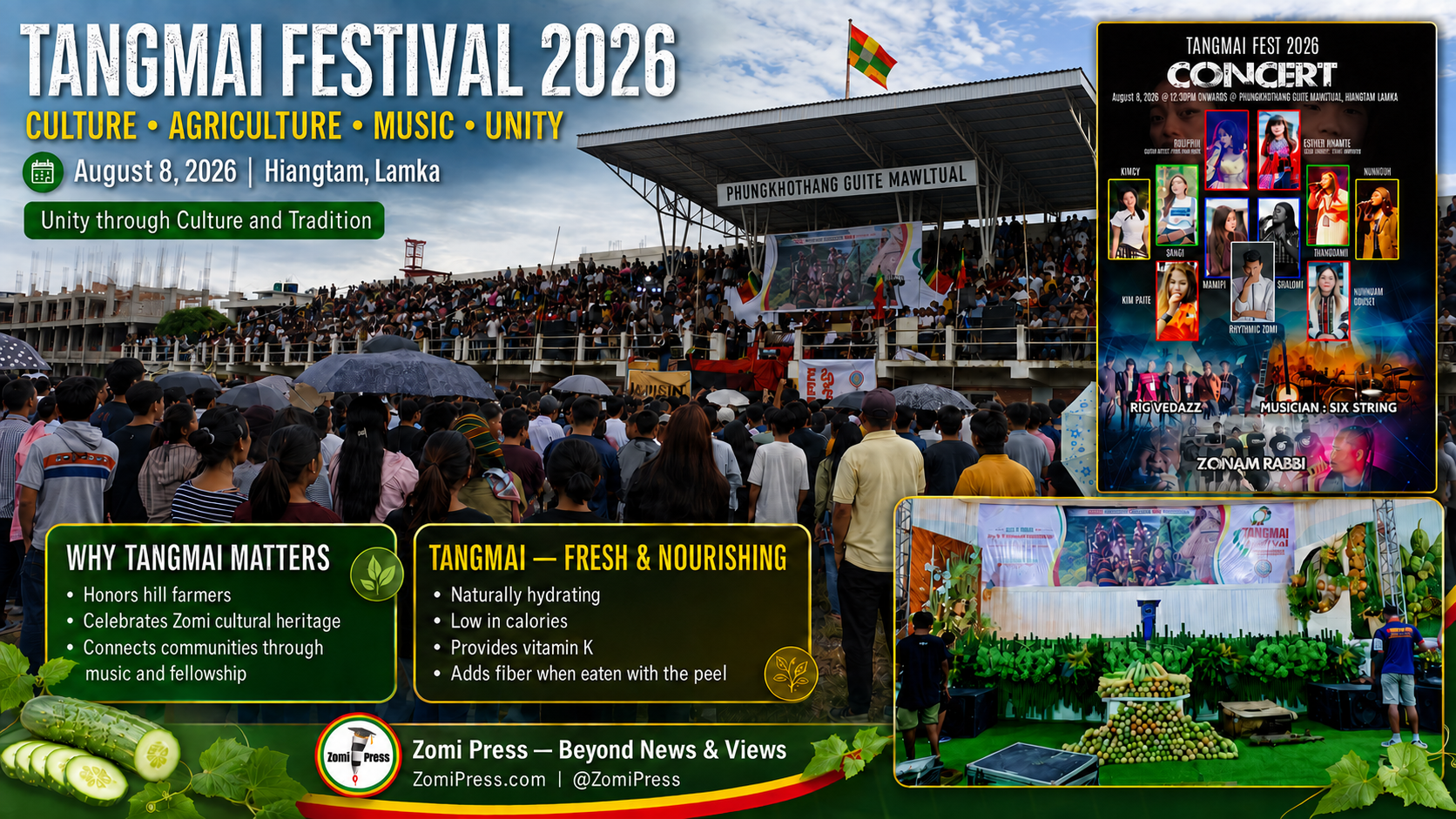
LAMKA, MANIPUR — On August 8, 2026, the Young Paite Association General Headquarters (YPA GHQs) brought farmers, cultural organisations, artists, public representatives, young people and families together in Hiangtam, Lamka, for the ninth Tangmai Festival.
Under the theme “Unity through Culture and Tradition,” the celebration placed the locally cultivated cucumber—tangmai—at the centre of a full day of agricultural education, communal feasting, traditional attire, cultural performance and contemporary Zomi music.
The festival’s meaning, however, reaches far beyond the cucumber served at its tables.
Tangmai has become a public expression of the relationship between the Zomi people and their land; a recognition of hill farmers whose work is too often invisible; a meeting place for related communities; and a living cultural platform through which one generation can pass identity, language, food knowledge, music and artistic traditions to the next.
It is Paite-founded and YPA-led. That history should be recorded faithfully. At the same time, its inclusive vision and the participation of multiple Zomi/Zo cultural organisations have given Tangmai the potential to become one of Lamka’s defining Zomi agricultural and cultural festivals.
What is Tangmai?
Tangmai means cucumber in Paite and related Zomi languages. Botanically, cucumber is Cucumis sativus, a member of the Cucurbitaceae or gourd family. In everyday food use it is treated as a vegetable, although botanically it is a fruit.
In the hills surrounding Lamka, cucumber has long been grown as a seasonal food. Community accounts emphasise the distinctive tenderness and water content of cucumbers cultivated in the area. In 2025, YPA GHQs President Lianmuanthang Valte explained that cucumber had historically helped farmers quench their thirst while working under the hot sun. This is an important community explanation of the crop’s cultural value, though it should not be confused with proof that the public festival itself is ancient (Chronicle News Service, 2025).
The available record shows that the Tangmai Festival is a modern cultural institution built upon older agricultural knowledge and practice.
The first documented public festival was held at YPA Hall, Hiangtam, on August 4, 2018. Contemporary reports explicitly called it the “first-ever Tangmai Festival.” Cucumbers from more than 45 villages were expected for display, and 14 villages ultimately participated in a competition judged by tenderness and flavour (The Sangai Express, 2018a; The Sangai Express, 2018b).
That distinction strengthens rather than weakens Tangmai’s authenticity. UNESCO explains that intangible cultural heritage is living heritage: communities transmit it, adapt it and continually recreate it in response to their environment, history and present needs (UNESCO, n.d.-a; UNESCO, n.d.-b). Tangmai is a clear example of a community creating a contemporary festival from an enduring relationship among food, land, labour and identity.
How the festival developed
The documented record traces Tangmai’s rapid development:
| Year | Documented milestone |
|---|---|
| 2018 | YPA GHQs held the first Tangmai Festival at Hiangtam, Lamka. More than 6,000 cucumbers were reportedly collected, consumed or sold. |
| 2019 | The second festival showcased about 10,000 organic cucumbers from hill villages. Contemporary reporting said 27 farmers participated. |
| 2022 | The fifth festival collected a reported 14,000 cucumbers; organisers said 10,000 were reserved for festival consumption and 4,000 for sale. |
| 2023–2024 | A 2025 retrospective reported that the public celebration could not be held because of the continuing Manipur conflict. |
| 2025 | YPA designated the revived celebration as the eighth Tangmai Festival. More than 7,000 cucumbers were sourced, particularly from Lungthul and Kaihlam. |
| 2026 | The ninth Tangmai Festival was held on August 8 under the theme “Unity through Culture and Tradition.” |
At the second festival in 2019, collection teams travelled along Guite Road and Tipaimukh Road. News reports named Lungthul, Suangdoh, Enpai, Lungchin, Singngat, Thanlon, Joutung, Mualpheng, Dialkhai and Sinzawl among the supplying areas. Cucumbers were sliced and served freely, while people wishing to take whole cucumbers home could purchase them (The Sangai Express, 2019a; The Sangai Express, 2019b).
The fifth festival in 2022 expanded the scale further. Organisers reported collecting 14,000 cucumbers and described the festival’s purposes as supporting farmers, promoting cucumber markets and sustaining cultural practices associated with the harvest (Chronicle News Service, 2022).
The official numbering requires a brief caution. Reports say no public festival was held in 2023 or 2024, yet organisers called the 2025 programme the eighth edition and the 2026 programme the ninth. Zomi Press follows YPA’s official edition numbers while noting that the publicly documented event sequence contains this interruption.
The ninth Tangmai Festival in 2026
The 2026 celebration had two principal venues and sessions. The formal agricultural and cultural programme was held at the YPA GHQs Hall, while the music festival took place at Phungkhothang Guite Mawltual, Hiangtam, Lamka.
Official programme material invited the public from 10:00 a.m. and announced Manipur Governor Ajay Kumar Bhalla as chief guest. Post-event reporting confirmed that the Governor could not attend because of official exigencies. He should therefore be described as the invited or announced chief guest, not as an attendee (Ukhrul Times, 2026).
The guest of honour was V. Malsawmtluanga, a member of the Mizoram Legislative Assembly. One post-event report incorrectly identified his constituency as Champhai. The official Mizoram Legislative Assembly record confirms that he represents Lunglei North (Mizoram Legislative Assembly, n.d.).
Speaking at the celebration, Malsawmtluanga presented Tangmai as an affirmation of the related history, heritage and kinship of Zo descendants and expressed hope that the festival would continue bringing communities together through culture and tradition.
Reported attendees also included legislators representing Saikot and Churachandpur, together with community leaders. The official programme listed the following sitting legislators, former public officials and community representative as special invitees (Young Paite Association General Headquarters, 2026):
- Pu L.M. Khaute, MLA for Churachandpur Assembly Constituency
- Pu Chinlunthang, MLA for Singngat Assembly Constituency
- Pu Paolienlal Haokip, MLA for Saikot Assembly Constituency
- Pu Letzamang Haokip, MLA for Henglep Assembly Constituency
- Pu Ngursanglur Sanate, MLA for Tipaimukh Assembly Constituency
- Pu V. Hangkhanlian, former minister
- Pu K. Vungzalian, former minister
- Pu T. Gouzadou, former minister
- Pu T.N. Haokip, former minister
- Pu T.T. Haokip, former deputy speaker
- Pu Thangso Baite, former minister
- Pu Ginsuanhau Zou, former MLA
- Pu Joseph Khamgousuan Valte, social worker
Post-event reporting identified L.M. Khaute and Paolienlal Haokip among those present. The other names above are included as the official programme’s announced special-invitee roster; being named in advance as an invitee should not automatically be treated as confirmation of attendance.
Agriculture given a place of honour
The official programme included:
- An opening prayer by Upa T. Awnkhanlun, a member of the YPA GHQs Central Executive Committee
- Choreography by The Starlets
- The Tangmai theme song by Paite Zai-awi Pawl (PZP)
- A keynote and welcome address by YPA GHQs President Lianmuanthang Valte
- A technical presentation on cucumber by Manngaihkimp, Senior Technical Officer associated with ICAR–Krishi Vigyan Kendra, Churachandpur
- A traditional-dress presentation by the Young Paite Association
- Cultural performances by participating community organisations
- Special musical presentations by Esther Hnamte, Zun Nuam Veng YPA and PZP
The agricultural presentation was especially valuable. It placed technical knowledge beside cultural celebration and recognised that a festival serving farmers must also help them address real production challenges.
The ICAR–Krishi Vigyan Kendra in Churachandpur provides extension, training, demonstrations and agricultural advisory services. Future Tangmai programmes should deepen this collaboration through practical sessions on seed selection, soil health, crop disease, pest management, water conservation, post-harvest handling, storage, transport, pricing and market access.
A feast created by farmers and volunteers
The cucumber feast remained the centre of the day. Organisers had gathered produce over an extended period from remote farming villages, including areas around Guite Kual. Volunteers transported, washed, sliced and served the cucumbers. Large quantities were also sold at subsidised or nominal prices (Ukhrul Times, 2026).
In 2025, more than 7,000 cucumbers were sourced from Zodawn and interior Guite Kual villages, particularly Kaihlam and Lungthul (Ukhrul Times, 2025; The Hills Journal, 2025).
Community publicity surrounding the 2026 preparations referred to a substantially larger quantity, including claims of more than 20,000 cucumbers. At the time of publication, however, no independently verified post-event report had documented a final number, total weight, market value or the number of participating farmers. The figure should therefore remain attributed to organisers or community media until YPA releases a final account.
This is not a minor statistical concern. Verified procurement data would show how much value the festival returns to farmers and would strengthen applications for sponsorship, public funding and official recognition.
Culture expressed through distinct communities
The 2026 programme announced performances by organisations associated with the:
- Young Mizo Association (YMA)
- Young Vaiphei Association (YVA)
- Zou Youth Organisation (ZYO)
- Hmar Youth Association (HYA)
- Kuki Khanglai Lompi (KKL)
- Paite Cultural Society (PCS)
Post-event reporting specifically confirmed performances by YMA, HYA, KKL and PCS.
This participation gave practical meaning to the festival theme. Unity did not require cultural uniformity. Each organisation could present its own attire, dance and artistic inheritance while taking part in a shared gathering.
Tangmai’s Paite origin should never be obscured. The festival was initiated, organised and sustained by YPA. Acknowledging that foundation is compatible with recognising Tangmai as a Zomi cultural festival. Its Paite foundation is the authentic contribution from which it welcomes the wider Zomi/Zo family.
Traditional attire as living knowledge
The traditional-dress presentation was not merely decorative. Textiles preserve information about identity, weaving, colour, craftsmanship, social memory and belonging.
When young people wear and explain traditional attire, they are not simply modelling clothing; they are transmitting knowledge. Future festivals should record the local name, community, materials, weaving method, patterns and cultural meaning of each garment. That would turn an attractive stage presentation into a lasting cultural archive.
The same principle applies to dance and song. Performances should be documented with the names of the communities, performers, composers or tradition bearers and the cultural context of each piece, with consent from those concerned.
Tangmai Music Fest: tradition meeting contemporary creativity
The second session moved to Phungkhothang Guite Mawltual for a large public concert. Promotional materials gave different proposed starting times: one poster advertised 12:30 p.m. onward, while the formal programme listed 2:30 p.m. Post-event reporting said the concert began at approximately 3:00 p.m.; that is the best available account of the actual start.
The session was hosted by V. Nunlian, with Churachandpur MLA L.M. Khaute serving as chief guest.
The featured guest artists from Mizoram were:
- Ruatpuii
- Esther Hnamte
The announced local lineup included:
- Kimcy
- Sangi
- Kim Paite
- Mawipi
- Shalomi
- Thanngaih
- Nunhoih
- Nunmawi Dousel
- Rhythmic Zomi
The announced bands and musicians included Rigvedazz, Six String and Zonam Rabbi. Post-event reporting confirmed performances by Ruatpuii, Esther Hnamte, PZP, Six String, Rigvedazz and Zonam Rabis. Because independent reporting did not name every advertised local artist, the remaining names should be described as the announced lineup rather than as confirmed individual performances.
The concert mattered because it gave established and emerging Zomi artists a major platform, connected Lamka with Mizoram, and brought younger audiences into an agricultural and cultural celebration. Tangmai demonstrated that cultural continuity can hold traditional dress, inherited dance, agricultural knowledge and contemporary music together.
A living culture preserves; it also creates.
Tangmai as food: nutritional and health importance
Tangmai’s cultural value is joined by genuine nutritional importance. Fresh cucumber is approximately 95 percent water and naturally low in calories, fat and sodium. That makes it a refreshing food during hot weather and physical work, although it does not replace safe drinking water or oral rehydration treatment when a person is dehydrated or ill.
The following figures are representative values for 100 grams of raw cucumber with peel. The composition of cucumbers grown around Lamka may vary by variety, soil, maturity and growing conditions.
| Nutritional component | Approximate amount per 100 g | Practical importance |
| Water | 95.2 g | Contributes to normal daily fluid intake |
| Energy | 15 kcal | A low-energy food that can replace more calorie-dense snacks |
| Carbohydrate | 3.6 g | Small contribution to dietary energy |
| Fibre | 0.5 g | Supports a balanced diet and normal bowel function; much is retained when the peel is eaten |
| Potassium | 147 mg | Contributes to normal nerve, muscle and fluid-balance functions |
| Vitamin K | 16.4 μg | Contributes to normal blood clotting and bone metabolism |
| Vitamin C | 2.8 mg | A modest contribution to vitamin C intake |
Source: USDA FoodData Central. Values are rounded and should not be treated as a laboratory analysis of Lamka-grown varieties.
1. Hydration during heat and physical work
The strongest health-related reason for Tangmai’s traditional popularity is straightforward: it contains a great deal of water. Eating water-rich foods contributes to total fluid intake and can be refreshing during warm weather or farm work.
This gives scientific plausibility to local accounts of farmers eating soft, juicy cucumbers under the sun. However, cucumber should complement—not replace—adequate clean drinking water. Anyone showing signs of heat exhaustion, heatstroke or serious dehydration needs appropriate first aid and medical care.
2. A low-calorie whole food
Fresh cucumber provides volume and texture for relatively few calories. Used in place of fried, highly salted or sugar-rich snacks, it can support a balanced dietary pattern and healthy weight management. It does not “burn fat,” and no single food causes weight loss by itself.
3. Fibre and digestive health
Cucumber contributes a modest amount of dietary fibre, especially when safely eaten with the peel. Fibre and water together support normal bowel function as part of an overall diet containing sufficient vegetables, fruits, legumes and whole grains.
It would be inaccurate, however, to market cucumber as a treatment for digestive disease. People with persistent abdominal pain, diarrhoea, constipation or other symptoms should seek qualified medical advice.
4. Vitamin K and bone health
Cucumber with peel contains vitamin K. The U.S. National Institutes of Health explains that vitamin K is needed for normal blood clotting and healthy bones (NIH Office of Dietary Supplements, 2021). Cucumber is one contributor among many; it is not a treatment for osteoporosis.
People taking warfarin or similar vitamin K–antagonist medicines should maintain a consistent vitamin K intake and follow advice from their physician or pharmacist. They should not suddenly make large changes to their consumption of vitamin K–containing foods.
5. Potassium and other micronutrients
Cucumber provides small amounts of potassium, vitamin C, magnesium and other nutrients. Potassium participates in normal muscle, nerve and fluid-balance functions. Nevertheless, cucumber alone is not a major source of all required vitamins and minerals, and it cannot substitute for a varied diet.
6. Plant compounds and possible therapeutic potential
Cucumber contains phytochemicals, including cucurbitacins, flavonoids and other phenolic compounds. Laboratory and animal studies have investigated antioxidant, anti-inflammatory, glucose-lowering and lipid-related effects. A scholarly review described cucumber as having therapeutic potential but relied heavily on traditional-use, laboratory and preclinical evidence (Mukherjee et al., 2013).
This distinction is essential: evidence that an isolated cucumber compound or concentrated extract affects cells or animals does not prove that ordinary cucumber prevents or cures cancer, diabetes, high blood pressure, arthritis or other diseases in people. Research on supplements or extracts also cannot automatically be applied to eating fresh cucumber.
Tangmai can truthfully be celebrated as a nutritious and hydrating food without repeating unproven medical claims.
7. Traditional cooling and skin use
Cool cucumber slices are commonly used for a temporary cooling or soothing sensation on intact skin or closed eyelids. Evidence for treating skin diseases is limited. Cucumber should not replace sunscreen, burn care, allergy treatment or dermatological care, and it should not be applied to broken or infected skin.
8. Food-safety and preparation considerations
Fresh cucumbers should be washed under safe running water before cutting. Hands, knives and surfaces should be clean. Damaged or spoiled produce should be discarded, and sliced cucumber should not remain for long periods in unsafe heat.
Peeling can reduce surface contamination, but it also removes some fibre and nutrients. Where water quality or handling conditions are uncertain, food safety must take priority.
Pickled cucumber is nutritionally different from fresh Tangmai. Fermented products may contain useful microorganisms when properly prepared, but many pickles are high in sodium. People managing high blood pressure, kidney disease or sodium intake should be mindful of portions and preparation methods.
More than a cucumber feast
Tangmai now performs several public functions at once.
It honours farmers
The festival brings rural cultivators and their produce into the centre of Lamka’s public life. Farmers should be recognised not only as suppliers but as holders of agricultural knowledge.
It strengthens the rural–urban relationship
The celebration in town depends upon land and labour in interior villages. Tangmai makes that interdependence visible.
It transmits culture
Traditional attire, dance, music, language and food practices become accessible to children and young people. UNESCO’s living-heritage framework emphasises that heritage remains viable through community participation and transmission, not simply through display.
It creates shared belonging
The free distribution of sliced cucumber turns the crop into a communal meal. Officials, elders, artists, farmers, children and visitors can eat together. The fruit becomes a symbol of hospitality, generosity and membership in the community.
It promotes local products and place
Peer-reviewed research finds that local food festivals can reinforce a sense of community and place while supporting the visibility and development of rural areas (Ossowska et al., 2023). Tangmai offers Lamka a distinctive public identity connected to locally grown food rather than an imported symbol.
It supports cultural continuity after conflict
The reported interruption of the festival in 2023 and 2024 occurred amid the wider violence and displacement in Manipur. Its return in 2025 and expansion in 2026 carry significance beyond entertainment.
Music, food and dance cannot resolve political conflict. They can, however, help a wounded community recover continuity, fellowship and confidence in a shared future. Tangmai reminds people that they remain connected through land, memory, creativity and mutual responsibility.
Does Tangmai already have state-level status?
Publicly available evidence reviewed by Zomi Press does not establish that Tangmai has been formally designated a state-level festival.
Since at least 2019, organisers and public representatives have advocated for that goal. Previous editions reportedly received ₹1 lakh in assistance from the Manipur Horticulture Department. YPA said it organised the 2025 festival without requesting government financial assistance and that progress toward state-level recognition had been delayed by the prevailing conflict (The Hills Journal, 2025).
Government funding or the attendance of officials does not by itself confer formal status. The accurate position is:
Tangmai has built a compelling case for official recognition and institutional support, but available public records do not yet confirm formal designation as a state-level festival.
Why Tangmai deserves recognition and investment
Tangmai merits support because it already:
- Recognises hill farmers and promotes their produce.
- Connects agricultural education with community celebration.
- Preserves and transmits attire, music, dance, language and food knowledge.
- Creates an inclusive platform for the wider Zomi/Zo family while honouring its Paite foundation.
- Provides a stage for local and Mizoram-based artists.
- Strengthens Lamka’s public cultural identity.
- Offers potential for farmer-centred rural tourism and market development.
- Builds community fellowship and cultural continuity after conflict.
Official recognition must not remove community ownership. Public agencies, sponsors and tourism bodies should support YPA and participating farmers without controlling the festival’s meaning or reducing it to political publicity.
A responsible roadmap for Tangmai’s future
1. Create a Tangmai Farmer Registry
Record every participating farmer’s name, village, cucumber variety, quantity, weight, agreed price and payment status. Publicly honour farmers during the main programme, including women and young farmers.
2. Publish an annual audited festival report
The report should document:
- Participating farmers and villages
- Number and total weight of cucumbers
- Procurement prices and total payments to farmers
- Produce freely distributed and sold
- Transport, programme and administration costs
- Sponsors and public funding
- Estimated attendance
- Food waste, composting and other environmental outcomes
3. Build an agricultural and seed exhibition
Document local cucumber names and varieties, seed sources, taste and texture, planting calendars, soil practices, pest challenges and post-harvest life. A community seed exchange could help preserve locally adapted planting material and farmer knowledge.
4. Introduce meaningful farmer awards
Awards could recognise quality, taste, tenderness, sustainable cultivation, traditional seed stewardship, highest verified yield, young farmer achievement and women’s agricultural leadership. Awards should include useful financial support, tools, seed or training—not certificates alone.
5. Conduct nutritional analysis of Lamka-grown Tangmai
The festival committee should partner with ICAR–KVK, a recognised university or an accredited laboratory to test representative local varieties for water, fibre, vitamin and mineral content. This would replace general assumptions with evidence specific to Lamka-grown Tangmai.
6. Develop post-harvest and market infrastructure
Farmers need collection points, safe crates, improved roads, low-cost cooling, storage, transparent market information and buyer connections. Research conducted in Churachandpur has examined low-cost zero-energy cool chambers for extending the storage life of produce, indicating one locally relevant area for further practical work.
7. Make food safety visible
Provide clean water, handwashing stations, hygienic cutting surfaces, covered serving containers and temperature-aware handling. A festival celebrating health and agriculture should model excellent food-safety practice.
8. Engage schools and young people
Festival-linked activities could include oral-history interviews, farm visits, Zomi-language writing, traditional-song documentation, weaving explanations, photography, filmmaking, agricultural demonstrations and youth volunteering.
9. Build responsible cultural tourism
Community-managed farm visits, food demonstrations, handicraft stalls and cultural performances could attract visitors. Growth should benefit farmers and local artisans directly, preserve dignity, and avoid turning sacred or private traditions into commodities.
10. Protect the environment
Introduce reusable serviceware, safe water stations, waste separation and composting. Cucumber peel and other organic waste can be composted where appropriate and returned to cultivation rather than mixed with plastic waste.
11. Establish a permanent digital archive
YPA should preserve programmes, photographs, videos, speeches, farmer interviews, crop data, artist lists and media reports from every edition. A bilingual or trilingual digital archive would become an important historical resource for future generations and researchers.
The fruit of a living culture
Tangmai began in 2018 with a simple community vision: gather the cucumber crop of the surrounding hills, honour those who cultivated it and bring the people together.
In less than a decade, it has grown into a major day of agriculture, cultural performance, traditional attire, music, fellowship and Zomi/Zo connection.
Its importance does not depend upon claiming an undocumented ancient origin. Tangmai’s real strength is that it shows Zomi culture to be alive—rooted in inherited knowledge, responsive to present needs and capable of creating new traditions worthy of transmission.
The festival belongs first to the community that founded and sustained it. Its Paite identity and YPA leadership must remain visible. From that firm foundation, Tangmai can continue welcoming the wider Zomi/Zo family and visitors from beyond.
It now deserves formal recognition, dependable institutional support, responsible sponsorship, professional documentation and serious investment in the farmers at its heart.
Let Tangmai become more than a day when cucumbers are consumed.
Let it become a place where farmers receive fair value, local seeds are preserved, young people learn, artists create, villages connect, culture is transmitted and a people rediscover their common belonging.
Tangmai is the fruit of the land, the labour of the farmer, the nourishment of the community and the living culture of the Zomi people.
Editorial and health note
This cultural-advocacy feature draws upon official Tangmai Festival programme and concert materials, contemporary news reports, institutional records and scholarly literature. Announced guests, activities and artists have been distinguished from attendance or performances confirmed after the event. Estimates that could not be independently verified are identified as such.
The nutrition section provides general public information, not individual medical advice. Cucumber is a nutritious food, not a substitute for medical diagnosis, prescribed treatment, safe drinking water or a balanced diet.
References
Chronicle News Service. (2022, August 12). Stage set for Tangmai (cucumber) festival today. E-Pao. https://e-pao.net/GP.asp?src=41..120822.aug22
Chronicle News Service. (2025, August 11). YPA hosts festival of cucumber. E-Pao. https://e-pao.net/GP.asp?src=48..110825.aug25
Food and Agriculture Organization of the United Nations. (2022, October 27). 20 years of celebrating the “culture” in agriculture. https://www.fao.org/newsroom/story/20-years-of-celebrating-the-culture-in-agriculture/en
ICAR–Krishi Vigyan Kendra, Churachandpur. (n.d.). ICAR Research Complex for NEH Region, Manipur Centre. https://churachandpur.kvk7.in/
Mizoram Legislative Assembly. (n.d.). V. Malsawmtluanga: Member profile—30 Lunglei North. https://www.mizoramassembly.in/members/details/57
Mukherjee, P. K., Nema, N. K., Maity, N., & Sarkar, B. K. (2013). Phytochemical and therapeutic potential of cucumber. Fitoterapia, 84, 227–236. https://doi.org/10.1016/j.fitote.2012.10.003
National Institutes of Health, Office of Dietary Supplements. (2021, March 29). Vitamin K: Fact sheet for consumers. https://ods.od.nih.gov/factsheets/vitaminK-Consumer/
Ossowska, L., Janiszewska, D., Kwiatkowski, G., & Kloskowski, D. (2023). The impact of local food festivals on rural areas’ development. Sustainability, 15(2), 1447. https://doi.org/10.3390/su15021447
The Hills Journal. (2025, August 9). 8th Tangmai Festival in Churachandpur showcases district’s unique cucumber cultivation. https://www.thehillsjournal.com/8th-tangmai-festival-in-churachandpur-showcases-districts-unique-cucumber-cultivation/
The Sangai Express. (2018a, August 4). Stage set for first ever Tangmai Festival. E-Pao. https://e-pao.net/GP.asp?src=Snipp11..040818.aug18
The Sangai Express. (2018b, August 5). Tangmai Festival celebrated. E-Pao. https://e-pao.net/GP.asp?src=32..050818.aug18
The Sangai Express. (2019a, August 10). 2nd Tangmai Festival to be held today. E-Pao. https://e-pao.net/GP.asp?src=13..100819.aug19
The Sangai Express. (2019b, August 11). Tangmai Festival celebrated at Churachandpur. E-Pao. https://e-pao.net/ge.asp?heading=19&mx=&src=110819
Ukhrul Times. (2025, August 9). Lamka hosts 8th Tangmai Festival with cucumber feast. https://ukhrultimes.com/lamka-hosts-8th-tangmai-festival/
Ukhrul Times. (2026, August 8). 9th Tangmai Festival celebrates Zo culture and traditions in Ccpur. https://ukhrultimes.com/9th-tangmai-festival-celebrates-zo-culture-and-traditions-in-ccpur/
UNESCO. (n.d.-a). What is intangible cultural heritage? https://ich.unesco.org/en/what-is-intangible-heritage-00003
UNESCO. (n.d.-b). Convention for the safeguarding of the intangible cultural heritage. https://ich.unesco.org/en/convention
U.S. Department of Agriculture, Agricultural Research Service. (n.d.). FoodData Central: Cucumber, with peel, raw. https://fdc.nal.usda.gov/food-search/?query=cucumber%20with%20peel%20raw
Young Paite Association General Headquarters. (2026, August 8). Tangmai Festival 2026: Unity through culture and tradition [Official programme poster supplied to Zomi Press].
Zomi Lengthe Media. (2026, August). Tangmai Fest 2026 concert [Digital promotional poster supplied to Zomi Press].
Zomi Press — Beyond News & Views
https://zomipress.com | info@zomipress.com | @ZomiPress