
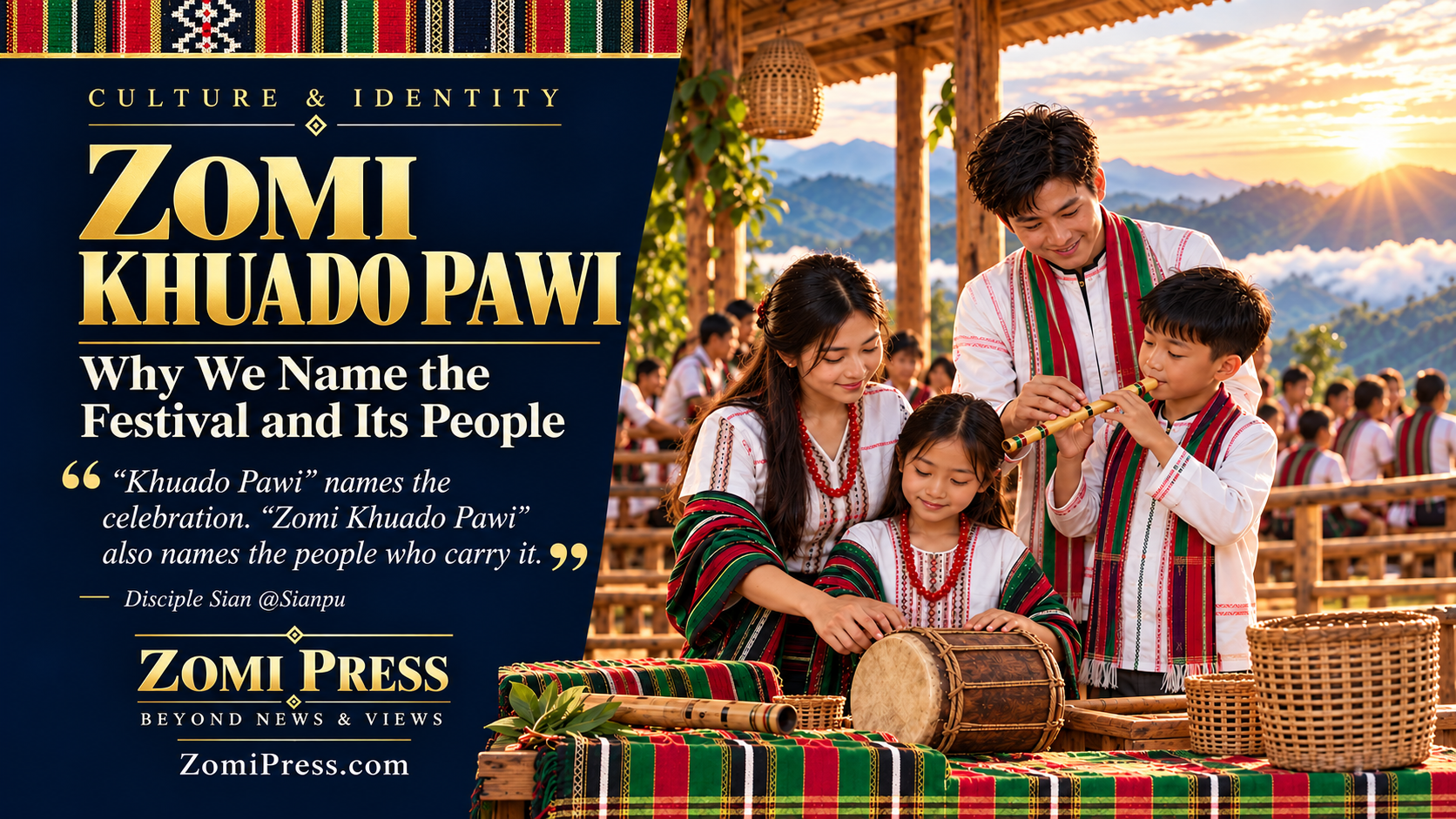
Download: Why We Call It Zomi Khuado Festival
Adding the community identifier “Zomi” to the harvest festival name “Khuado Pawi” clarifies both the event being celebrated and the people who sustain it. While the shorter name is internally familiar to community members, using “Zomi Khuado Pawi” in public contexts provides essential cultural context to external audiences.
Explicit naming is particularly vital in diaspora settings, helping younger generations and outside observers connect the tradition to Zomi identity. Adapting the full title on invitations, media, and official records supports cultural visibility and heritage preservation without displacing the traditional shorter term used in casual settings.
Cultural naming, intergenerational transmission, and the visibility of Zomi identity
Introduction
“Khuado Pawi” is a familiar name in Zomi cultural life. It evokes a celebration associated with the harvest, communal gathering, and traditions passed across generations. Its familiarity has prompted a reasonable question: If Khuado is already recognized as our festival, why add “Zomi” to its name?
The answer lies in the difference between what a name communicates within a community and what it communicates beyond it.
“Khuado Pawi” tells us what festival we celebrate. “Zomi Khuado Pawi” also tells us whose festival it is.
The expanded name preserves Khuado Pawi while identifying the people who present and sustain it. For Zomi communities addressing the public—especially across national borders—this is a valuable act of cultural self-identification. It makes the festival and its community visible together.
A Distinctive Name Still Needs Context
Among Zomi people who know the celebration, Khuado Pawi needs little introduction. No one must say “Zomi Khuado Pawi” every time the subject arises. In conversation, songs, and Zomi-language writing, the shorter name remains natural.
A distinctive word, however, does not explain itself to everyone who encounters it. Consider a child raised outside the ancestral homeland, a teacher preparing a multicultural program, or a neighbor seeing a festival poster for the first time. That person may know neither Khuado nor Zomi. A public title should help them discover both.
A simple analogy illustrates the point. “Happy birthday” identifies an occasion; “Happy birthday, Thangpu” also identifies the person being celebrated. Adding the name does not redefine a birthday. It makes the message more specific. Similarly, adding Zomi does not change the meaning of Khuado Pawi. It identifies the community whose celebration is being introduced.
Public terms such as Chinese New Year and Hmong New Year likewise place a community identifier alongside an occasion.¹ ² Their histories and traditions differ from Khuado’s. The relevant comparison is limited to the way a concise public name helps an unfamiliar audience understand what is being celebrated and whose cultural context it is entering. americanhistory.si.edu
The distinction already appears in reporting. Describing a celebration in Australia, Democratic Voice of Burma identified the Zomi community and named the celebration Khuado Pawi.³ Readers needed both elements to understand the event and its participants. english.dvb.no
Naming as Cultural Self-Representation
The decision to use “Zomi Khuado Pawi” carries an implication beyond publicity. It places the Zomi name wherever the festival is introduced: on invitations, in school programs, in news coverage, and in archives that future generations may consult.
This is a form of cultural advocacy, though naming alone cannot accomplish the work of preservation. A title can direct attention to the community; Zomi speakers, elders, families, artists, and scholars must then explain the histories, language, practices, and changing meanings that give the celebration substance.
The 2003 UNESCO Convention describes intangible cultural heritage in relation to practices that communities recognize as their heritage and transmit across generations. UNESCO’s ethical principles emphasize the primary role of communities in safeguarding such heritage.⁴ ⁵ Neither source prescribes a name for Khuado. Their relevance is the principle of community agency: people who sustain a living tradition should have a leading voice in how it is documented and presented. ich.unesco.org
Using Zomi in the public title helps ensure that a newcomer seeking to understand Khuado can find Zomi accounts of it. The name becomes an entry point, followed by the deeper work of teaching and documentation.
Why the Diaspora Changes the Naming Context
In communities where Khuado has long been observed, shared language, family relationships, and local memory may provide context without formal explanation. Migration changes that setting. A Zomi child in Tulsa, Melbourne, or Nelson may first encounter Khuado through a stage performance, a community meal, or an image online. The child may recognize an enjoyable event before understanding its relationship to Zomi history and identity.
“Zomi Khuado Pawi” makes that relationship explicit. It connects the celebration the child can see with the name of a people to whom the child belongs. It also gives non-Zomi classmates, teachers, and neighbors a respectful starting point for learning.
Zomi Press has described Khuado celebrations in the diaspora as opportunities for younger generations to hear the Zomi language, encounter inherited customs, and connect with community knowledge.⁶ Writing on the Zomi Political Coordination Council website, Professor C. Thang Za Tuan includes Khuado Pawi among the cultural observances that Zomi communities abroad should continue to practice.⁷ These accounts emphasize participation and transmission. Clear naming supports that work by making the relationship between the festival and its people visible from the outset. zomipress.com
The expanded form is already documented in practice. A New Zealand review of community cultural projects lists “Zomi Khuado Pawi 2023” as a festival organized by **New Zealand Zomi Innkuan (Nelson) Inc.**⁸ The public record names both the inherited celebration and the community that organized it. www.multiculturalnt.co.nz
A Contextual Approach to Usage
There is no need to turn the shorter and fuller forms into opposing camps. Each can serve its audience.
Within a familiar Zomi setting, Khuado Pawi may be sufficient. For a first reference in an English-language article, public invitation, school notice, or exhibition, Zomi Khuado Pawi or Zomi Khuado Festival communicates more. One useful first mention is:
A writer can then use Khuado Pawi or Khuado throughout the remaining text.
A shorter public title can succeed when an accompanying article supplies the missing context. Henry Lyan’s “The Khuado Festival Revisited,” for example, uses Khuado in its title and discusses the community within the article.⁹ An image card or poster encountered without its accompanying text has less room to do that. In those settings, the fuller title is particularly useful. www.ichins.org
Historical Precision and Cultural Confidence
Advocating “Zomi Khuado Pawi” does not require claiming that every historical observance bore that exact expanded title. It does not require treating local forms of celebration as identical or directing other communities to use the same terminology.
The claim is more precise: Zomi communities have good reason to identify themselves when presenting their own Khuado celebrations today. They can retain an inherited name and supply the context needed by a wider audience. Historical accuracy and confident self-representation are compatible.
Conclusion
Khuado Pawi names the celebration. Zomi Khuado Pawi names the celebration and the people who carry it. The difference is especially consequential when the audience includes diaspora children and others encountering Zomi culture for the first time.
A name cannot preserve a tradition by itself. Cultural continuity depends on people gathering, speaking, recording, teaching, and passing on what they know. Yet public names help determine whether those people remain visible in the account of their heritage.
Name the festival. Name the people. Give the next generation both parts of the story.
References
- Democratic Voice of Burma, “Zomi Community Celebrates Khuado Pawi in Australia,” October 11, 2023, https://english.dvb.no/zomi-community-celebrates-khaudo-pawi-in-australia.
- UNESCO, Convention for the Safeguarding of the Intangible Cultural Heritage, adopted October 17, 2003, arts. 2 and 15, https://ich.unesco.org/doc/src/15164-EN.pdf; UNESCO, “Ethics and Intangible Cultural Heritage,” accessed September 25, 2026, https://ich.unesco.org/en/ethics-and-ich-00866.
- Zomi Press, “Khuado Festival: Celebrating the Zomi Heritage,” https://zomipress.com/khuado-festival-celebrating-the-zomi-heritage/.
- Zomi Political Coordination Council, “Gamdang Tung Zomite’ Ading Ka Deihsak Thu Pawlkhat,” accessed September 25, 2026, https://zpcc.net/gamdang-tung-zomite-ading-ka-deihsak-thu-pawlkhat/.
- Shared Communities Initiative: Independent Review of Initial Phase (October 2024), appendix 2, 43, https://www.multiculturalnt.co.nz/assets/Shared-Communities-Initiative-Independent-Review-of-Initial-Phase-October-2024-smaller-file.pdf.
- Henry Lyan, “The Khuado Festival Revisited,” Institute of Chin Studies, September 13, 2024, https://www.ichins.org/posts/the-khuado-festival.