
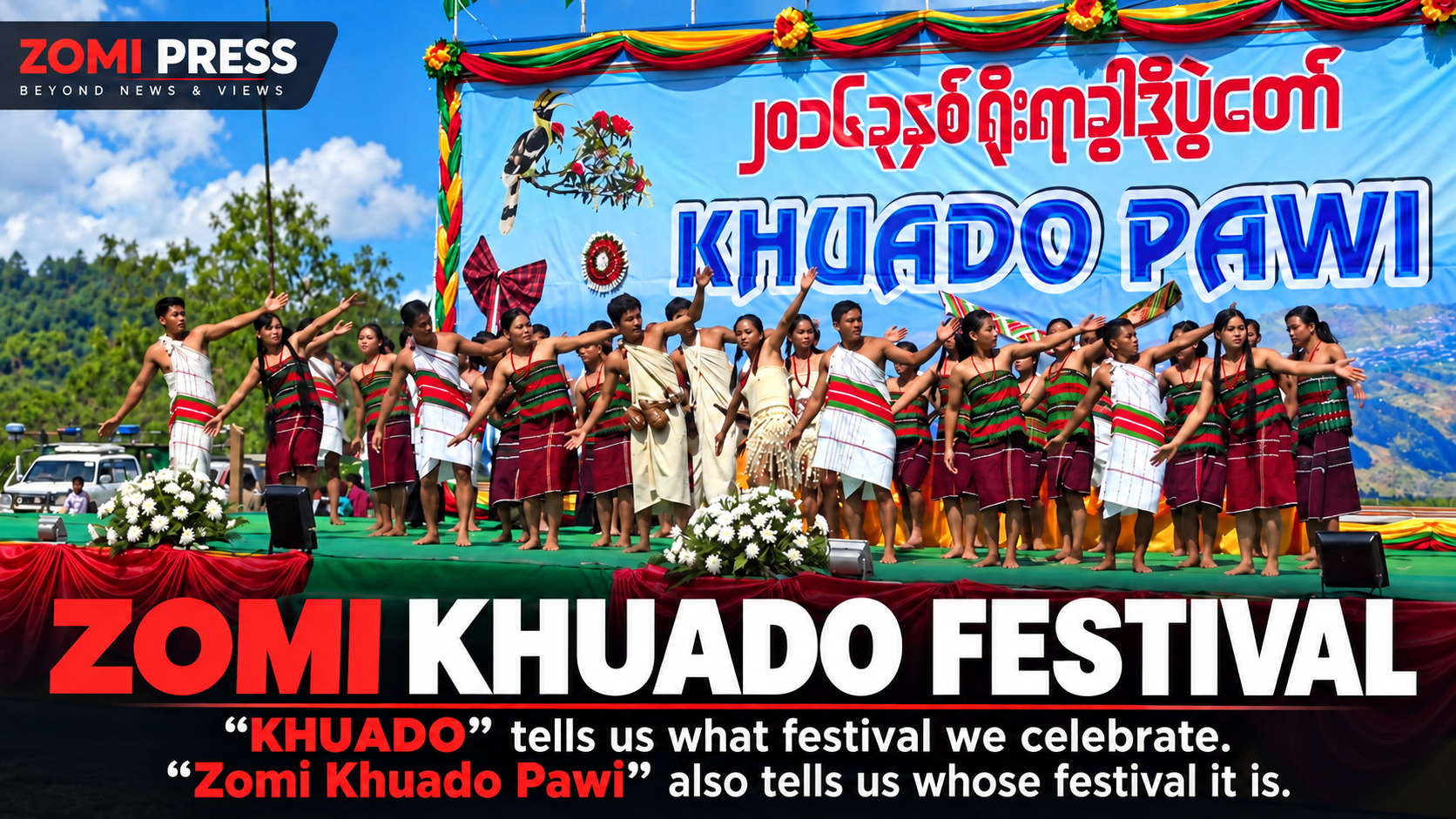
Download: Name the Festival, Name the People: Why “Zomi Khuado Pawi” Matters
Using the title Zomi Khuado Pawi or Zomi Khuado Festival explicitly identifies both the harvest tradition and the community that sustains it. While the traditional name Khuado Pawi remains familiar internally, adding Zomi helps public and diaspora audiences recognize the cultural origin of the celebration.
This naming practice supports cultural transmission for younger generations in multicultural settings. Context determines when to use each form, with the expanded title serving as an accessible entry point in public notices, leaving the shorter traditional name for familiar or Zomi-language contexts.
Cultural continuity, Zomi identity, and the language of a living tradition
By Disciple Sian @Sianpu
Zomi Press | Cultural Commentary
What a Festival Name Tells Us
“Khuado Pawi” is a familiar and meaningful name among Zomi people. It recalls the harvest season, communal gathering, and practices passed from one generation to the next. Some therefore ask why Zomi should be added. If Khuado Pawi is already known, what purpose does “Zomi Khuado Pawi” serve?
The answer lies in what each name communicates:
“Khuado Pawi” tells us what festival we celebrate. “Zomi Khuado Pawi” also tells us whose festival it is.
Khuado Pawi names the celebration. Zomi identifies the people presenting and sustaining it. Together, the words express the tradition and its community in one concise title. For Zomi organizers, using the fuller name is an act of cultural self-identification. For audiences unfamiliar with either Khuado or the Zomi people, it is an invitation to learn about both.
“Zomi Khuado Pawi,” or “Zomi Khuado Festival” in English-facing settings, is a strong public name for Zomi community celebrations. It preserves the traditional wording while making Zomi identity visible across generations and borders.
The Festival’s Name and the People’s Name
The argument that Khuado Pawi is already known assumes that recognition of the festival also brings recognition of the people associated with it. Within a familiar community, that context may be understood. On a school calendar, a public poster, or a news page viewed far from the community, it may not be.
Adding Zomi does not alter Khuado Pawi. It supplies a community identifier. That addition matters where a title must stand on its own, without an elder, organizer, or accompanying article to explain it.
In its account of an Australian celebration, Democratic Voice of Burma identified the Zomi community and described its celebration as Khuado Pawi. Both pieces of information helped readers understand what had taken place and who had celebrated it.^1
Why Public Naming Matters
A festival remains alive because people celebrate it, explain it, and pass it on. Naming cannot replace those acts. Yet a name influences whose voices a new audience will seek when it wants to understand the tradition.
“Zomi Khuado Pawi” makes a clear first statement: this is a Khuado celebration presented by Zomi people. It creates room for the fuller account that should follow—Zomi-language terms, elders’ memories, family and community practices, historical change, and the meanings participants give the celebration today.
The 2003 UNESCO Convention describes intangible cultural heritage in relation to practices that communities recognize as their heritage and transmit across generations. UNESCO’s ethical principles also emphasize the primary role of communities in safeguarding that heritage.^2,3 These documents do not prescribe a title for Khuado. They provide a relevant principle: a living practice should be understood with attention to the community that carries it.
Publicly naming the Zomi community is thus a form of cultural advocacy. It affirms the people’s own name wherever the celebration appears—in an invitation, an exhibition, a photograph caption, a school program, or an online archive. It gives unfamiliar readers a way to discover Zomi accounts of Zomi cultural life.
A Clearer Connection for New Generations
The fuller name is particularly useful in the diaspora. Where Khuado has long been celebrated, relatives, language, and shared memory may provide context without anyone having to state it. A child growing up elsewhere may first meet the tradition at an annual event, through a song or dance, or in a photograph shared online.
“Zomi Khuado Pawi” connects the celebration that child can experience with the name of a people to whom the child belongs. For a classmate or neighbor who has never heard of either word, it provides the same connection as a starting point for learning.
Zomi Press has previously discussed Khuado as a setting where diaspora communities can share language and customs and transmit cultural heritage to younger generations.^4 In an article published by the Zomi Political Coordination Council, Professor C. Thang Za Tuan likewise includes Khuado Pawi among valued observances that Zomi people living abroad should continue to practice.^5 Both accounts point toward the sustained work required for cultural continuity. A clear public name supports that work; families, elders, writers, and organizers give it substance.
The expanded wording is already documented in community activity. An independent review of cultural projects in Nelson, New Zealand, lists “Zomi Khuado Pawi 2023” as a festival organized by New Zealand Zomi Innkuan (Nelson) Inc.^6 In that public record, the traditional festival name and the community name appear together.
Choosing the Right Form for the Audience
Supporting a fuller public title does not diminish the familiar shorter one. “Khuado Pawi” remains natural in Zomi conversation and in writing whose readers already know its context. A public announcement or an article’s first mention may need to say more.
One practical introduction is:
After that, a writer can use Khuado Pawi or Khuado. This approach welcomes a new reader while keeping the inherited words in view.
A shorter public title can also work when the accompanying text supplies the context. Henry Lyan’s article, “The Khuado Festival Revisited,” uses Khuado in its title and describes the community in the article itself.^7 A poster, image card, or headline shared without its full text may not have that opportunity. In those settings, an expanded title communicates more at first sight.
Historical Care and Cultural Confidence
The case for “Zomi Khuado Pawi” does not require claiming that every earlier observance used this exact expanded name. Nor does it require claiming that practices have been identical in every place or that other communities must name their events in the same way.
The argument is precise: Zomi people have good reason to identify themselves when presenting their own Khuado celebrations today. They can preserve Khuado Pawi and make its Zomi context explicit. Historical care and cultural confidence can work together.
Keep the People in the Story
“Khuado Pawi” tells an audience what is being celebrated. “Zomi Khuado Pawi” also tells it who carries the celebration. Where both facts can be expressed briefly, the fuller name serves new generations, diaspora communities, and people meeting Zomi culture for the first time.
No title can preserve a tradition on its own. Zomi people keep it alive by gathering, speaking, writing, teaching, and remembering. But the words used to introduce that tradition help determine whether its people remain visible in the account.
Name the festival. Name the people. Teach the generations what connects them.
References
- Democratic Voice of Burma, “Zomi Community Celebrates Khuado Pawi in Australia,” October 11, 2023, https://english.dvb.no/zomi-community-celebrates-khaudo-pawi-in-australia.
- UNESCO, Convention for the Safeguarding of the Intangible Cultural Heritage, adopted October 17, 2003, arts. 2 and 15, https://ich.unesco.org/doc/src/15164-EN.pdf; UNESCO, “Ethics and Intangible Cultural Heritage,” accessed September 25, 2026, https://ich.unesco.org/en/ethics-and-ich-00866.
- Zomi Press, “Khuado Festival: Celebrating the Zomi Heritage,” https://zomipress.com/khuado-festival-celebrating-the-zomi-heritage/.
- Zomi Political Coordination Council, “Gamdang Tung Zomite’ Ading Ka Deihsak Thu Pawlkhat,” accessed September 25, 2026, https://zpcc.net/gamdang-tung-zomite-ading-ka-deihsak-thu-pawlkhat/.
- Shared Communities Initiative: Independent Review of Initial Phase (October 2024), appendix 2, 43, https://www.multiculturalnt.co.nz/assets/Shared-Communities-Initiative-Independent-Review-of-Initial-Phase-October-2024-smaller-file.pdf.
- Henry Lyan, “The Khuado Festival Revisited,” Institute of Chin Studies, September 13, 2024, https://www.ichins.org/posts/the-khuado-festival.