
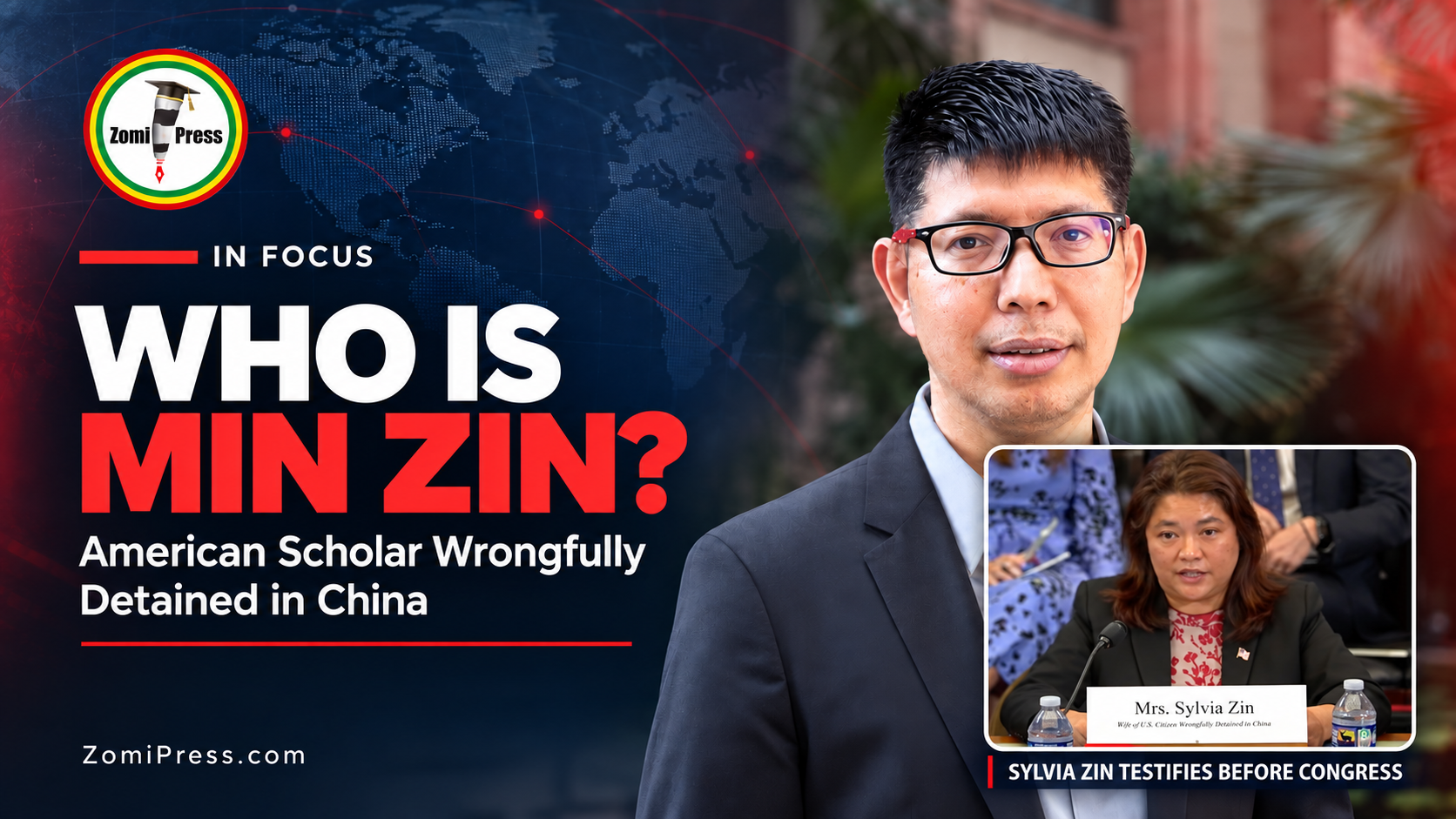
The Myanmar-born U.S. citizen has been officially designated “wrongfully detained” by Washington, as his wife, Sylvia Zin, appeals for his immediate release.
By Zomi Press
September 17, 2026 | International Affairs and Human Rights
Min Zin is a Myanmar-born American political analyst, former democracy activist, and founder and executive director of the Institute for Strategy and Policy–Myanmar, commonly known as ISP-Myanmar. He is also affiliated with the University of California, Berkeley, where he has pursued doctoral studies in political science.
Chinese state-security authorities detained Min Zin on June 3, 2026, shortly after he arrived in Kunming, Yunnan Province, to attend an academic workshop. China says he is suspected of espionage and activities endangering national security, but Chinese authorities have publicly disclosed few specific details supporting those allegations.
After reviewing the circumstances, U.S. Secretary of State Marco Rubio formally determined on August 20 that Min Zin was “wrongfully detained.” China rejected Washington’s designation and maintained that the case was being handled according to Chinese law.
More than 100 days after Min Zin was taken into custody, his wife, Sylvia Zin, testified before a U.S. congressional subcommittee. She described his sudden disappearance, reported interrogation and confinement conditions, lack of access to Chinese lawyers, and the devastating effect of his detention on their 14-year-old daughter.
Sylvia appealed directly to President Donald Trump and the U.S. government to secure her husband’s immediate release.
From Myanmar’s Democracy Movement to American Academia
Min Zin’s public life began in Myanmar’s pro-democracy movement rather than in a university or research institution.
As a teenager, he participated in the nationwide 1988 uprising against Myanmar’s military government. Following the military crackdown, he reportedly spent approximately seven years in hiding before leaving Myanmar and reaching Thailand.
He later moved to the United States, where his knowledge of Myanmar politics and intellectual ability opened an unconventional path into academia.
According to a statement signed by more than 100 scholars, Min Zin became a visiting scholar at the University of California, Berkeley’s School of Journalism in 2001. He returned to Berkeley as a Carnegie teaching fellow in 2008.
Although he had not completed the conventional preparatory degrees, Berkeley reportedly granted him a special admissions waiver into its master’s program in Asian Studies. He later entered the university’s political science doctoral program and received a Chancellor’s Graduate Fellowship. In 2013, he received an Institute of East Asian Studies fellowship supporting his dissertation research in Myanmar.
Min Zin became a naturalized U.S. citizen in 2012, according to information provided by his family. He is married to Sylvia Zin, and they have a 14-year-old daughter.
His university affiliation is listed on his official UC Berkeley Political Science profile. His academic history is further documented in a joint statement published by Scholars at Risk.
Founding ISP-Myanmar
In 2016, Min Zin co-founded the Institute for Strategy and Policy–Myanmar as an independent research organization.
ISP-Myanmar conducts research on:
- Conflict, peace, and security;
- Myanmar’s political economy;
- Socioeconomic conditions;
- Myanmar–China relations;
- Border trade and regional connectivity;
- Armed organizations and territorial control;
- Natural resources and conflict economies; and
- The political and humanitarian consequences of Myanmar’s civil war.
Its policy papers, research reports, maps, conflict trackers, datasets, and public briefings have been used by journalists, academics, diplomats, humanitarian organizations, and policymakers.
Following Myanmar’s February 2021 military coup, ISP-Myanmar moved much of its operation outside the country. It continued publishing open-source, data-driven analysis of Myanmar’s changing political and security environment.
ISP-Myanmar describes itself as an independent, nonpartisan, and nongovernmental think tank. Its publications are generally accessible through the official ISP-Myanmar website.
Why Min Zin Traveled to China
Min Zin arrived in Kunming on June 3 to participate in an academic workshop reportedly focused on economic cooperation.
His family said the invitation was arranged through a professor he had known for several years at the Yunnan Academy of Social Sciences. U.S. officials have described him as traveling to an academic conference at the invitation of the Chinese government.
The exact institutional arrangement behind the invitation has not been fully documented publicly. Available accounts consistently indicate, however, that Min Zin entered China with a valid visa to attend an academic event. He had previously traveled to China, including for a conference in Shanghai, without incident.
His family said Min Zin believed China played an indispensable role in any effort to end Myanmar’s civil war. He therefore considered dialogue with Chinese scholars important, despite the political sensitivities surrounding China’s relationships with Myanmar’s military authorities, ethnic armed organizations, and border communities.
Detained After Arriving in Kunming
According to Sylvia Zin’s congressional testimony, her husband initially communicated normally with family members and colleagues after arriving in Kunming. Then, without warning, all communication stopped.
For approximately six hours, his family had no information about his location or safety. As their concern increased, they alerted U.S. officials in China and Washington.
On June 4, Sylvia received a call from a Chinese number informing her that Min Zin was in custody and under investigation by the Yunnan branch of China’s Ministry of State Security.
The call confirmed that he was alive, but Sylvia said she was not told exactly where he was being held or given meaningful details about the evidence against him.
On June 12, Chinese Foreign Ministry spokesperson Lin Jian publicly confirmed Min Zin’s detention. Lin said he was suspected of engaging in espionage and activities endangering China’s national security.
The spokesperson did not identify the alleged activities or disclose what information Min Zin was accused of collecting. China said the U.S. consulate in Guangzhou had been notified and maintained that his legitimate rights were being protected.
China’s confirmation was documented by Reuters and the Associated Press.
China’s Position
China maintains that:
- Min Zin is suspected of espionage;
- His alleged activities endangered Chinese national security;
- His detention was conducted under Chinese law;
- Chinese judicial authorities are handling the case lawfully; and
- Washington has no basis for characterizing the detention as wrongful.
After the State Department announced its determination, China rejected the designation.
A Chinese Foreign Ministry spokesperson said there was no such thing as “wrongful detention” in China and reiterated that Min Zin was suspected of activities violating Chinese law.
Chinese authorities, however, have not publicly presented detailed evidence against him. Publicly available information also does not establish that Min Zin has been tried, convicted, or given a transparent opportunity to challenge the allegations.
An allegation of espionage is not the same as a proven criminal finding.
China’s response to Washington’s designation was reported by Al Jazeera, drawing on official Chinese statements and international news-agency reporting.
Family and Colleagues Reject the Allegations
Min Zin’s family and ISP-Myanmar categorically deny that he engaged in espionage.
His brother, Aung Maw Zin, said the allegations made by security authorities in Yunnan “could not be further from the truth.”
ISP-Myanmar said Min Zin traveled to China solely to attend an academic workshop and called for his immediate and unconditional release.
The institute emphasized that its work is based on publicly available information. Its research—including analysis of China’s strategic role in Myanmar—is published openly rather than produced as secret intelligence.
In its official statement on Min Zin’s detention, ISP-Myanmar said its mission was to conduct independent, open-source research and provide analysis serving the public interest.
More than 100 scholars subsequently signed a statement describing Min Zin as an internationally respected political analyst committed to independent, evidence-based research.
They argued that researchers must be able to conduct their work and participate in academic exchanges without fear of intimidation or arbitrary detention.
Why Washington Calls Him “Wrongfully Detained”
On August 20, Secretary Rubio formally determined that Min Zin was wrongfully detained.
The State Department said the decision followed an extensive review of the circumstances surrounding his detention. It called on Beijing to release Min Zin and other U.S. citizens whom Washington considers arbitrarily detained or subjected to coercive exit bans.
The determination is recorded in the official State Department statement.
“Wrongfully detained” is a formal U.S. government classification—not merely a description used by Min Zin’s family, supporters, or the news media.
When making such a determination, U.S. authorities may consider whether:
- The allegations appear unsubstantiated;
- The proceedings lack credible due process;
- The detainee is being held because of U.S. citizenship;
- The person is being subjected to inhumane conditions;
- The detention appears intended to influence U.S. policy;
- The treatment is discriminatory or arbitrary; or
- The individual may be used as political leverage.
The designation does not itself overturn Chinese law or constitute a ruling by an international court. It means that, following an official review, the United States concluded that Min Zin’s case met its criteria for specialized diplomatic intervention.
The designation also gives his case greater priority within the U.S. government’s hostage-recovery system.
Sylvia Zin’s Plea for Her Husband’s Release
More than 100 days after Min Zin disappeared into Chinese custody, Sylvia Zin brought her family’s appeal directly before the United States Congress.
In testimony publicized by the House Foreign Affairs Committee Republicans, Sylvia described herself as a wife and mother trying to serve as her husband’s voice while caring for their daughter.
The committee introduced her testimony with a direct message:
“We don’t leave Americans behind.”
Its accompanying statement said Min Zin was arrested and wrongfully detained while traveling to an academic conference. It identified him as one of the Americans whom President Trump and Secretary Rubio were working to bring home.
The official video of Sylvia Zin’s testimony presents the case not only as a dispute between Washington and Beijing, but also as a family crisis defined by fear, separation, and prolonged uncertainty.
Reported Interrogation and Detention Conditions
Sylvia testified that Min Zin was initially subjected to daily interrogations lasting approximately four to six hours.
Based on information available to the family, she said he had been:
- Confined in a small cell;
- Kept under lights operating 24 hours a day;
- Subjected to lengthy daily interrogations;
- Denied communication with his wife and daughter;
- Prevented from receiving assistance from Chinese lawyers; and
- Held at a location that had not been disclosed to his family.
These details should be understood as allegations presented in Sylvia’s testimony and related reporting. His family and independent observers have not been given sufficient access to verify every aspect of his treatment directly.
China maintains that Min Zin’s rights are being protected. Nevertheless, the absence of family communication, independent legal access, transparent proceedings, and publicly disclosed evidence raises serious concerns about due process and humane treatment.
The reported conditions have also been examined by The Wall Street Journal.
The Toll on His Wife and Daughter
Sylvia’s testimony placed particular emphasis on the emotional suffering experienced by their 14-year-old daughter.
The family has been forced to live without knowing when—or whether—Min Zin will return. Their daughter must cope with uncertainty about her father’s safety while receiving little reliable information about his condition or future.
Sylvia said she is a stay-at-home mother who must care for their daughter while communicating with U.S. officials, seeking information about her husband, and publicly advocating for his freedom.
Her testimony demonstrated that wrongful detention affects more than the person in custody. The uncertainty, isolation, and fear also impose an enduring burden on spouses, children, parents, and extended family members.
The Associated Press report on Sylvia’s congressional appeal provides additional reporting on the family’s situation.
Sylvia’s Appeal to President Trump
Sylvia expressed gratitude to Secretary Rubio for formally designating her husband as wrongfully detained. She also thanked President Trump and the U.S. officials working on the case.
She appealed directly to the president to raise Min Zin’s detention during his anticipated meeting with Chinese President Xi Jinping.
“Knowing the president’s historic record on bringing wrongfully detained Americans home has reassured me that he will also be able to secure the swift release of Min Zin and other wrongfully detained American citizens.”
Her request was straightforward: continue diplomatic pressure at the highest level and secure Min Zin’s safe return to his family.
She also placed his case alongside that of Youlin Chen, a Chinese-born American seismologist whom the State Department has similarly designated as wrongfully detained in China.
Sylvia urged U.S. leaders to treat these cases not as secondary matters within the broader U.S.–China relationship, but as urgent questions involving the safety and freedom of American citizens.
Why His Research May Be Politically Sensitive
No publicly available evidence conclusively explains why Chinese security authorities targeted Min Zin. However, several areas of his research are politically sensitive to Beijing.
China’s Role in Myanmar
China has extensive strategic, political, military, and economic interests in Myanmar. These include border stability, trade, energy pipelines, infrastructure projects, rare-earth resources, access to the Indian Ocean, and the China–Myanmar Economic Corridor.
Armed Organizations Along the Border
Beijing maintains influence over several armed organizations operating near the China–Myanmar frontier. It has also mediated ceasefires and negotiations involving Myanmar’s military and ethnic armed groups.
Independent research examining these relationships may be viewed as sensitive, even when based entirely on publicly available information.
Myanmar’s Civil War
Since the 2021 military coup, Myanmar has experienced an expanding and increasingly fragmented civil war.
China has maintained relations with Myanmar’s military authorities while also communicating with ethnic armed organizations and other political actors. ISP-Myanmar’s research has examined territorial control, conflict economies, border trade, armed organizations, and Chinese strategic interests.
Independent Analysis
Authoritarian governments may distinguish between scholarship conducted under approved institutional arrangements and independent research they cannot control.
Min Zin’s work combines academic analysis, public data, policy research, and firsthand knowledge of Myanmar’s democracy movement.
These factors provide context for the sensitivity of his work. They do not establish that he committed espionage or any other crime.
Implications for Academic Freedom
Min Zin’s detention has consequences beyond his individual case.
Researchers studying China must increasingly consider whether invitations, conferences, and collaborative workshops provide sufficient protection from broadly defined national-security enforcement.
His detention could have a chilling effect on:
- Myanmar and Southeast Asia specialists;
- Researchers examining Chinese foreign policy;
- Civil-conflict and borderland scholars;
- Think-tank personnel;
- Journalists and data analysts;
- Naturalized U.S. citizens with ties to politically sensitive countries; and
- Researchers whose public work could be reinterpreted as intelligence gathering.
The case may discourage scholars from entering China, engaging with Chinese institutions, or conducting independent research on politically sensitive regional issues.
Implications for Myanmar
Min Zin’s detention is especially consequential for Myanmar because reliable, independent research has become increasingly difficult since the 2021 coup.
Armed conflict, media restrictions, surveillance, displacement, political persecution, and institutional collapse have sharply reduced the space available for credible research.
ISP-Myanmar is one of the organizations seeking to document these developments through publicly accessible evidence. The detention of its executive director could:
- Disrupt independent research on Myanmar;
- Discourage engagement between Myanmar scholars and Chinese institutions;
- Reduce opportunities for unofficial dialogue;
- Make analysts more cautious about examining China’s influence;
- Increase uncertainty about Beijing’s role in Myanmar; and
- Intensify international scrutiny of China’s regional policies.
The case may ultimately undermine the academic dialogue that China has sometimes presented as an alternative to confrontational diplomacy.
What Remains Unknown
Several important questions remain unanswered:
- What specific conduct does China allege constituted espionage?
- What evidence do Chinese authorities claim to possess?
- Has Min Zin been formally charged, or does he remain under investigation?
- Where exactly is he being held?
- Does he have meaningful access to independent legal counsel?
- What is his present physical and psychological condition?
- How frequently have U.S. consular representatives been allowed to see him?
- Was the workshop invitation issued directly by a government body or through a state-affiliated academic institution?
- Are negotiations for his release underway?
Responsible reporting must distinguish these unknowns from verified facts.
Zomi Press Assessment
The available public record supports several conclusions:
- Min Zin is a recognized Myanmar political scholar, American citizen, and independent policy researcher.
- He traveled to China with a valid visa to attend an academic workshop and had previously visited the country without incident.
- China has accused him of espionage and activities endangering national security but has not publicly presented detailed evidence.
- The United States formally designated him as wrongfully detained after an official review.
- His family, ISP-Myanmar, and more than 100 scholars reject the espionage allegation and have called for his unconditional release.
- China rejects Washington’s characterization and maintains that the detention is lawful.
- The reported denial of family communication and Chinese legal counsel, combined with the absence of transparent evidence and proceedings, raises serious human-rights and academic-freedom concerns.
Min Zin’s case should therefore be reported neither as a proven espionage case nor merely as a private family tragedy.
It is an international case involving academic freedom, opaque national-security laws, Myanmar’s civil war, and strategic competition between China and the United States.
Conclusion
Min Zin’s life reflects much of Myanmar’s modern political history: the 1988 uprising, military repression, exile, intellectual reconstruction, democratic opening, renewed dictatorship, civil war, and China’s growing regional influence.
He developed from a teenage democracy activist hiding from Myanmar’s military government into an American citizen, Berkeley scholar, policy analyst, and leader of one of Myanmar’s prominent independent research institutions.
His detention raises a fundamental question: Can scholars engage China on sensitive regional issues without legitimate academic research being treated as a national-security threat?
For Sylvia Zin and their daughter, however, the matter is more immediate and personal. A husband and father has been held for more than 100 days without family contact, access to Chinese lawyers, or a transparent presentation of the case against him.
Sylvia’s appeal to the United States government is clear: continue advocating at the highest level, demand transparency and humane treatment, and secure Min Zin’s immediate and unconditional release.
Until Chinese authorities present credible evidence through transparent proceedings—or release him—the concerns surrounding his detention will continue to deepen.
Sources and Further Reading
Primary and Institutional Sources
- U.S. Department of State: Wrongful Detention Designation for U.S. Citizen Min Zin
- House Foreign Affairs Committee Republicans: Sylvia Zin’s Testimony
- House Foreign Affairs Committee Republicans: Official YouTube Channel
- UC Berkeley Political Science: Min Zin
- ISP-Myanmar: Statement on the Wrongful Detention of U Min Zin
- ISP-Myanmar: Official Website
- Scholars at Risk: Joint Statement of Concern for Min Zin
Independent Reporting
- Associated Press: Sylvia Zin Appeals for Her Husband’s Release
- Associated Press: China Arrests U.S. Scholar on Suspicion of Espionage
- Reuters: China Confirms Min Zin’s Detention
- Reuters: United States Designates Min Zin Wrongfully Detained
- CBS News: U.S. Designates Min Zin Wrongfully Detained
- The Wall Street Journal: A U.S. Scholar Was Invited to China, Then Vanished
- Al Jazeera: China Rejects the U.S. Wrongful-Detention Designation
Editorial Note
Zomi Press distinguishes among verified facts, official allegations, family testimony, institutional statements, and analytical conclusions. China’s espionage allegation has not been proven in publicly accessible judicial proceedings, and Chinese authorities have not publicly released detailed supporting evidence. Reported detention conditions are attributed to Sylvia Zin and established news organizations because independent observers have not been granted sufficient access to verify every detail directly.