
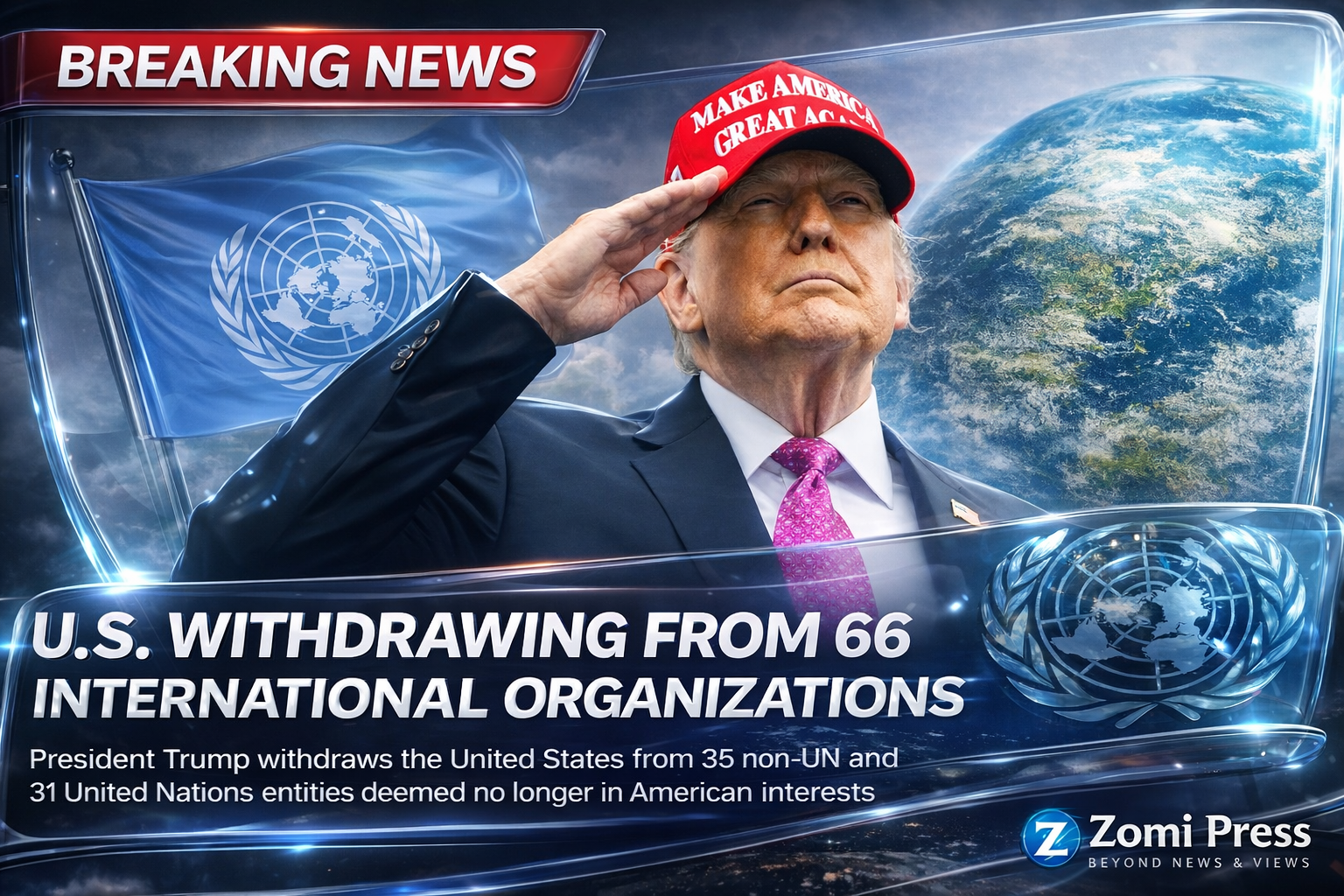
In a major shift in U.S. foreign and multilateral engagement, Donald J. Trump has signed a Presidential Memorandum directing the United States to withdraw from 66 international organizations and multilateral frameworks that the administration says no longer serve American national interests.
The directive orders the withdrawal from 35 non–United Nations organizations and 31 United Nations–affiliated entities, representing one of the most extensive realignments of U.S. participation in international institutions in modern history.
According to the White House, the decision reflects a renewed commitment to the “America First” doctrine—emphasizing national sovereignty, fiscal responsibility, and policy independence. Administration officials argue that many of the organizations involved have become bureaucratic, politicized, or ideologically driven, offering limited tangible benefits to the American people while constraining U.S. decision-making.
The memorandum asserts that U.S. engagement in international bodies must be results-oriented, transparent, and aligned with constitutional principles, rather than serving what officials describe as globalist agendas detached from American priorities.
I. Non–United Nations Organizations (35)
The United States has been directed to withdraw from the following non-UN organizations and agreements:
- 24/7 Carbon-Free Energy Compact
- Colombo Plan Council
- Commission for Environmental Cooperation
- Education Cannot Wait
- European Centre of Excellence for Countering Hybrid Threats
- Forum of European National Highway Research Laboratories
- Freedom Online Coalition
- Global Community Engagement and Resilience Fund
- Global Counterterrorism Forum
- Global Forum on Cyber Expertise
- Global Forum on Migration and Development
- Inter-American Institute for Global Change Research
- Intergovernmental Forum on Mining, Minerals, Metals, and Sustainable Development
- Intergovernmental Panel on Climate Change
- Intergovernmental Science-Policy Platform on Biodiversity and Ecosystem Services
- International Centre for the Study of the Preservation and Restoration of Cultural Property
- International Cotton Advisory Committee
- International Development Law Organization
- International Energy Forum
- International Federation of Arts Councils and Culture Agencies
- International Institute for Democracy and Electoral Assistance
- International Institute for Justice and the Rule of Law
- International Lead and Zinc Study Group
- International Renewable Energy Agency
- International Solar Alliance
- International Tropical Timber Organization
- International Union for Conservation of Nature
- Pan American Institute of Geography and History
- Partnership for Atlantic Cooperation
- Regional Cooperation Agreement on Combating Piracy and Armed Robbery against Ships in Asia
- Regional Cooperation Council
- Renewable Energy Policy Network for the 21st Century
- Science and Technology Center in Ukraine
- Secretariat of the Pacific Regional Environment Programme
- Venice Commission of the Council of Europe
II. United Nations–Affiliated Organizations (31)
The memorandum also directs withdrawal from the following UN bodies and programs:
- UN Department of Economic and Social Affairs
- UN Economic and Social Council (ECOSOC) – Economic Commission for Africa
- ECOSOC – Economic Commission for Latin America and the Caribbean
- ECOSOC – Economic and Social Commission for Asia and the Pacific
- ECOSOC – Economic and Social Commission for Western Asia
- International Law Commission
- International Residual Mechanism for Criminal Tribunals
- International Trade Centre
- Office of the Special Adviser on Africa
- Office of the Special Representative of the Secretary-General for Children in Armed Conflict
- Office of the Special Representative of the Secretary-General on Sexual Violence in Conflict
- Office of the Special Representative of the Secretary-General on Violence Against Children
- Peace building Commission
- Peace building Fund
- Permanent Forum on People of African Descent
- UN Alliance of Civilizations
- UN Collaborative Programme on Reducing Emissions from Deforestation and Forest Degradation in Developing Countries
- UN Conference on Trade and Development
- UN Democracy Fund
- UN Energy
- UN Entity for Gender Equality and the Empowerment of Women
- UN Framework Convention on Climate Change
- UN Human Settlements Programme
- UN Institute for Training and Research
- UN Oceans
- UN Population Fund
- UN Register of Conventional Arms
- UN System Chief Executives Board for Coordination
- UN System Staff College
- UN Water
- UN University
Administration Rationale
White House officials contend that many of these organizations have shifted away from their original mandates and now function as policy-shaping instruments that pressure the United States on issues ranging from climate policy and migration to social governance and economic regulation.
The administration argues that continued participation has resulted in disproportionate financial contributions, limited accountability, and reduced flexibility for U.S. domestic and foreign policy decisions.
“This memorandum ensures that American resources are directed toward American priorities,” an administration official said, emphasizing that international cooperation will continue only where it clearly benefits U.S. national interests.
Global Reactions and Implications
The move is expected to generate strong reactions from international partners, global institutions, and advocacy groups. Supporters view the decision as a long-overdue correction to what they describe as unchecked multilateralism, while critics warn it could reduce U.S. influence on global standards and international governance.
Policy analysts note that the withdrawals do not necessarily prohibit future bilateral cooperation but signal a decisive pivot toward selective engagement rather than institutional entanglement.
The withdrawal from 66 international organizations represents a defining moment in U.S. foreign policy under the America First doctrine. By asserting national sovereignty over multilateral commitments, the administration has drawn a clear line between cooperation and constraint, signaling that future U.S. participation on the global stage will be driven by national interest, accountability, and results—not ideology.
Zomi Press: Beyond News & Views
🌐 https://zomipress.com
📘 fb.com/ZomiPress | ✖ @ZomiPress