
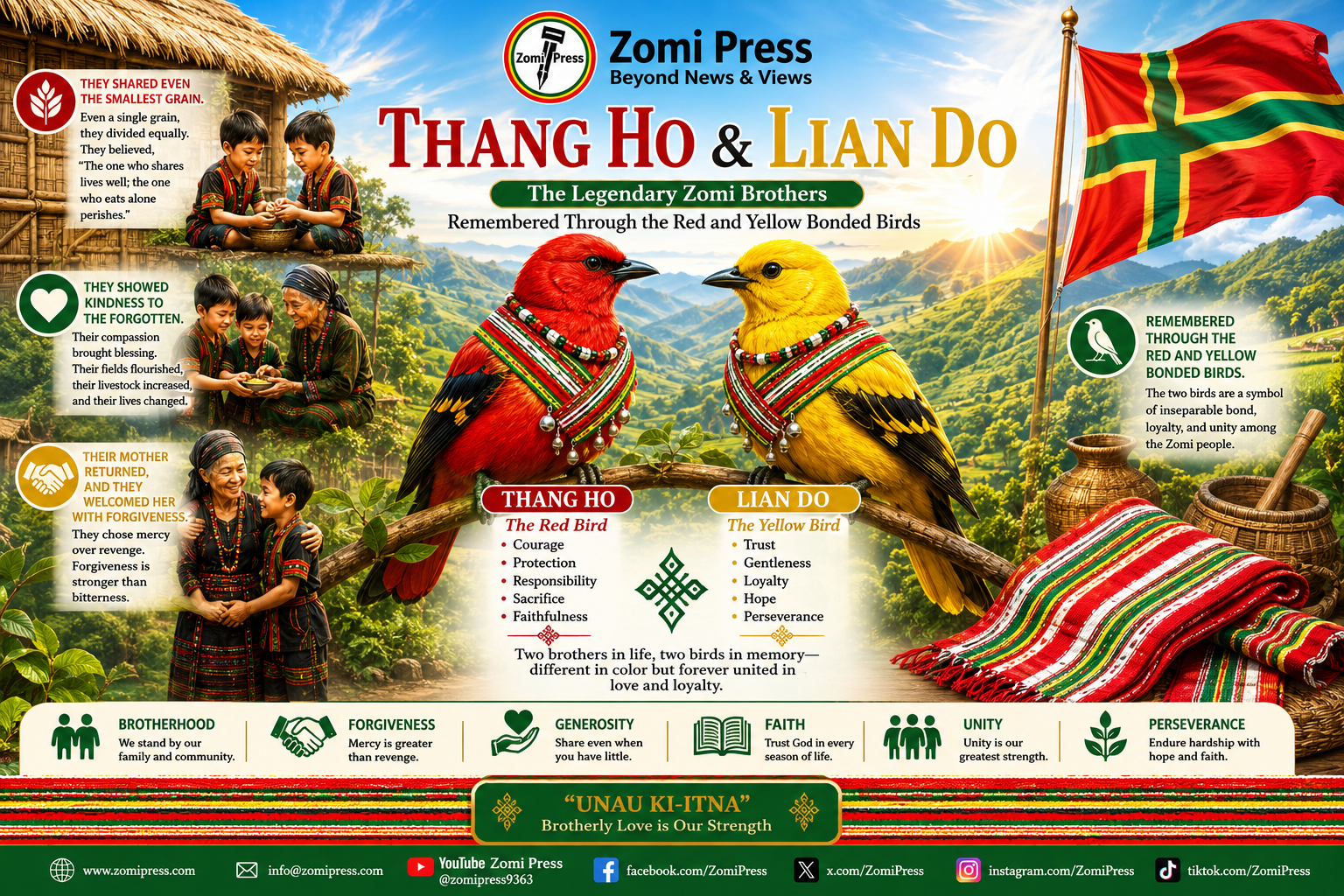
Download: Thang Ho and Lian Do: The Legendary Zomi Brothers Remembered Through the Red and Yellow Bonded Birds
By Zomi Press
For generations, the story of Thang Ho and Lian Do has been treasured in Zomi oral tradition as one of the most enduring examples of brotherly love, loyalty, generosity, forgiveness, and unity. More than a simple folktale, the legend reflects the moral values that have shaped Zomi society for centuries and continues to inspire new generations today.
Like many ancient oral traditions, the story has been preserved through storytelling rather than written records. As a result, certain details vary among regions, clans, and storytellers. Nevertheless, its central message remains remarkably consistent: true brotherhood is marked by love, sacrifice, faithfulness, and a willingness to share even in times of hardship.
Two Brothers Left to Survive
According to many versions of the tradition, Thang Ho, the elder brother, and Lian Do, the younger brother, lost their father while they were still young. After their father’s death, their mother remarried, and the boys were eventually left to survive on their own.
From an early age, they endured rejection, poverty, hunger, and uncertainty. Yet despite every hardship, the two brothers never abandoned one another.
Thang Ho faithfully protected and guided his younger brother, while Lian Do trusted and remained devoted to his elder sibling. Their unwavering relationship became a lasting model of unau ki-itna—brotherly love and mutual faithfulness.
Sharing Even the Smallest Grain
One of the most memorable scenes in the legend illustrates the brothers’ extraordinary generosity.
Having little food of their own, they survived by gathering scattered grains left behind in harvested fields. Even when they found only a single grain, neither brother was willing to eat without sharing it with the other.
Their actions reflected a timeless Zomi moral principle: true prosperity begins with generosity rather than abundance.
The greatness of Thang Ho and Lian Do was not measured by wealth or status. Instead, it was revealed during the season when they possessed almost nothing yet refused to become selfish.
Compassion That Brought Blessing
Another cherished episode tells how the brothers showed kindness to an elderly woman whom others had overlooked.
Although they themselves had very little, they welcomed her with compassion and shared what they had.
According to the tradition, this act of mercy became a turning point in their lives. Their fields became fruitful, their livestock multiplied, and their circumstances gradually changed from poverty to abundance.
Yet prosperity never changed their character. They remained humble, generous, and devoted to one another, becoming remembered not simply for their wealth but for their compassion and integrity.
Mercy Toward the Mother Who Left Them
Many retellings also describe how their mother eventually returned after hearing that her sons had become prosperous.
Rather than seeking revenge or holding onto bitterness, the brothers welcomed her with kindness and forgiveness.
Their response demonstrated one of the legend’s most powerful lessons: mercy is greater than resentment, and forgiveness is stronger than revenge.
Remembered Through the Red and Yellow Bonded Birds
In the poetic conclusion of the legend, Thang Ho and Lian Do came to be remembered through two colorful birds that were always seen together.
🔴 Thang Ho became associated with the red bird.
🟡 Lian Do became associated with the yellow bird.
Though different in color, the two birds were never seen as rivals. Instead, they symbolized an inseparable bond—moving together, remaining faithful to one another, and reflecting the enduring unity of the two brothers.
The legend does not seek to identify these birds according to modern ornithology. Rather, the red and yellow birds function as poetic and cultural symbols representing brotherhood, loyalty, and inseparable unity within Zomi heritage.
The Meaning Behind Their Colors
🔴 Thang Ho — The Red Bird
As the elder brother, Thang Ho symbolizes:
- Courage
- Protection
- Responsibility
- Sacrificial love
- Faithfulness
🟡 Lian Do — The Yellow Bird
As the younger brother, Lian Do represents:
- Trust
- Gentleness
- Loyalty
- Hope
- Perseverance
Together, the two birds embody values deeply cherished by the Zomi people:
- Brotherhood
- Covenant loyalty
- Mutual sacrifice
- Family unity
- Harmony
- Shared destiny
A Timeless Lesson for Every Generation
The legend of Thang Ho and Lian Do continues to teach timeless truths that remain relevant today.
It reminds us:
- Share with others, even when resources are limited.
- Remain faithful to family and community during hardship.
- Care for the vulnerable, the elderly, and those who are often overlooked.
- Never judge others because of poverty or social status.
- Let prosperity strengthen humility rather than pride.
- Choose forgiveness over revenge.
- Preserve unity as one of the greatest strengths of the Zomi people.
For generations, elders have passed this story from one generation to the next, preserving not only an ancient legend but also the moral values that define Zomi identity. Whether understood as folklore, cultural memory, or moral tradition, the story continues to remind us that true greatness is measured not by wealth or power but by steadfast love, faithful relationships, generosity, and compassion.
Thang Ho and Lian Do are therefore more than legendary figures. They remain enduring symbols of unau ki-itna—brotherly love, loyalty, and inseparable unity.
Two brothers in life, two birds in memory—Thang Ho in red and Lian Do in yellow—different in color yet forever united in love, faithfulness, and the enduring spirit of the Zomi people.
Editor’s Note
This article presents a traditional Zomi oral legend preserved through generations of storytelling. As with many oral traditions, details may vary among regions, clans, and storytellers. The narrative is presented as part of Zomi cultural heritage and folklore rather than as a verified historical account.