
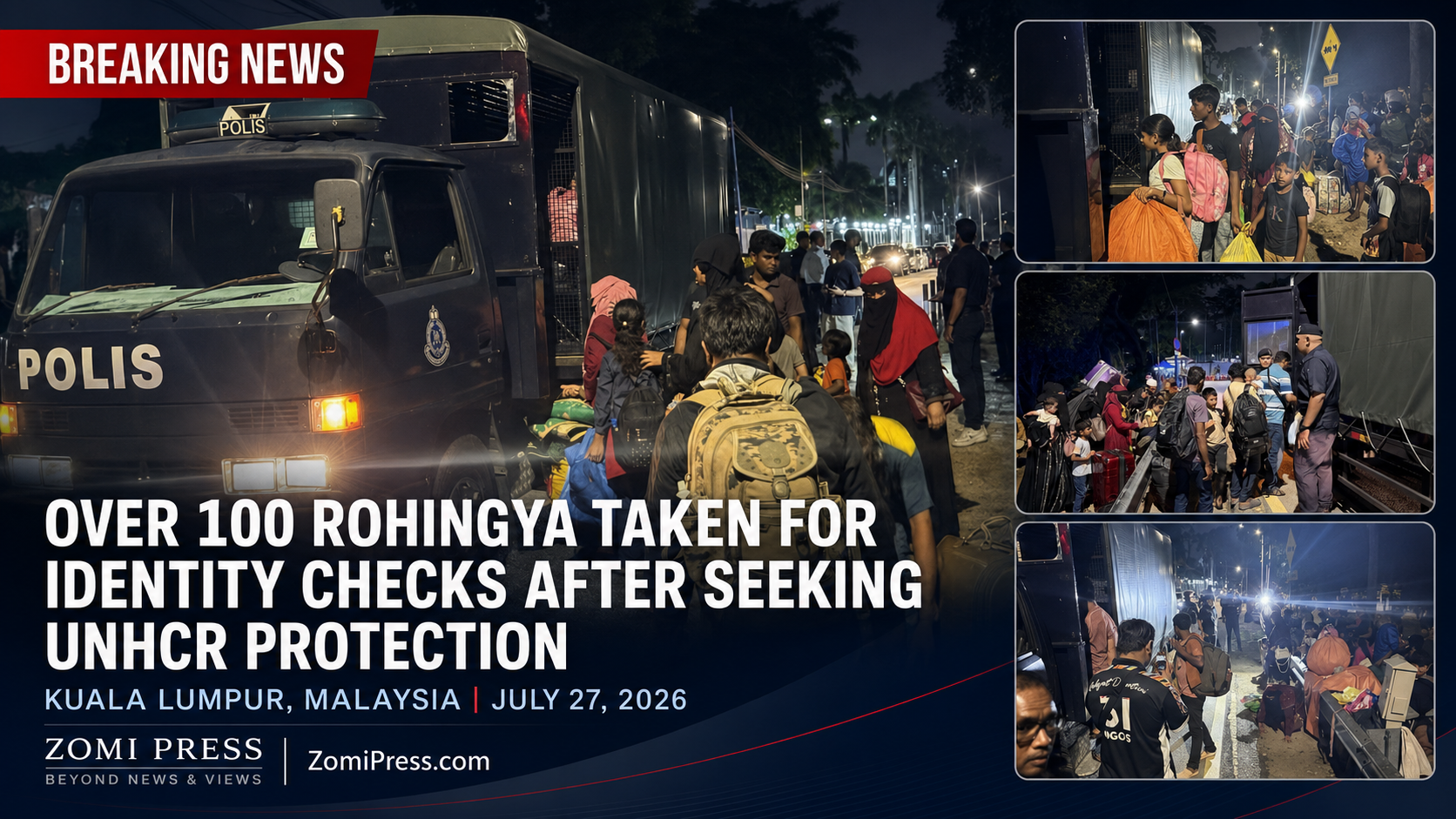
More than 100 refugees—including women and children—were transported to Kuala Lumpur police headquarters after gathering outside the UN refugee agency’s office.
By Zomi Press News Desk
KUALA LUMPUR | July 27, 2026
More than 100 Rohingya refugees and asylum seekers have been taken by Malaysian authorities for documentation and identity verification after gathering outside the United Nations High Commissioner for Refugees office in Kuala Lumpur.
The group—including women, children, elderly people and at least one pregnant woman—arrived in the capital on Monday after leaving a long-established Rohingya settlement in Kuala Muda, Penaga, in northern Penangm Malaysia.
Some early reports estimated that approximately 200 people traveled to Kuala Lumpur. Reuters later reported that authorities transported more than 100 people who remained outside the UNHCR office.
At approximately 8:30 p.m., the refugees and their belongings were placed in four police trucks and taken to the Kuala Lumpur Police Contingent Headquarters. Police described the transfer as being conducted for further checks, while Reuters characterized the authorities’ action as detention. Their final status had not been publicly confirmed as of late Monday.
Disputed Accounts of the Penang Departure
Refugees interviewed at the scene said local residents had forced or pressured them to leave their rented homes in Penaga on Sunday, July 26. They said they traveled overnight by bus to seek protection and possible relocation assistance from UNHCR.
Local reporting indicated that members of the community had rented approximately 33 houses in Kuala Muda. Some reportedly had lived in the area for nearly 20 years, earning livelihoods as fishermen, laborers and small-business operators.
A 28-year-old refugee identified as Rizuan said his family left because of alleged threats and fears for their safety. He said residents were given little time to pack and that some possessions had to be left behind. With his wife pregnant, he said the family hoped UNHCR could help them secure safe accommodation.
Penang police offered a different account. Seberang Perai Utara district police chief Anuar Abdul Rahman said the Rohingya families “voluntarily moved” to Kuala Lumpur with assistance from state and federal agencies, including the National Security Council.
According to the police statement, the relocation followed “economic and territorial competition” associated with growth in the local Rohingya population.
The conflicting accounts have not yet been independently reconciled. It therefore remains unclear whether the families freely agreed to leave, departed under community pressure, or were subjected to an effective forced eviction.
Families Camp Outside UNHCR Office
After reaching Jalan Bukit Petaling, the families erected makeshift shelters outside the UNHCR compound while waiting for assistance. Images and reporting from the scene showed children and families sitting among bags, household belongings and temporary coverings.
One refugee, Syed Kasim, told Reuters that he had lived in Malaysia for 20 years and had traveled to the office with his wife and children. He said the group had received no assistance during the day.
Police were initially deployed to maintain traffic, security and public order around the area.
Prime Minister Anwar Ibrahim later directed the police, Immigration Department and Kuala Lumpur City Hall to take firm action. He said Malaysia understood that refugees were seeking UNHCR protection but insisted that public roads and urban areas could not be occupied in ways that disrupted traffic or concerned residents.
Anwar said people without appropriate documents would be referred to immigration authorities, while documented individuals would be warned to comply with Malaysian law.
Documentation and Identity Verification
Malaysian reports said the refugees were moved to Kuala Lumpur police headquarters for documentation and identity checks.
Malaysia Gazette, citing unnamed sources, reported that the National Security Council was expected to help coordinate the process, distinguish people holding valid UNHCR documents from those without them and identify possible accommodation arrangements.
The same report claimed that individuals unable to establish a recognized protection status could be transferred to the Immigration Department and potentially placed in immigration detention. Because this information came from unnamed sources, it should not yet be treated as a confirmed final government decision.
The checks come as Malaysia introduces its own Refugee Registration Document, or Dokumen Pendaftaran Pelarian (DPP), system.
Under the new program, Malaysian agencies intend to collect and verify information including:
- Names, ages and residential addresses
- Gender and employment skills
- Existing UNHCR documentation
- Facial and iris biometric data
- Immigration and security-screening information
Home Minister Saifuddin Nasution Ismail has said refugee claims will be assessed through verification involving the Immigration Department, police and other relevant agencies.
However, Monday’s police verification of the Penang group should not automatically be described as full DPP registration. Authorities had confirmed immediate documentation and identity checks, but had not publicly explained whether every member of the group was formally being enrolled in the DPP system.
Registration Policy in Transition
On July 23, Malaysia announced that it had asked UNHCR to temporarily stop registering new refugees while the government developed its national registration system.
The government says the DPP will create a more organized national database and reduce reliance on records maintained by an international agency. UNHCR has described a nationally administered system as potentially important, provided that it supports Malaysia’s humanitarian and protection responsibilities.
UNHCR documentation identifies a person as a refugee or asylum seeker requiring international protection. However, a UNHCR card is not a Malaysian residence permit, work authorization, travel document or grant of citizenship.
Malaysia is not a party to the 1951 Refugee Convention and does not presently provide refugees with a comprehensive legal status. Consequently, even UNHCR-registered refugees remain vulnerable to immigration arrest, restricted employment and exclusion from public education.
At the end of February 2026, approximately 215,600 refugees and asylum seekers were registered with UNHCR in Malaysia. About 126,000 were Rohingya from Myanmar.
Penang officials previously cited older UNHCR figures indicating that approximately 20,022 Rohingya refugees and asylum seekers were living across the state as of August 2023.
Humanitarian and Protection Concerns
Human Rights Watch criticized the decision to take the displaced families into custody, arguing that authorities should protect people who had lost their homes instead of exposing them to further fear.
The case raises several urgent protection questions:
- Were the Penang departures voluntary?
Authorities should conduct an impartial investigation into allegations of threats, coercion or collective punishment. Misconduct by individuals should be addressed individually and lawfully, not used to displace entire families. - Will families remain together?
Women, children, pregnant women, elderly people and those with medical needs should receive appropriate care and must not be separated unnecessarily. - Will UNHCR have access?
UNHCR access is essential for verifying existing records, identifying asylum seekers and helping prevent refugees from being treated solely as undocumented migrants. - How will biometric information be protected?
Refugees should be informed about what information is being collected, why it is needed, who can access it and whether it could be shared with other governments. Data must not be transferred to Myanmar in a manner that could expose refugees or their relatives to persecution. - Could anyone be returned to danger?
No individual should be deported without a fair assessment of protection needs. The customary international-law principle of non-refoulement prohibits returning people to a place where they face threats to life, freedom, torture or persecution.
Growing Anti-Rohingya Hostility
The Penang displacement occurred amid an increase in online hostility, misinformation and dehumanizing language directed at Rohingya refugees in Malaysia.
UNHCR has warned that online hate narratives can produce harassment and discrimination in the physical world. Reuters reported that at least nine Rohingya community schools had closed amid safety fears, public pressure or official scrutiny.
Malaysia’s Human Rights Commission, SUHAKAM, had already warned in June that escalating anti-Rohingya rhetoric could endanger the community and undermine Malaysia’s commitment to human dignity.
Malaysia has legitimate responsibilities to preserve public order, verify identities and address criminal conduct. Those responsibilities, however, should be exercised through individualized and transparent procedures—not collective blame, forced displacement or indefinite detention.
What Happens Next
The immediate questions are whether documented refugees will be released, where the displaced families will be accommodated, whether UNHCR will be allowed to participate in verification and what will happen to those whose documents are missing, expired or pending.
Authorities have not yet announced a permanent housing solution or released a complete breakdown of the number of adults and children involved.
A lawful and humane response should include temporary shelter, food, medical care, child protection, independent monitoring and confidential status determination. Community concerns in Penang should be addressed through mediation, accountable policing and clear local coordination rather than allowing fear or misinformation to determine the fate of vulnerable families.
This remains a developing story.
Sources
- Reuters: Malaysia detains over 100 Rohingya refugees seeking shelter at UNHCR
- SAYS: Refugees camp outside UNHCR office after leaving Penang
- Malaysia Gazette: Rohingya group moved to Kuala Lumpur police headquarters
- Malay Mail/Bernama: Prime Minister orders enforcement action
- Reuters: Malaysia asks UNHCR to temporarily cease refugee registration
- The Star: Malaysia’s DPP refugee database and biometric verification
- Bernama: Penang’s management of approximately 20,022 Rohingya
- UNHCR Malaysia: Facts concerning refugees and UNHCR documentation
- SUHAKAM: Statement on escalating hatred against the Rohingya community
- Fortify Rights: Concerns about indefinite refugee detention in Malaysia
Zomi Press — Beyond News & Views
🌐 ZomiPress.com | @ZomiPress
#Rohingya #Refugees #Malaysia #Penang #UNHCR #HumanRights #ZomiPress