
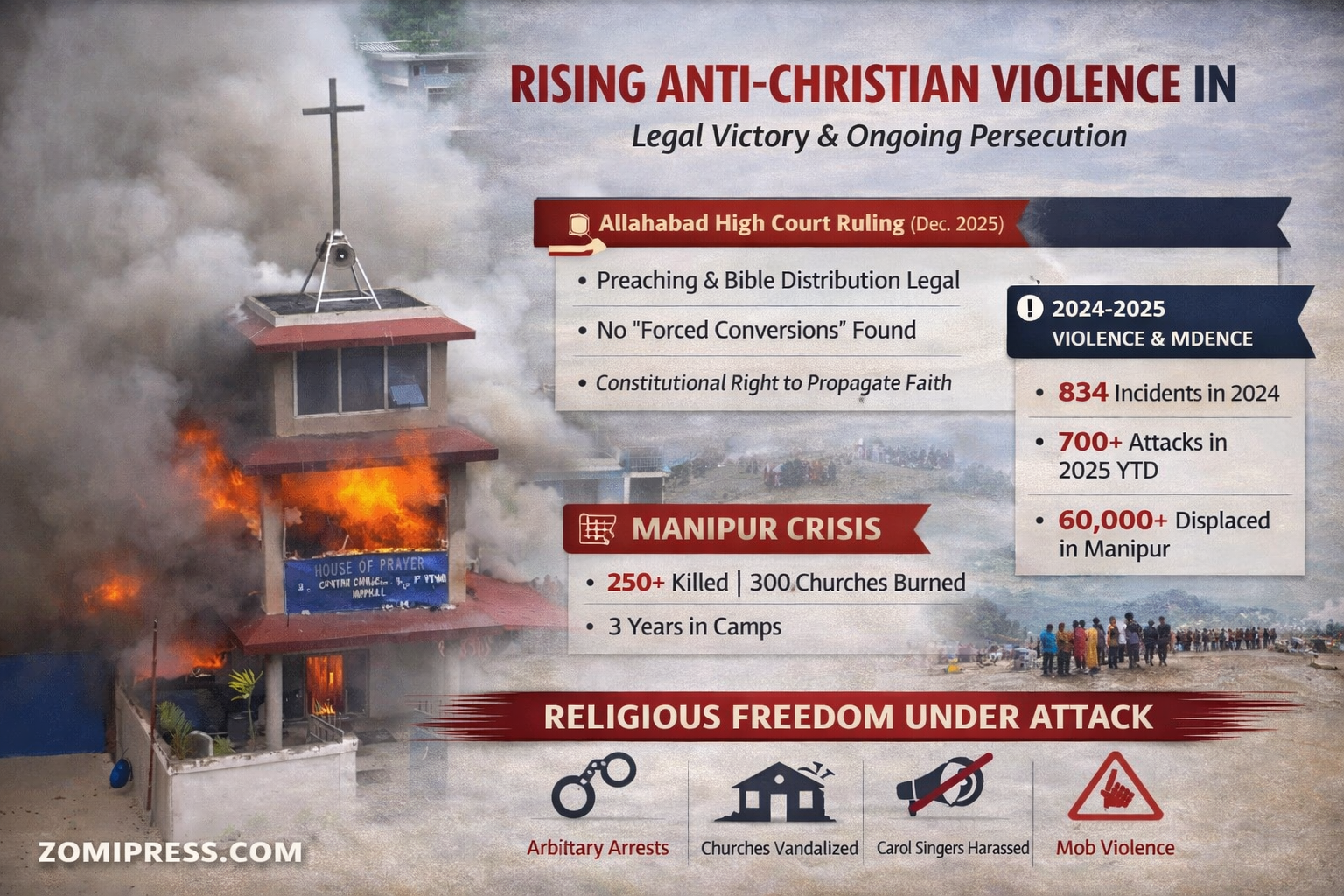
India’s Constitution guarantees every person the right to profess, practise, and propagate their faith (Article 25). Yet anti‑Christian violence and the weaponisation of state anti‑conversion laws continue to undermine these protections. On 6 December 2025, the Allahabad High Court delivered an important corrective: distributing Bibles and preaching the Gospel are not crimes under the Uttar Pradesh Prohibition of Unlawful Conversion of Religion Act, unless there is evidence of force, fraud, or allurement. The bench chastised police for filing cases without a complainant, reaffirming that peaceful evangelism falls squarely within constitutional freedoms. Bishop Ignatius D’Souza of Bareilly cautioned that anti‑conversion laws are being used against innocent Christians and welcomed the ruling as a “judicial pushback” against the misuse of the law.
This landmark judgment comes amid an alarming escalation of attacks on Christians across India. Official indifference, vigilante violence, and legal harassment have created a climate of fear, especially for tribal and Dalit Christians. Below, we examine the scale of the violence, reactions from Christian leaders, and arguments advanced by proponents of anti‑conversion legislation.
A Surge of Attacks and Impunity
Nationwide statistics
Independent monitoring groups document a dramatic rise in anti‑Christian incidents. The United Christian Forum (UCF) verified 834 attacks on Christians in 2024 and reported 706 incidents by November 2025, averaging nearly two attacks every day. The Evangelical Fellowship of India (EFI) recorded 334 cases of violence from January–July 2025. These assaults include:
- Physical violence and threats: mobs beating pastors, tearing up Bibles, and attacking worshippers.
- Vandalism: arson and desecration of churches and prayer halls.
- Harassment and social boycotts: denial of burial rights, disruption of Christmas carol processions, and intimidation of believers.
- Legal harassment: arrests and FIRs under state anti‑conversion laws based on unfounded accusations of forced conversion.
Hotspots include Uttar Pradesh, Chhattisgarh, and Madhya Pradesh, where stringent anti‑conversion laws empower police and vigilantes to arrest Christians with little evidence. Activists from UCF and EFI report that a majority of incidents are triggered by allegations of fraudulent conversions, often made by neighbours or right‑wing groups. news. Many victims are tribal or Dalit Christians, who already face discrimination; arrests compound their marginalization.
Ethnic conflict in Manipur
The gravest example of faith‑based violence remains the ongoing ethnic conflict in Manipur. Since May 2023, clashes between the Hindu Meitei and predominantly Christian Kuki‑Zo communities have killed over 250 people and displaced more than 60,000. Over 300 churches and thousands of homes were destroyed, with Kuki‑Zo Christians bearing the brunt. Two years on, tens of thousands remain in relief camps without adequate security or resettlement, and tensions persist.
Judicial Clarification of Anti‑Conversion Laws
Allahabad High Court ruling (December 2025)
In response to numerous cases filed under the Uttar Pradesh Prohibition of Unlawful Conversion of Religion Act (2021), the Allahabad High Court delivered a pivotal ruling. The bench held that the peaceful distribution of Bibles and evangelistic preaching does not constitute inducement or allurement, and therefore cannot trigger the anti‑conversion statute. The court criticised police for registering cases without any person alleging coercion and reiterated that the law applies only when conversion is achieved through force, fraud, or inducements. Catholic leaders, including A.C. Michael of the United Catholic Forum, applauded the judgment but demanded punitive action against officials who harass Christiansucanews.com.
Earlier bail case (September 2023)
Precedents exist. In September 2023, Justice Shamim Ahmad of the same High Court granted bail to two Christians accused of luring Dalits. The court observed that distributing Bibles and imparting good teachings cannot be termed an allurement for conversion under the Act. It further held that only close relatives of alleged victims may file complaints, limiting third‑party petitions. These judgments establish that evangelism is protected speech and caution against frivolous prosecutions.
Supreme Court intervention (2025)
In November 2025, India’s Supreme Court quashed false charges against more than 90 Christians booked under a state anti‑conversion law. The court admonished police for pursuing cases without evidence and stressed that the Constitution protects voluntary conversions. Though a relief, such rulings have not yet curbed local vigilance committees from filing new cases.
Christian Leaders Speak Out
Prominent clerics and advocacy groups have condemned the violence and misuse of laws:
- Bishop Ignatius D’Souza (Bareilly Diocese) argues that anti‑conversion laws are being weaponised not just against forced conversions but against ordinary religious activity. He notes that third‑party complaints fuel harassment and calls the high‑court ruling a necessary judicial pushback.
- Pastor Joy Mathew (Uttar Pradesh) states that Christians are routinely entangled in unfounded conversion cases; despite court rulings, no meaningful action is taken against officials who persecute them.
- United Christian Forum, in a letter to Home Minister Amit Shah, warned of “unbridled violence” with 706 incidents in 2025, noting that most allegations of forced conversion are baseless. The UCF urged the government to instruct state authorities to protect Christians, citing denial of burial rights, mob attacks, and the stoning of churches.
- The Catholic Bishops’ Conference of India (CBCI) described the escalation of anti‑Christian attacks ahead of Christmas 2025 as “alarming” and demanded swift action against officials spreading hatred. The bishops cited incidents such as carol‑singers being harassed by a ruling party official in Madhya Pradesh and posters calling for a Christmas‑eve bandh in Chhattisgarh.
What Proponents of Anti‑Conversion Laws Say
Arguments from right‑wing organisations and government officials
Supporters of anti‑conversion laws contend that they protect vulnerable communities from coercive or fraudulent conversion. Conservative outlets and political leaders often refer to a “conversion mafia.” For instance, an article in the pro‑Hindutva magazine Organiser claimed that Uttar Pradesh has become a “hotbed for the conversion mafia.” The article detailed a police complaint filed by a local Bharatiya Janata Party (BJP) official alleging that two Christians lured Scheduled Caste villagers with allurements. While the High Court later granted them bail, the article insisted that authorities must curb such “conversion gangs” organiser.org. Similar narratives circulate in nationalist media, portraying missionaries as predatory and conversions as a threat to social cohesion.
State officials echo these concerns. In July 2025, Uttar Pradesh Chief Minister Yogi Adityanath claimed that certain preachers had fixed rates for converting people from different castes and accused them of receiving crores of rupees from abroad. He urged citizens to be “cautious” of religious conversions and said his government had undertaken a major action in Balrampur to expose a conversion conspiracy. Later, a government spokesperson said that since the BJP came to power in 2017, Uttar Pradesh authorities have launched a crackdown on “unlawful religious conversions,” likening it to operations against gangsters and the drug mafia, timesofindia.indiatimes.com. These statements reveal a political narrative that equates conversion with criminality.
Contextualising the claims
Sociologists note that conversions among India’s Dalits and Adivasis often reflect protest against caste oppression and a search for dignity, not inducement. However, right‑wing groups argue that missionaries exploit poverty and offer material incentives. This tension fuels legislation like the anti‑conversion laws in 12 states. Critics note that such laws typically require prospective converts to notify authorities and empower third parties to lodge complaints, inviting harassment opendoorsuk.org.
International Concern and Rankings
International observers have expressed alarm. The U.S. Commission on International Religious Freedom (USCIRF) again recommended that the U.S. Department of State designate India as a “Country of Particular Concern” for engaging in systematic, ongoing, and egregious violations of religious freedom. The advocacy group Open Doors ranked India 11th on its 2025 World Watch List of countries where Christians face severe persecution. These assessments emphasise the gap between India’s constitutional ideals and the lived reality for minority believers.
Conclusion and Call for Justice
The Allahabad High Court’s December 2025 ruling underscores that India’s Constitution protects the peaceful propagation of faith. Yet this legal clarity has not stemmed the tide of violence. Rising attacks, particularly in Manipur, the Hindi belt, and the tribal Northeast, reveal a crisis that cannot be resolved through repression or vigilante justice.
ZomiPress stands with persecuted Christian communities and calls for:
- Strict enforcement of constitutional rights: Authorities must ensure that Article 25 freedoms are upheld, and police should register cases of violence rather than colluding with mobs.
- Reform of anti‑conversion statutes: Laws should be amended to prevent frivolous complaints and misuse against legitimate religious activities.
- Accountability for perpetrators: Whether state actors or vigilante groups, those who attack churches or harass believers must face legal consequences.
- Dialogue and reconciliation: Long‑term peace requires addressing the grievances of tribal communities, ensuring justice for victims in Manipur, and promoting interfaith understanding.
India’s diversity is its strength. Protecting that diversity means safeguarding the rights of its smallest communities. Courts have spoken; now executive action must follow.
What the Court Ruling Means
In December 2025, the Allahabad High Court delivered a significant clarification on the interpretation of the Uttar Pradesh Prohibition of Unlawful Conversion of Religion Act, 2021.
1. Peaceful Preaching Is Not a Crime
The Court affirmed that preaching the Gospel, distributing Bibles, or speaking about one’s faith does not constitute “unlawful conversion” unless there is clear evidence of:
- Force
- Fraud
- Coercion
- Material inducement (“allurement”)
Mere religious expression or persuasion, the Court ruled, falls squarely within the protection of Article 25 of the Indian Constitution.
2. Burden of Proof Lies with the Accuser
The judgment emphasized that allegations alone are insufficient.
Authorities must demonstrate specific, verifiable acts showing unlawful conversion—not assumptions based on religious identity or activity.
3. Reinforcement of Constitutional Guarantees
Article 25 guarantees the right to:
- Profess one’s faith
- Practice one’s faith
- Propagate one’s faith
The Court clarified that “propagate” includes peaceful communication of beliefs, not merely private worship.
4. Limits of Anti-Conversion Laws
While the Court did not strike down anti-conversion laws, it narrowed their misuse, warning against:
- Arbitrary arrests
- Vague FIRs
- Vigilante-driven complaints
The ruling cautions law-enforcement agencies against criminalizing religious minorities without evidence.
5. Why This Matters
This ruling provides:
- Legal protection for pastors, evangelists, and lay believers
- Judicial guidance to lower courts and police
- A constitutional counterweight to rising religious vigilantism
However, legal clarity alone does not automatically translate into ground-level safety, especially in violence-affected regions such as Northeast India.
Legal Citation Appendix
This appendix is designed for use in legal petitions, advocacy letters, international submissions, and policy briefings.
A. Constitutional Law
- Constitution of India, Article 25 — Freedom of conscience and free profession, practice, and propagation of religion.
B. Statutory Law
- Uttar Pradesh Prohibition of Unlawful Conversion of Religion Act, 2021.
- Similar anti-conversion statutes have been enacted in 11 other Indian states (as of 2025).
C. Key Judicial Authority
- Allahabad High Court, Bail and Interpretation Order, December 2025.
Holding that peaceful preaching and Bible distribution do not amount to unlawful conversion absent force, fraud, or inducement.
D. Domestic Human-Rights Documentation
- United Christian Forum (UCF), Annual Reports on Violence against Christians, 2024–2025.
- Evangelical Fellowship of India, Religious Liberty Commission, Incident Monitoring Reports, 2025.
E. International Human Rights Findings
- U.S. Commission on International Religious Freedom (USCIRF), 2025 Annual Report and Issue Update on India.
- Open Doors International, World Watch List 2025 (India ranked 11th).
F. Conflict & Displacement References (Northeast India)
- The Guardian, Manipur Violence and Minority Communities.
- Al Jazeera, Ethnic Conflict and Religious Targeting in Manipur.
- The New Humanitarian, Displacement and Humanitarian Impact in Manipur.
G. Religious Freedom Advocacy
- International Christian Concern, India Persecution Dossiers, 2024–2025.
- Catholic Bishops’ Conference of India (CBCI), Christmas 2025 Public Statements.
Editorial Note:
This legal explainer and citation appendix are provided for informational and advocacy purposes and do not constitute legal advice. They reflect publicly available judgments, statutes, and human-rights documentation.
References
- Allahabad High Court, Judgment on the Uttar Pradesh Prohibition of Unlawful Conversion of Religion Act, 2021, December 2025.
- United Christian Forum (UCF), Annual Report on Violence against Christians in India 2024, New Delhi, 2024.
- United Christian Forum (UCF), Incident Monitoring Report, January–November 2025, New Delhi, 2025.
- Evangelical Fellowship of India, Religious Liberty Commission, Violence and Discrimination against Christians in India, January–July 2025.
- U.S. Commission on International Religious Freedom (USCIRF), 2025 Annual Report: India Chapter, Washington, DC, 2025.
- U.S. Commission on International Religious Freedom (USCIRF), Issue Update: Systematic Religious Persecution in India, November 2025.
- Open Doors International, World Watch List 2025: India Country Profile, 2025, https://www.opendoors.org.
- Catholic Bishops’ Conference of India (CBCI), Statement on Attacks against Christian Communities during Christmas Season, New Delhi, December 2025.
- National Herald (India), “Rising Attacks on Christians and the Misuse of Anti-Conversion Laws,” 2024–2025.
- The Guardian (UK), “Manipur Violence and the Impact on Minority Christian Communities,” 2023–2025.
- Al Jazeera, “India’s Manipur Crisis: Ethnic Conflict, Displacement, and Religious Targeting,” 2023–2025.
- International Christian Concern, Persecution Reports: India, 2024–2025, https://www.persecution.org.