
By Zomi Press | Immigration & Policy Analysis
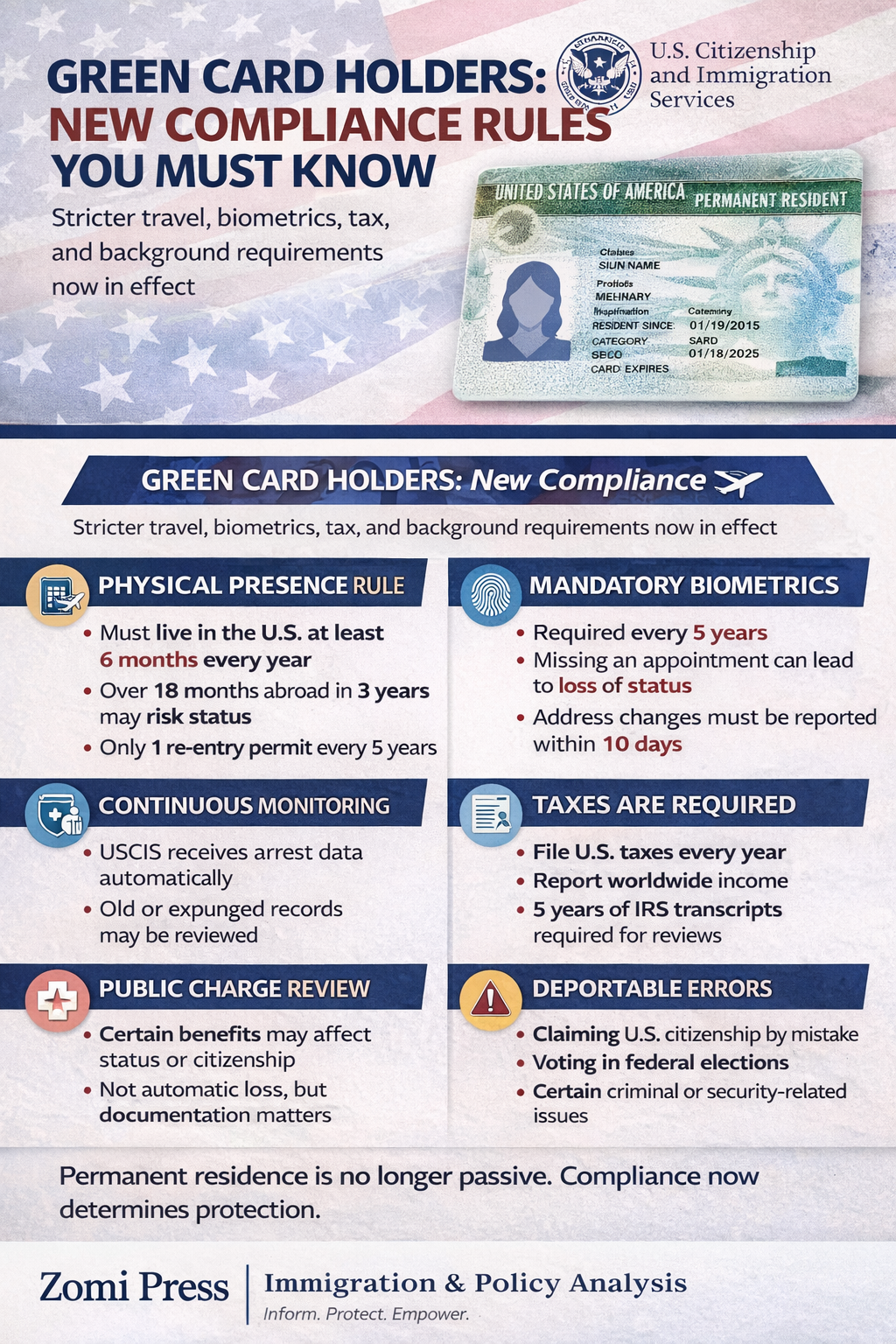
U.S. immigration authorities are enforcing long-standing green card requirements more strictly, increasing scrutiny on lawful permanent residents’ travel, biometrics compliance, tax filings, public benefit use, and background checks.
While no single new law has been passed by Congress changing the definition of permanent residence, U.S. Citizenship and Immigration Services (USCIS), the Department of Homeland Security (DHS), and partner agencies are applying existing laws with greater intensity, aided by expanded data sharing and digital monitoring.
For millions of green card holders, this shift means that permanent residence is no longer passive. Compliance, documentation, and awareness now play a central role in maintaining lawful status.
1. Physical Presence and Travel Outside the United States
USCIS requires green card holders to maintain the United States as their primary place of residence. Extended or repeated stays outside the country can raise questions about whether a person has abandoned permanent residence.
Long absences, patterns of frequent travel, or spending the majority of time abroad may lead immigration officers to conclude that a green card holder no longer intends to live permanently in the United States. Re-entry permits may allow longer absences, but they must be applied for while physically present in the U.S. and do not guarantee admission.
Implication:
Green card holders who travel frequently, care for family abroad, or work internationally face higher risk if they cannot clearly demonstrate strong ties to the United States. Maintaining U.S. housing, employment, tax filings, and documentation of intent to return is now more important than ever.
2. Mandatory Biometrics and Address Reporting
USCIS has legal authority to require biometrics, including fingerprints and photographs, to verify identity and conduct security checks. Missing a biometrics appointment without proper rescheduling or explanation can result in application denial or immigration consequences.
Federal law also requires non-citizens to report address changes to USCIS within ten days.
Implication:
Administrative failures—such as missing mail, failing to update an address, or overlooking an appointment—can now lead to serious immigration consequences even when no crime has been committed. Green card holders must actively monitor their mail, online USCIS accounts, and appointment notices.
3. Continuous Background and Security Checks
USCIS conducts ongoing background and security screening throughout a person’s period of permanent residence, not only at the time of application or citizenship filing. Arrest records and law-enforcement data may be shared with immigration authorities.
In some cases, old or expunged criminal records may still be considered under immigration law, which operates differently from criminal courts.
Implication:
Green card holders with any criminal history—no matter how minor or old—should seek legal advice before filing immigration applications or traveling internationally. Immigration consequences may arise even when criminal penalties no longer apply.
4. Tax Compliance and Reporting Obligations
Under U.S. tax law, green card holders are treated as resident aliens for tax purposes and must file U.S. tax returns every year, reporting worldwide income regardless of where it is earned.
Tax compliance is increasingly reviewed during immigration benefit applications, including green card renewals and citizenship filings.
Implication:
Failure to file taxes is no longer just a financial issue—it can directly affect immigration status. Even individuals with no income must often file returns. Proactive correction of tax issues is strongly preferable to non-filing.
5. Public Charge Considerations
USCIS may review certain public benefit usage when evaluating eligibility for future immigration benefits, including naturalization. Not all benefits are counted, and use of benefits does not automatically result in loss of status.
However, context, duration, and supporting documentation matter.
Implication:
Low-income green card holders and families facing temporary hardship should carefully document why benefits were used and demonstrate efforts toward financial stability. Misunderstanding public charge rules can create unnecessary fear or risk.
6. Grounds of Deportability Under Immigration Law
U.S. immigration law lists specific actions that can place a green card holder into removal proceedings. These include certain criminal offenses, false claims to U.S. citizenship, unlawful voting in federal elections, and national security-related issues.
Importantly, immigration law does not always require intent; mistakes made in good faith can still carry consequences.
Implication:
Green card holders must exercise extreme caution when completing official forms, registering to vote, or responding to government agencies. Small errors can have irreversible immigration consequences.
7. Citizenship Application Review and Testing
Applying for U.S. citizenship triggers a comprehensive review of a green card holder’s entire immigration history, including travel patterns, tax compliance, employment records, and interactions with law enforcement.
The civics and English language requirements remain in place, but interviews increasingly involve deeper questioning and verification.
Implication:
Naturalization is not merely a test—it is a full compliance audit. Applicants should prepare thoroughly and seek legal advice if any aspect of their history raises concern.
What Green Card Holders Should Do Now
Green card holders should actively maintain records of international travel, file U.S. taxes every year, attend all USCIS appointments, report address changes promptly, and avoid criminal exposure of any kind. Being truthful and precise on all immigration forms is essential.
Those who are eligible should consider applying for U.S. citizenship, which offers the strongest protection against changes in enforcement practices.
What This Means Overall
The legal definition of permanent residence has not changed—but the expectations surrounding it have. Enforcement has intensified, tolerance for administrative mistakes has narrowed, and data sharing between agencies has expanded.
Lawful permanent residents who remain informed, organized, and proactive can protect their status. Those who assume their green card is secure without ongoing attention may face unexpected risk.
Editorial Note from Zomi Press
This article reflects the enforcement of existing U.S. immigration law and official guidance from USCIS, DHS, and the IRS. It does not claim the passage of a single new congressional law. All analysis is based on publicly available government sources.
Official Sources
U.S. Citizenship and Immigration Services (USCIS) – Maintaining Permanent Residence
https://www.uscis.gov/green-card/after-receiving-a-decision/maintaining-permanent-residence
USCIS Policy Manual
https://www.uscis.gov/policy-manual
Internal Revenue Service – Green Card Test
https://www.irs.gov/individuals/international-taxpayers/us-tax-residency-green-card-test
Immigration and Nationality Act (8 U.S.C.)
https://uscode.house.gov