
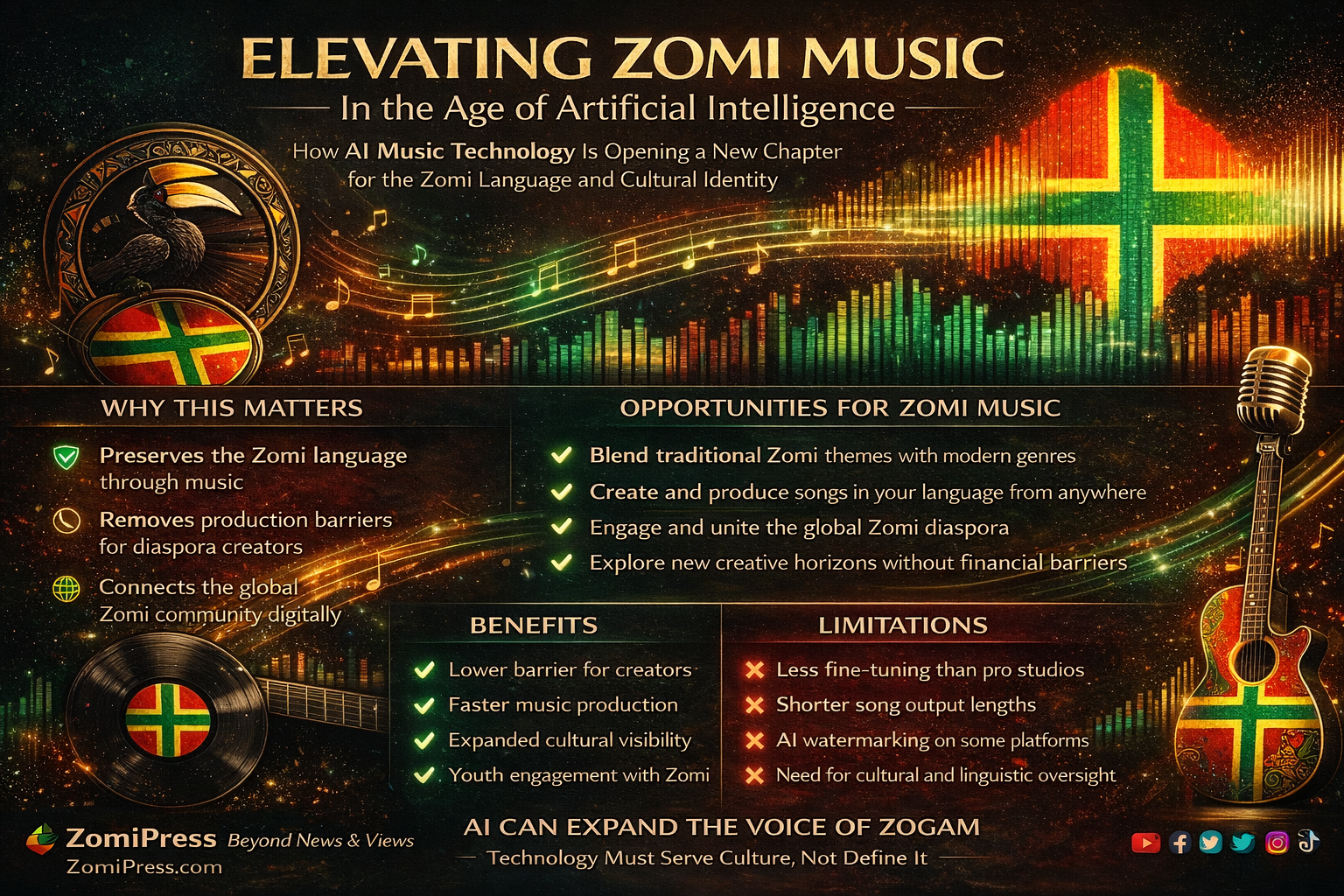
How AI Music Technology Is Opening a New Chapter for the Zomi Language and Cultural Identity
The global music industry is undergoing one of the most significant transformations in modern history. Artificial intelligence is reshaping how music is composed, produced, and distributed. What once required expensive studios, advanced software, and years of technical training can now begin with a simple prompt.
For the Zomi people, this technological shift presents more than convenience. It presents an opportunity.
AI-powered music generation is opening unprecedented doors for Zomi music, Zomi language preservation, and global cultural visibility.
The Changing Landscape of Music Creation
Traditionally, producing high-quality music required:
- Professional recording studios
- Sound engineers and producers
- Expensive equipment
- Distribution networks
Today, AI music systems can:
- Generate melodies instantly
- Produce full instrumental arrangements
- Create studio-quality vocals
- Blend traditional and modern genres
This does not eliminate human creativity. Instead, it removes barriers between inspiration and execution.
For smaller linguistic communities like the Zomi, removing those barriers is transformative.
Why This Matters for the Zomi Language
Historically, “low-resource” languages—those with limited digital data—have struggled in AI environments. Many AI systems have difficulty accurately reproducing tone, pronunciation, and linguistic nuance.
As AI models improve, however, new possibilities emerge:
- Clearer pronunciation in Zomi-language vocals
- More natural tonal reproduction
- Reduced reliance on external translation systems
- Increased Zomi-language digital content
Music becomes one of the most powerful tools for language preservation.
When young people sing in their language, they remember it.
A New Era for Zomi Music
AI music tools now allow creators to:
- Blend traditional Zomi themes with modern pop, acoustic, or worship styles
- Produce demo-quality songs without expensive studios
- Experiment creatively without financial risk
- Create culturally rooted yet globally accessible tracks
This means a young Zomi creator in Tulsa, Kuala Lumpur, Imphal, Tedim, or Melbourne can generate Zomi music from anywhere in the world.
Diaspora no longer limits cultural production.
Connecting the Global Zomi Community
Music has always been a bridge across borders.
For the global Zomi diaspora, AI music technology enables:
- Shared creative collaboration
- Instant distribution through global streaming platforms
- Youth-driven innovation
- Cross-generational engagement
A song created in one country can be heard worldwide within minutes.
This strengthens identity and community cohesion across continents.
Benefits and Limitations
While AI music technology offers exciting possibilities, it must be approached responsibly.
Benefits
- Lower barrier to entry for creators
- Faster music production cycles
- Expanded cultural visibility
- Youth engagement with the Zomi language
Limitations
- Limited fine-tuning compared to professional digital audio workstations
- Shorter output lengths in some systems
- AI watermarking on certain platforms
- Need for cultural and linguistic oversight
AI should serve culture—not define it.
Ethical Responsibility
The Zomi community must approach AI music innovation with:
- Transparency (clearly labeling AI-generated works)
- Cultural integrity (protecting traditional melodies and identity)
- Educational focus (training youth in responsible digital use)
- Governance oversight (ensuring authenticity is preserved)
Technology without guidance risks distortion.
Technology with structure becomes empowerment.
The Road Ahead
The rise of AI music generation marks a cultural turning point.
If used wisely, it can:
- Increase the volume of Zomi-language songs
- Strengthen intergenerational language transmission
- Introduce Zomi culture to global audiences
- Inspire a new generation of digital creators
The Zomi voice has always been strong in the mountains.
Now, in the digital age, it has the opportunity to echo worldwide.
This is not a replacement for tradition.
It is the expansion of tradition.
And the future of Zomi music has just begun.
Published by Zomi Press
Beyond News & Views
https://zomipress.com