
By Zomi Press | Medical & Public Health Policy Desk
Zomi Press — Beyond News & Views
Editor’s Note
Childhood vaccination policy sits at the intersection of medical science, public trust, and government responsibility. In light of recent changes announced by the Centers for Disease Control and Prevention (CDC), Zomi Press presents this policy explainer to help parents, healthcare workers, and the wider community understand what has changed, what has not, and why it matters. This article is intended to inform—not to persuade—and encourages readers to rely on qualified medical professionals for individual healthcare decisions.
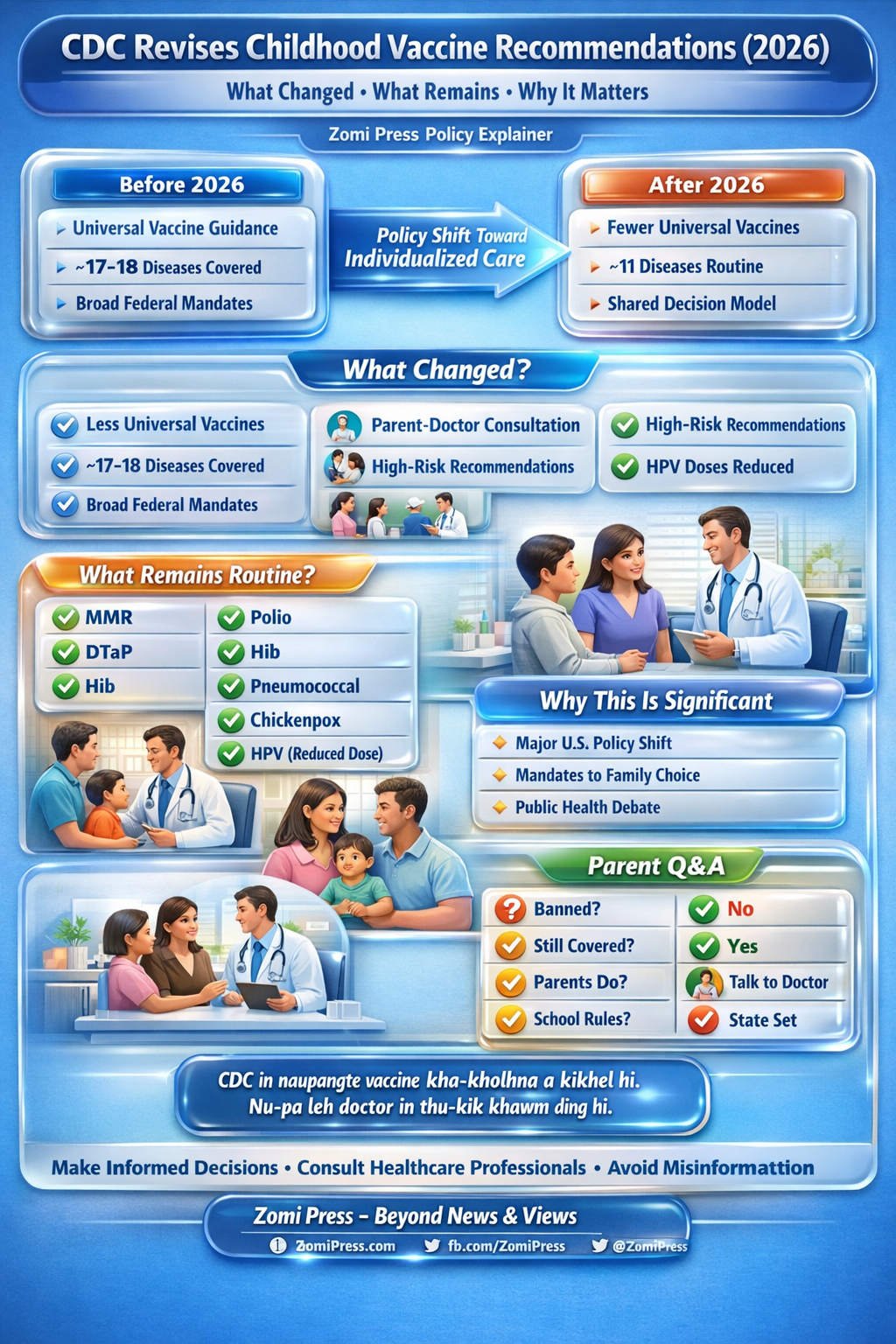
On January 5, 2026, the CDC released a revised U.S. childhood and adolescent immunization schedule, marking one of the most significant adjustments to federal vaccine guidance in decades. The update modifies how certain vaccines are recommended, moving away from a broad universal model toward a framework that emphasizes shared clinical decision-making and risk-based recommendations for selected vaccines.
Federal health officials state that the change followed a comprehensive review comparing U.S. immunization policy with that of other developed nations, as well as a reassessment of how federal guidance can better support informed consent and clinical discretion.
What Changed in the 2026 Immunization Schedule
Under the revised CDC guidance:
- The number of diseases for which vaccines are universally recommended for all children has been reduced.
- Several vaccines previously listed as routine are now recommended primarily through:
- Shared clinical decision-making, or
- High-risk-only guidance based on medical, environmental, or exposure factors.
- Certain vaccines that remain routine have updated dosing recommendations, where evidence supports fewer doses while maintaining effectiveness.
The CDC and the U.S. Department of Health and Human Services (HHS) emphasize that no licensed vaccine has been banned, withdrawn, or declared unsafe. All vaccines referenced in the revised schedule remain available and are covered by insurance when recommended.
Vaccines That Remain Routine for All Children
The CDC continues to recommend routine vaccination for all children against several long-established diseases with a strong public-health impact, including:
- Measles, mumps, and rubella (MMR)
- Polio
- Diphtheria, tetanus, and pertussis (DTaP)
- Haemophilus influenzae type b (Hib)
- Pneumococcal disease
- Varicella (chickenpox)
- Human papillomavirus (HPV), with revised dosing guidance
These vaccines remain the foundation of childhood disease prevention in the United States.
Vaccines Now Guided by Shared or Risk-Based Decisions
Vaccines such as influenza, COVID-19, hepatitis A, hepatitis B, RSV, rotavirus, and meningococcal vaccines are no longer universally recommended for every child at the federal level. Instead, healthcare providers are advised to consider:
- The child’s medical history
- Underlying health conditions
- Local disease prevalence
- Household and community exposure risks
- Parental preferences following informed discussion
This approach reflects a broader policy shift toward individualized care rather than uniform national mandates.
Why the CDC Says the Change Was Made
According to federal health officials, several factors informed the revised schedule:
- The United States historically recommended more routine childhood vaccines than many peer nations.
- High vaccine confidence depends not only on mandates, but also on transparency and trust.
- Greater clinical flexibility may strengthen patient-provider communication and informed consent.
The CDC states that the goal is to maintain disease prevention while allowing healthcare professionals to tailor recommendations to individual circumstances.
Concerns Raised by Medical and Public Health Experts
The policy revision has generated debate among medical professionals and public-health organizations.
Concerns raised include:
- Potential confusion among parents and healthcare providers
- Risk of reduced vaccination coverage for certain diseases
- Increased vulnerability to localized outbreaks, particularly in under-immunized communities
Some state and local health authorities have indicated they may continue broader recommendations at the state level to maintain population immunity.
The Role of Advisory Committees
CDC vaccine recommendations are traditionally guided by the Advisory Committee on Immunization Practices (ACIP), an expert panel composed of specialists in pediatrics, immunology, epidemiology, and public health.
Recent changes in advisory processes and committee composition have drawn calls from experts for continued transparency, rigorous scientific review, and clear public communication.
Why Routine Immunization Still Matters
Despite policy adjustments, decades of medical evidence show that routine childhood immunization remains one of the most effective public-health interventions in history. Vaccination has:
- Nearly eliminated polio in the U.S.
- Dramatically reduced measles, Hib, and hepatitis B infections
- Prevented millions of hospitalizations and deaths over time
Policy changes alter how decisions are made, not the underlying science demonstrating vaccine effectiveness.
What Parents and Families Should Do
Zomi Press encourages families to:
- Consult licensed healthcare professionals
- Ask informed questions about risks and benefits
- Consider local disease conditions and individual health needs
- Avoid misinformation and unverified claims on social media
Medical decisions should be based on evidence, professional guidance, and individual circumstances.
Medical & Editorial Disclaimer
This article is provided for informational and public policy analysis purposes only. It does not constitute medical advice, diagnosis, or treatment. Vaccine decisions should always be made in consultation with a licensed healthcare professional who can assess individual health needs and risks.
Zomi Press does not issue clinical recommendations. Our role is to provide accurate, balanced, and fact-based reporting to support informed public understanding.
Zomi Press Policy Perspective
The CDC’s 2026 revision reflects a broader national conversation about the balance between federal public-health authority and individual medical choice. While increased flexibility may empower families and clinicians, it also places greater responsibility on healthcare systems to ensure clear communication, equitable access, and robust disease surveillance.
Zomi Press will continue to monitor developments and provide responsible, community-focused medical policy analysis.
References
Readers seeking primary and authoritative information may consult the following official sources:
- Centers for Disease Control and Prevention (CDC)
https://www.cdc.gov - CDC Immunization Schedules
https://www.cdc.gov/vaccines/schedules - U.S. Department of Health and Human Services (HHS)
https://www.hhs.gov - Advisory Committee on Immunization Practices (ACIP)
https://www.cdc.gov/vaccines/acip - Vaccines for Children Program (VFC)
https://www.cdc.gov/vaccines/programs/vfc