Download: Zomi representative urges stronger humanitarian support and inclusion at 2026 UN Social Forum
GENEVA, Switzerland — October 30, 2026
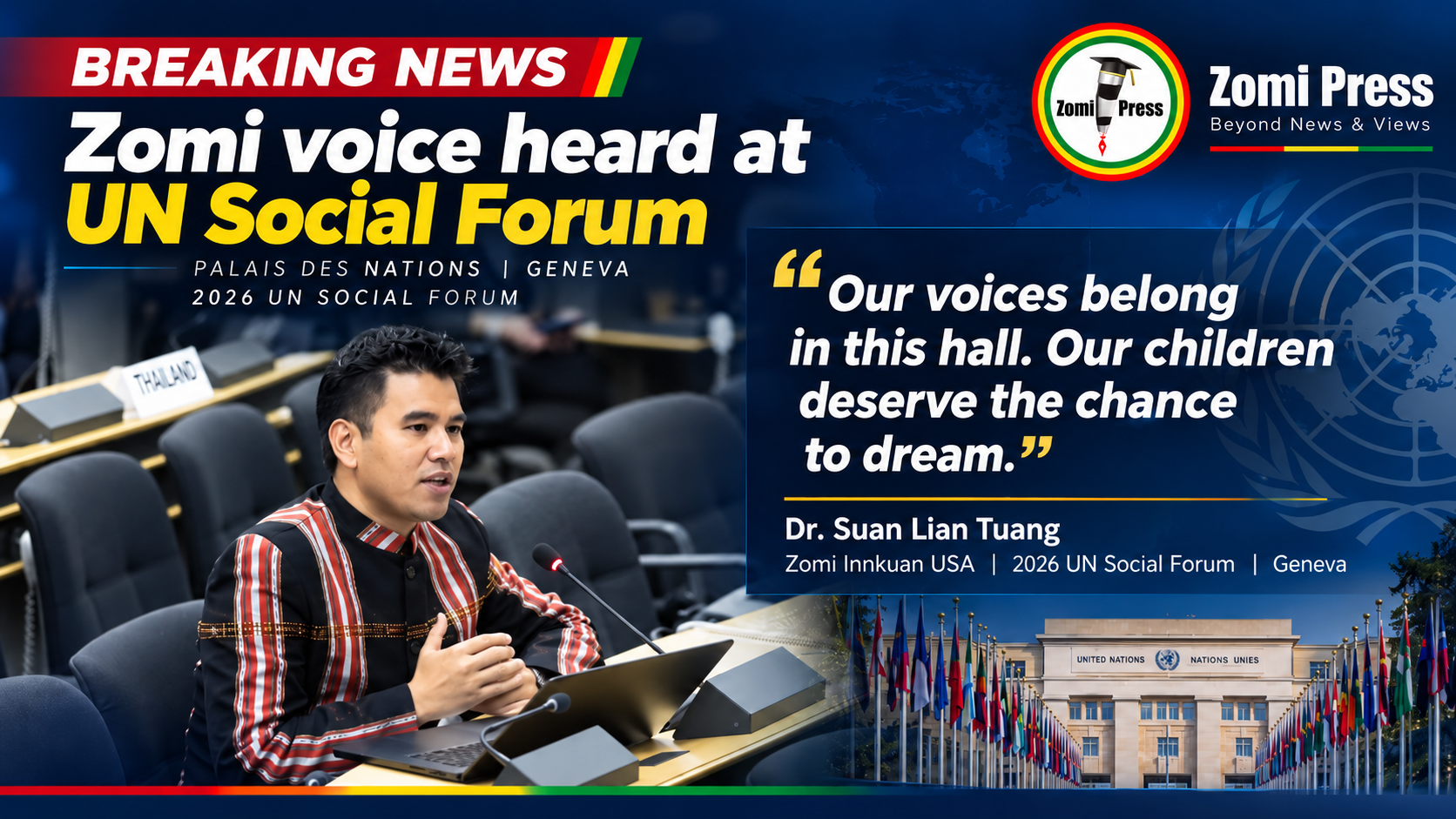
A representative of Zomi Innkuan USA called for sustained humanitarian assistance, greater protection for displaced Zomi communities, and stronger participation of refugee-led organizations during an intervention at the 2026 United Nations Social Forum in Geneva on Friday.
Dr. Suan Lian Tuang, speaking on behalf of Zomi Innkuan USA, also known as Zomi Community USA, addressed delegates at the Assembly Hall of the Palais des Nations as the forum considered international cooperation, solidarity, health and development.
The United Nations confirmed that the 2026 Social Forum was held on October 29–30 at the Palais des Nations in Geneva, with a focus on the contribution of international cooperation and solidarity to the realization of the right of everyone to the highest attainable standard of physical and mental health.
Introducing himself as a Zomi originally from Myanmar, Dr. Tuang told delegates that communities affected by conflict and displacement should not be left outside international discussions on health and development.
“This forum’s promise of health and development for everyone must include communities whose voices too often go unheard,” he said.
He described the United Nations as a source of hope for vulnerable communities and appealed for greater international attention to the situation facing Zomi people in Myanmar and neighboring countries.
According to his remarks, Zomi families in Myanmar continue to experience the effects of conflict and displacement, including disrupted access to healthcare, education and livelihoods. He also drew attention to Zomi refugees and displaced families who have sought safety in countries including Thailand, Malaysia and India, saying they require protection, dignity and opportunities to rebuild their lives.
Two requests to the international community
Dr. Tuang presented two principal requests to the forum.
First, he called for sustained humanitarian assistance and for essential services to reach people in need irrespective of their legal status.
Second, he urged international organizations and humanitarian actors to involve Zomi communities and refugee-led organizations directly in the design of programs and responses affecting them.
“We ask for two commitments,” he said. “First: sustain the humanitarian support and ensure that essential services reach those who are still without aid, regardless of legal status. Second: include Zomi communities and refugee-led organizations as partners in designing responses from the beginning.”
The intervention reflected a broader principle increasingly discussed within humanitarian and development frameworks: that affected communities should participate not only as recipients of assistance but also as partners in identifying needs, shaping programs and implementing responses.
Focus on displacement and dignity
Dr. Tuang also emphasized the situation of Zomi refugees living outside Myanmar, where legal insecurity can affect access to employment, education, healthcare and other basic services.
His remarks are consistent with recent community research and advocacy concerning Zomi refugees in Malaysia. In a 2026 initiative associated with Zomi Innkuan USA, Dr. Tuang described long-standing challenges faced by Zomi refugees who fled conflict, persecution and political instability in Myanmar and sought protection in Malaysia.
Zomi Innkuan USA describes itself as a community-based nonprofit organization established in 2005 to promote the development, welfare and rights of Zomi people in the United States while preserving Zomi identity and cultural heritage.
From Myanmar to Harvard and MIT
Dr. Tuang’s academic background has also been documented by both Zomi Innkuan USA and the Massachusetts Institute of Technology.
Zomi Innkuan USA states that he earned an M.D. from Harvard Medical School and a Ph.D. in Chemistry from MIT, after completing his undergraduate studies at MIT.
MIT previously reported that Suan Lian Tuang was born and raised in Tedim, northwestern Myanmar, and later immigrated with his family to the United States. MIT also recognized him in 2016 as a recipient of the Paul and Daisy Soros Fellowship for New Americans.
During Friday’s intervention, however, Dr. Tuang focused primarily on humanitarian needs and community representation rather than his personal achievements.
“Our voices belong in this hall”
Toward the end of his remarks, Dr. Tuang addressed Zomi people directly.
“To my fellow Zomi: our voices belong in this hall. Our children deserve the chance to dream.”
He encouraged Zomi communities around the world to support one another and work toward a more secure future for younger generations.
He concluded his intervention with the words:
“Wherever we live, let us help one another turn that hope into a brighter future. Mainawt Zomi.”
The appearance placed Zomi humanitarian concerns within an international forum focused on health, solidarity and development and provided another opportunity for Zomi civil society representatives to bring community experiences directly before an international audience.
For Zomi communities affected by conflict, forced migration and prolonged displacement, the central message of the intervention was that humanitarian protection should be accompanied by meaningful participation: communities should have a role in decisions concerning their own future.
Source notes:
• United Nations Office at Geneva / UN Web TV — Social Forum 2026, October 29–30, 2026
• Remarks delivered by Dr. Suan Lian Tuang at the 2026 UN Social Forum, October 30, 2026
• Zomi Innkuan USA organizational and biographical materials
• Massachusetts Institute of Technology biographical record
Zomi Press | Beyond News & Views
ZomiPress.com | @ZomiPress