
By Zo Muan Taang | Zomi Strategic Affairs Correspondent
EXECUTIVE SUMMARY
As resistance forces prepare for what may be the final majorမြို့သိမ်း (town-seizing) operation on Tedim—one of only two junta-held major towns remaining in Chin State, Myanmar—this analysis examines whether the operation risks repeating the devastating Thantlang, Pyidawtha pattern: tactical victory followed by aerial destruction and mass civilian displacement. With 3.7 million internally displaced persons across Myanmar as of March 2026, over 16 million people in need of humanitarian assistance, and resistance forces still lacking meaningful air defense capabilities, the stakes for Tedim’s population have never been higher.
I. The Strategic Imperative
The air in Tedim Township carries the scent of gunpowder, the dread of displacement, and the memory of ashes from Thantlang—a town reduced to skeletal ruins by the junta’s scorched-earth doctrine. Today, as PDF-Zoland and their allies in the Chin Brotherhood finalize plans for a (မြို့သိမ်း) operation against one of the last two major junta strongholds in Chin State, one question demands an honest answer: Are we about to win a battle only to lose a homeland?
Let there be no ambiguity—militarily, the plan to seize Tedim is strategically sound. Of Chin State’s nine townships, only Hakha and Tedim remain under junta control. Seven townships have already been liberated by resistance forces. The Chin Brotherhood controls Matupi, Mindat, Kanpetlet, and Falam. The Chin National Front controls Tonzang. The Arakan Army holds Paletwa. In February 2026, ICNCC Chairman Salai Than Chun Pe declared at the 78th Chin National Day ceremony that resistance forces would intensify operations to liberate the final two urban strongholds. The intention is clear and the momentum is undeniable.
The capture of Kennedy Peak on January 4, 2026—jointly seized by PDF-Zoland and CDF-CDM Siyin—represents a critical tactical gain. Kennedy Peak, at 2,703 meters, dominates the Tedim Road connecting Tedim Town to the Kalay Valley in Sagaing Region. With prisoners of war captured and weapons seized, this operation demonstrated effective coordination between the Chin Brotherhood and Chinland Council factions. The resistance now commands the high ground—literally and strategically.
By capturing Tedim, the resistance would effectively liberate over 90 percent of Chin State, sever the junta’s supply lines from Kalay, and deliver a psychological blow from which the SAC’s Western Command may never recover. On paper, the မြို့သိမ်း looks inevitable.
II. The Thantlang Precedent: A Warning Written in Embers
But strategy must reckon with brutal precedent. The story of Thantlang is the story the resistance cannot afford to repeat.
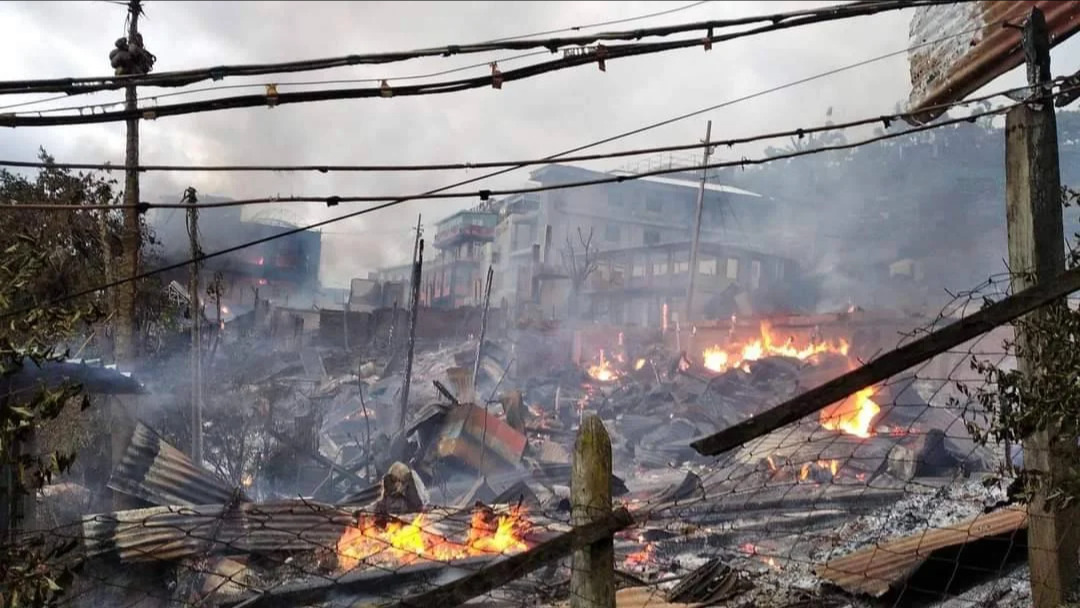
In September 2021, the Myanmar military launched its scorched-earth campaign against Thantlang. Over the following months, junta forces burned over 1,000 buildings—roughly 30 percent of the town, according to satellite imagery analysis by the Washington Post and Human Rights Watch. Twenty-one of the town’s twenty-two churches were destroyed. A pastor was shot dead while trying to extinguish flames; soldiers then cut off his finger for his wedding ring. All 10,000 inhabitants were forced to flee toward the India-Myanmar border. Thantlang became a ghost town—a place where, as one resident described it, “the only thing we hear is gunshots and bomb blasts.”
The junta’s operational doctrine was exposed by a defecting clerk, Hin Len Piang, who revealed that the orders were blunt: “Just clear the insurgency.” When the military could not hold Thantlang, it ensured no one else could live in it. The town was eventually recaptured by resistance forces—the last junta base fell on August 5, 2024—but what they inherited was rubble, not a functioning township.
In May 2024, the first attempt to seize Tedim itself ended in a stalemate. The Chin Brotherhood captured Microwave Hill camp and the electricity office, controlling roughly half the town. But the junta responded with eight bombing raids, twelve airstrikes, and systematic arson—torching over 70 houses in downtown Tedim. Soldiers forced residents from their homes, doused structures in gasoline, and set them ablaze. When homeowners returned to fight the fires, the military forbade re-entry, ensuring total destruction. A commander from PDF-Zoland was killed in the fighting.
The pattern is unmistakable: the SAC’s playbook is consistent. If we cannot hold it, no one will live in it.
III. The Battlefield: Current Force Disposition
A clear-eyed assessment of the current military situation reveals both the opportunity and the peril.
Resistance Forces
Four principal resistance groups operate in Tedim Township: PDA-Tedim (aligned with the Chin National Front), CDF-CDM Siyin, CDF-Hualngoram, and PDF-Zoland (the Chin Brotherhood’s primary force in the area). The January 2026 unification of southern Chin Brotherhood members—CDF-Mindat, CDF-Matupi, and CDF-Kanpetlet—into a consolidated force signals growing organizational coherence. The broader CB-AA (Arakan Army) military and political alliance, formalized in November 2025, provides additional strategic depth and reportedly includes ammunition and logistical support from the AA.
However, the multiplicity of armed factions also introduces friction. In 2024, clashes broke out between the ZRA and CNA along the Myanmar-Mizoram trade route in Tedim Township. The ZFU publicly rejected any claims by the Chinland Council to Tedim. While the February 2025 unity agreement between the CB and CNA was a positive step, underlying tensions over territorial control, political representation, and command authority remain unresolved.
Junta Forces
The junta maintains the 269th Infantry Battalion and police station hill positions in northern Tedim. Since October 2025, the regime has launched counteroffensives along the Kalay-Tedim road and from the Pon Taung-Pon Nya region toward Falam, deploying columns of over 1,000 troops from the Kalay Regional Operations Command. In November 2025, regime forces recaptured the strategic Taingen village—the junction connecting northern and southern Chin State—displacing over 2,000 residents. Junta troops suffered heavy losses in the Falam theater, with at least 100 killed in recent engagements, but they continue to hold critical road junctions.
The regime’s objective is transparent: maintain control of Tedim and recapture Falam as a staging ground for broader reconquest. The junta’s air superiority—including Y-12 bombers, fighter jets, and increasingly, drone capabilities—remains the decisive asymmetric advantage that no amount of ground-level coordination can neutralize.
IV. The Case for Proceeding
Proponents of an immediate operation present three compelling arguments:
- Strategic Collapse of the Western Front.Without Tedim, the junta cannot reinforce its remaining positions in Chin State. The entire northern front collapses, and the Kalay Valley—the regime’s primary logistics corridor—becomes exposed. The resistance would control the Indian border crossing, cutting a critical supply and intelligence artery.
- Political Leverage.A unified military victory would dramatically strengthen the Chin Brotherhood and ICNCC’s negotiating position vis-à-vis the NUG, pushing for a genuine federal arrangement. The ICNCC has already issued joint statements with the CRPH, NLD, NUCC, and NUG on common political positions. A liberated Chin State transforms these from aspirational documents into demonstrable governance capacity.
- Momentum and Timing.Waiting allows the SAC to dig in deeper, as evidenced by its November 2025 counteroffensive columns. The resistance controls the high ground at Kennedy Peak, holds coordination advantages with the AA alliance, and possesses the morale boost of recent victories in Falam and across southern Chin State. Delay invites junta consolidation.
V. The Case for Caution: The Cost of Ashes
The counter-arguments, however, are devastating:
- Humanitarian Catastrophe.Tedim still hosts thousands of internally displaced persons from surrounding villages—many of whom are refugees-within-refugees, having already fled Tonzang. During the May 2024 fighting, mass displacement was immediate: over 4,000 of Sakawlan ward’s 5,200 residents fled; 3,700 of Myoma ward’s 3,800 abandoned their homes. Urban combat will kill them. Junta airstrikes will compound the toll. Myanmar already has 3.7 million IDPs as of March 2026, and 16.2 million people requiring humanitarian assistance.
- Destruction of Irreplaceable Infrastructure.Tedim is not merely a military objective. It contains a hospital, a market complex, schools, and churches central to Zomi community life. Once leveled, the resistance inherits a graveyard, not a capital. Thantlang’s example is instructive: its reconstruction has barely begun years after the fighting, with the Chin diaspora shouldering an estimated $4 million in IDP support costs alone.
- Logistics and Fuel Crisis.Fuel supply restrictions to Chin State—combined with the junta’s control of the Kalay corridor—create severe operational constraints. Without fuel, the resistance cannot evacuate the wounded, transport relief supplies, or sustain positions against counter-attacks. The World Food Programme has warned that over 12 million people in Myanmar face acute hunger in 2026, with one million reaching emergency levels.
- Internal Fragmentation Risk.The January 2025 dispute between the Zomi Federal Union and Chinland Council over Tedim operational authority reveals a fault line that the junta could exploit. Four separate resistance factions in one township, with competing chains of command, risk not only operational confusion but post-liberation governance chaos. As political commentator U Than Soe Naing observed, the proliferation of approximately 14 Chin armed groups has already reduced the pace of operations against the military council.
- The Air Defense Deficit.This is the fatal variable. The junta has conducted extensive airstrikes across Chin State. In the Tedim theater alone, Y-12 bombers have struck civilian areas, including stadiums, factories, and residential neighborhoods. Without credible air defense or anti-aircraft capability, every captured position is a target, and every civilian in the battle radius is at risk.
VI. The Most Probable Outcome: An Honest Assessment
My analysis, grounded in the documented pattern of warfare in Chin State since 2021, is unflinching.
The resistance will likely take Tedim. And then the junta will destroy it.
We are looking at a Pyrrhic victory—a tactical success that becomes a strategic wound. The flag will change, but the rubble will remain. The junta will lose the town, but the Zomi people will lose their homes. The Chin Brotherhood will claim victory, but the IDP camps will swell by thousands more souls joining the 3.7 million already displaced across Myanmar.
This is the brutal arithmetic of the Spring Revolution in the ethnic states: You can only win if you can hold. You can only hold if you can protect. And you can only protect if you have air defense. Today, the resistance has none.
The April 2026 killing of three Indian nationals in Tedim—arrested by PDA-Tedim resistance forces, then killed under circumstances still under investigation—illustrates the dangerous chaos of contested territory. This incident, reported by The Diplomat, signals how ungoverned the Tedim corridor has become, with implications for regional stability and India-Myanmar border security that extend well beyond Chin State.
VII. Recommendations: Win the Town, Save the People
I do not write this to discourage the revolution. I write this because I have studied the photographs of Thantlang—row after row of charred foundations where Zomi families once lived, laughed, and worshipped. I write this because the Chin diaspora has already contributed millions to sustain displaced communities, and another mass displacement event will stretch an already exhausted support network to its breaking point.
If the PDF-Zoland, Chin Brotherhood, and allied resistance forces proceed with the မြို့သိမ်း on Tedim without the following preconditions, they will not be liberating a town. They will be signing its death warrant.
Precondition 1: Civilian Evacuation Protocol
A comprehensive, pre-announced evacuation plan with secured corridors to Kalay, Indian border areas, and nearby villages must be operational before any offensive begins. The May 2024 experience—where residents who stayed were trapped by airstrikes they did not anticipate—must not be repeated.
Precondition 2: International Humanitarian Guarantees
The ICNCC and NUG must secure pre-positioned humanitarian commitments from international organizations and the Chin diaspora network. Post-conflict relief cannot be an afterthought. The UN’s 2026 Humanitarian Response Plan has already noted that only a quarter of required funding was received in 2025—the resistance cannot assume aid will materialize.
Precondition 3: Air Defense Acquisition
This is the strategic imperative that transcends Tedim. Without MANPADS or equivalent anti-aircraft systems, every liberated town remains a target. The Chin Brotherhood-AA alliance should prioritize the acquisition and deployment of air defense assets before, not after, the offensive.
Precondition 4: Unified Command Structure
The four resistance factions in Tedim must establish a single operational command for this campaign. The January 2026 CDF unification in the south provides a model. A fragmented offensive risks friendly-fire incidents, command confusion, and post-liberation territorial disputes that the junta will exploit politically and militarily.
Precondition 5: Fuel and Medical Supply Corridors
Secure pre-positioned fuel depots and medical supply chains. The February 2026 seizure of junta ammunition—including 122mm rockets, 120mm mortar shells, and RPG rounds—near the Manipur River demonstrates that captured materiel can supplement but not replace a sustained logistics chain.
VIII. Conclusion
Victory without a home to return to is not victory. It is exile by another name.
The revolution needs towns that are free and livable. Tedim can still be that—but only if the resistance changes its calculus. The courage of the Zomi fighters is beyond question. Their sacrifice has already liberated seven townships. But courage without preparation is recklessness, and recklessness with civilian lives is unforgivable.
Delay the assault. Build air defense. Evacuate the non-combatants. Secure fuel and medicine. Unify command.
Otherwise, the next article written about a Zomi town will not chronicle its liberation. It will record its epitaph.
ABOUT THE AUTHOR
Zo Muan Taangis a Zomi strategic affairs analyst and independent author, specializing in Myanmar’s Spring Revolution, ethnic resistance movements, and Zomi political affairs. The views expressed in this article are the author’s own.
SOURCES AND REFERENCES
- The Irrawaddy – Fighting Grips Chin State Town Amid Myanmar Junta Airstrikes (May 2024)
- BNI Online – Junta and Chin Resistance Forces Share Control Over Tedim Town (2024)
- BNI Online – Chin Resistance Coalition Recaptures Kennedy Peak Military Outpost (Jan 2026)
- Mizzima – Resistance Leaders Pledge to Seize Remaining Towns (Feb 2026)
- DVB – Counteroffensive from Sagaing Region Displaces 70,000 Chin State Residents (Nov 2025)
- DVB – Rival Chin Factions Dispute Over Plans to Seize Tedim (Jan 2025)
- Mizzima – Myanmar Junta Troops Suffer Heavy Losses in Falam (Feb 2026)
- UNHCR Myanmar Operational Data Portal – 3,708,300 IDPs as of March 30, 2026
- UN Myanmar – Humanitarian Needs and Response Plan 2026: 16.2 million in need
- Human Rights Watch – A Month of Fires in Thantlang, Myanmar (2021)
- The Washington Post – How Myanmar’s Military Targeted Civilians by Burning Chin State Villages (2021)
- The Diplomat – Three Indian Nationals Killed in Myanmar Civil War (April 2026)
- Wikipedia – Chin Brotherhood; Operation Chin Brotherhood; Battle of Thantlang (updated 2026)
- Development Media Group – AA, Chin Brotherhood Form Alliance to Resist Junta Offensive (2025)
- Myanmar Peace Monitor – ICNCC, CC, CB: Key Chin Forces to Watch (2025)
© 2026 ZomiPress.com. All rights reserved. This article may be reproduced with attribution.