
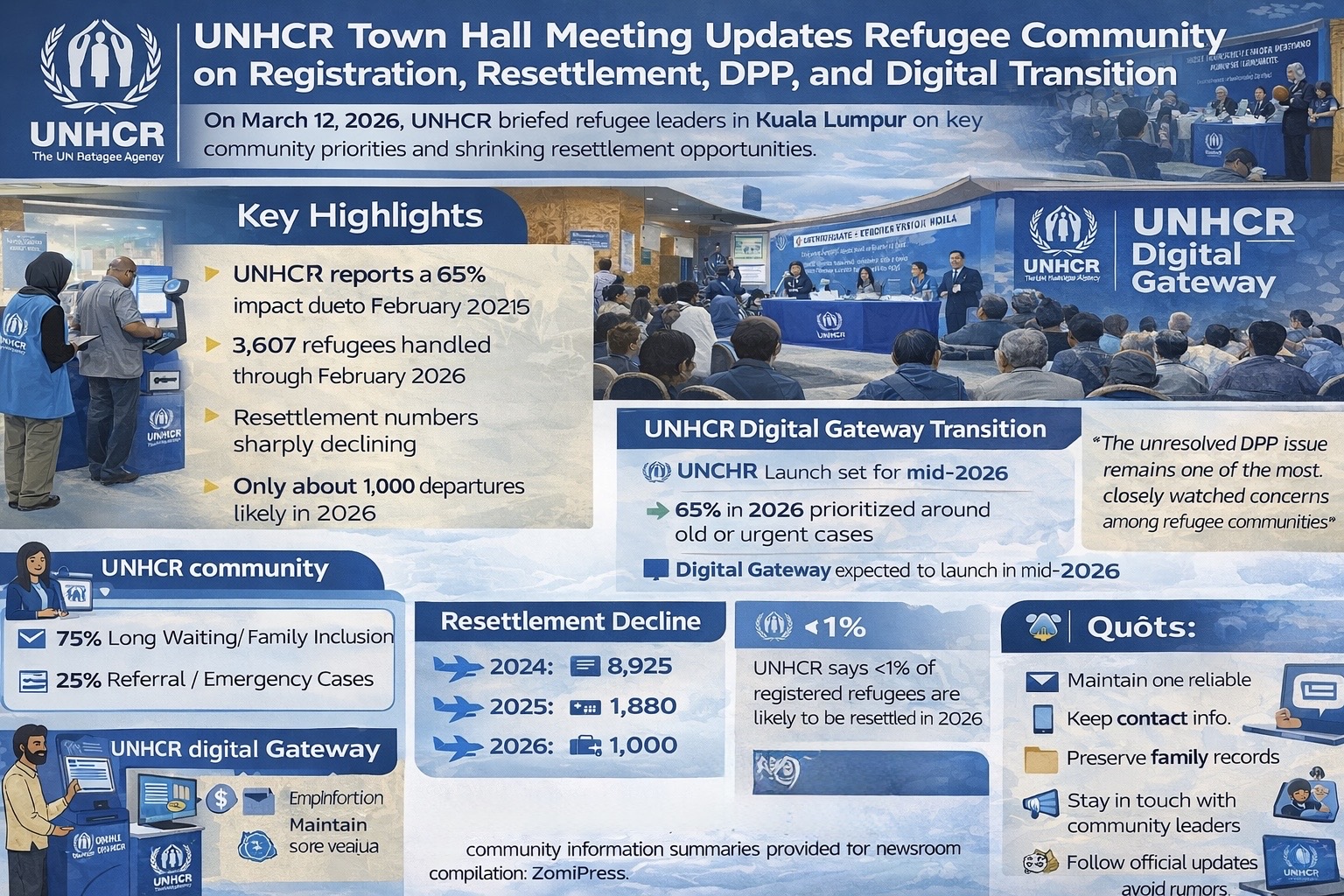
At its 2026 first-quarter Community Leaders Town Hall in Kuala Lumpur, UNHCR briefed refugee leaders on budget pressures, registration priorities, family inclusion, unresolved DPP concerns, shrinking resettlement opportunities, complementary pathways, and the rollout of a new Digital Gateway system.
By Refugee & Asylum Department, ZomiPress Office
Date: March 12, 2026
Category: Refugee Affairs / Humanitarian / Malaysia / UNHCR
Location: UNHCR Office, Kuala Lumpur, Malaysia
🔎 Key Highlights
- 🏢 UNHCR says budget shortfalls have affected about 65% of operations
- 📝 Registration in 2026 is being prioritized around long-pending cases, family inclusion, urgent protection cases, and referrals
- 👥 3,607 refugees had received registration-related processing by February 2026
- 📄 11,796 UNHCR documents had been issued by the end of February 2026
- 📞 Reachability remains a serious problem, with response rates reportedly below 15% in some cases
- 🪪 The DPP issue remains unresolved, with no confirmed policy details yet
- 🌐 The Digital Gateway system is expected to begin rollout in mid-2026 and replace current web-based processes by December 2026
- ✈️ Resettlement opportunities have sharply declined: 8,925 departures in 2024, 1,880 in 2025, and only about 1,400 anticipated in 2026
- 🇺🇸 The US Resettlement Program has been suspended since January 2025, with only the most vulnerable cases reportedly under limited review
- 🛂 Resettlement selection is based on vulnerability and protection needs, not nationality, time spent in Malaysia, or simple request volume
- 🤝 Complementary pathways and private sponsorship were highlighted as alternative routes outside UNHCR’s standard resettlement channel
A UNHCR Community Leaders Town Hall Meeting was held on March 12, 2026, from 10:00 a.m. to 1:00 p.m. at the UNHCR Office in Kuala Lumpur, bringing together refugee community leaders and community-based organizations for a wide-ranging briefing on registration, family inclusion, documentation, resettlement, digital systems, and refugee case management in Malaysia.
The meeting opened with remarks by Ms. Aubin, who outlined the scale of the financial pressure now facing UNHCR’s operations. According to the meeting briefing, current funding disruptions and the suspension or reduction of international assistance have forced UNHCR to reduce or otherwise affect approximately 65 percent of its office-based operational capacity.
Even with those constraints, UNHCR said it would continue to engage relevant departments and institutions to strengthen refugee protection and internal safety in Malaysia.
“The meeting offered a sobering message: refugee protection systems in Malaysia are still moving, but they are moving under pressure.”
📝 Registration Priorities in 2026
A major portion of the town hall focused on the Registration Department’s work and the strategy now being applied to new registrations and family-linked case handling.
According to the information shared, UNHCR is currently giving priority to:
- Refugees facing life-threatening medical conditions
- Individuals facing serious protection or security risks
- People who have waited for years for a new registration or family-linked card inclusion, especially those pending from 2022 and earlier
- Cases raised through community referrals
- Individuals who have made contact through the UNHCR hotline and requested appointments
UNHCR also explained that the 2026 registration work will center on two core tracks:
- Family inclusion
- Urgent and long-pending cases
Additional community summaries indicated that UNHCR’s 2026 registration strategy is being described in some briefings as roughly:
- 75% focused on long-pending family inclusion and new registration requests
- 25% focused on referral cases, especially emergency referrals
By the end of February 2026, the meeting reported that 3,607 refugees had already received registration-related processing.
Community updates further described that:
- 83% of completed registration-related processing involved long-pending cases
- 17% involved referral cases
- 670 refugees from the CBO lists had reportedly completed registration processing
“For many refugee families, 2026 may be defined by three realities at once: limited capacity, selective prioritization, and digital transition.”
📞 Communication Problems and Appointment Access
The meeting also addressed one of the most persistent frustrations in the refugee system: communication failure.
UNHCR and community representatives noted that many applicants remain difficult to contact. Some community updates indicated a reachability rate below 15 percent, making it difficult for UNHCR to progress cases when applicants cannot be reached.
For that reason, refugees were strongly urged to:
- Update phone numbers immediately if they change
- Coordinate updates through recognized community organizations where needed
- Remain reachable for calls related to registration and documentation
UNHCR also indicated that appointment scheduling may be influenced by:
- The date of the registration request
- Whether the person has contacted the UNHCR hotline
- Whether the case appears on lists submitted by recognized UNHCR-linked community organizations
Community leaders were reminded that community organizations should remain the main channels for written communication and structured submission.
🪪 DPP Issue Remains Unresolved
The town hall revisited the much-discussed issue of DPP (Dokumen Pendaftaran Pelarian).
UNHCR said it still lacks definitive information on the matter and that no final policy details are available. At the same time, officials stated that they are continuing to work closely with the Malaysian government on the issue.
That means refugee communities should remain cautious about rumors or unconfirmed assumptions. While many continue to watch the issue closely, UNHCR did not present the DPP as a finalized operational framework.
“The unresolved DPP issue remains one of the most closely watched concerns among refugee communities.”
🌐 Digital Gateway Will Replace Current Website-Based Processes
Another major update from the meeting concerned the rollout of the UNHCR Digital Gateway, a new online system.
According to the information shared:
- The new system is expected to begin rollout around mid-2026
- By December 2026, the current UNHCR web-based process, including existing Refugee Malaysia web functions, is expected to be phased out in favor of the new structure
- Future communication will depend increasingly on individual or family email accounts
Refugees were urged to prepare now by ensuring that each family maintains:
- One stable email account
- Continued access to that email
- Secure password control
- Basic digital ability to use email and follow online case updates
Community organizations also raised a practical concern: because many refugees may face technical difficulties later, a refugee community representative reportedly proposed that a secondary organization email be accepted as a backup communication channel for community members. UNHCR officials said the proposal would be considered.
This transition may be among the most significant technical changes refugee households face in 2026.
📄 Documents and Case Processing
UNHCR reported that by the end of February 2026, it had processed or issued 11,796 documents across multiple categories, including:
- Document renewals
- New registration
- Lost document replacement
- Late renewals
The meeting also underscored the importance of preserving family composition records and ensuring documentation is complete, as incomplete records continue to slow case progression.
✈️ Resettlement Outlook: A Sharp Decline
One of the most consequential parts of the town hall concerned third-country resettlement.
According to the figures shared:
- 2024: 8,925 departures
- 2025: 1,880 departures
- 2026: 1,400 anticipated departures
However, community updates indicate that IOM is expecting only around 1,000 departures in 2026.
UNHCR and community organizations also emphasized that, in practice, fewer than 1 percent of registered refugees in Malaysia are eligible for resettlement in 2026.
In addition, one source summary noted that, due to Australia-related verification requirements, about 1,000 people were able to depart for Australia in 2025.
Taken together, these numbers reveal a steep decline in resettlement access.
“The sharp decline in resettlement numbers highlights a growing gap between protection needs and durable solutions.”
🛂 How Resettlement Selection Works
Community updates from the town hall repeatedly stressed that resettlement selection is not based on:
- How long has a refugee lived in Malaysia
- Whether someone asked for resettlement
- Nationality alone
Instead, selection is based on vulnerability and protection needs.
The seven standard UNHCR resettlement categories cited in the briefings were:
- Legal / Physical Protection Needs
- Survivors of Violence or Torture
- Medical Needs
- Women and Girls at Risk
- Family Reunification
- Children and Adolescents at Risk
- Lack of Durable Solutions
One community summary further stated that, in practice, those considered extremely vulnerable, especially those meeting multiple criteria, may be more likely to receive attention under very limited quotas.
🇺🇸 US Resettlement Program and Related Clarifications
Community information updates also included important clarification about the US Resettlement Program (USRAP).
According to those summaries:
- The US Resettlement Program has been suspended since January 2025
- Only the most vulnerable cases are currently subject to limited review
- Closure of a US case does not automatically improve eligibility for another country
- A US case cannot simply be transferred to another country’s resettlement track
This clarification is important because many refugees continue to assume that a stalled or closed U.S. case automatically opens another resettlement path. The information shared at the meeting suggests that such assumptions are incorrect.
🤝 Complementary Pathways and Private Sponsorship
Another significant topic raised in community information sharing following the meeting was complementary pathways.
These are pathways to third countries that exist outside the standard UNHCR resettlement program. According to the community updates:
- Third-country governments generally manage such programs
- UNHCR is not part of the application process
- UNHCR cannot check the application status
- cases usually require a family member abroad or another sponsor to initiate the process
Community updates also encouraged greater attention to:
- private sponsorship routes
- education-based pathways, such as Australia’s RSSP-related opportunities for refugee students
These were presented not as guaranteed solutions, but as additional avenues refugees may explore where available.
🧭 RSD / RST Interviews
The meeting also addressed confusion around RSD and RST interview call-ups.
According to the information shared, such interviews are not determined by the number of years someone has spent in Malaysia, but rather by the condition and characteristics of the individual case file.
That clarification matters for many long-waiting refugees who assume that time alone should automatically trigger case advancement.
📣 Community Guidance
The practical message to refugee communities from the various information summaries was consistent:
- Create and maintain one email account per family
- Keep phone numbers updated
- Stay in close communication with recognized community leaders and organizations
- Report serious medical or protection vulnerabilities through proper community channels
- preserve family records and supporting documents
- Prepare early for Digital Gateway
- Follow official updates through community organizations, not rumor networks
The March 12, 2026, UNHCR Community Leaders Town Hall Meeting in Kuala Lumpur offered one of the clearest recent windows into the pressures and priorities shaping refugee case management in Malaysia.
The message was both practical and sobering.
UNHCR continues to operate but is under severe financial strain. Registration remains active, but selectively prioritized. Resettlement remains possible, but at sharply reduced levels. The DPP issue remains unsettled. And a major digital shift is coming, one that will require refugee families to be more technologically prepared than before.
For refugee communities, the path ahead will likely depend not only on protection needs and institutional capacity, but also on documentation, responsiveness, community coordination, and readiness for structural change.
“Budget shortfalls have affected approximately 65 percent of UNHCR operations, underscoring the strain now weighing on refugee service systems in Malaysia.”
“The unresolved DPP issue remains one of the most closely watched concerns among refugee communities.”
“Less than one percent of registered refugees in Malaysia may be considered for resettlement in 2026 under current projections.”
“For many refugee households, access to one stable email account may soon become essential for navigating the new UNHCR Digital Gateway system.”