
Download: Israel Recognizes Somaliland: A Strategic Shift Reshaping the Horn of Africa and Global Security
By International Affairs Desk — Zomi Press: Beyond News & Views
Published: December 2025
Introduction: A Diplomatic Moment That Redefined the Map
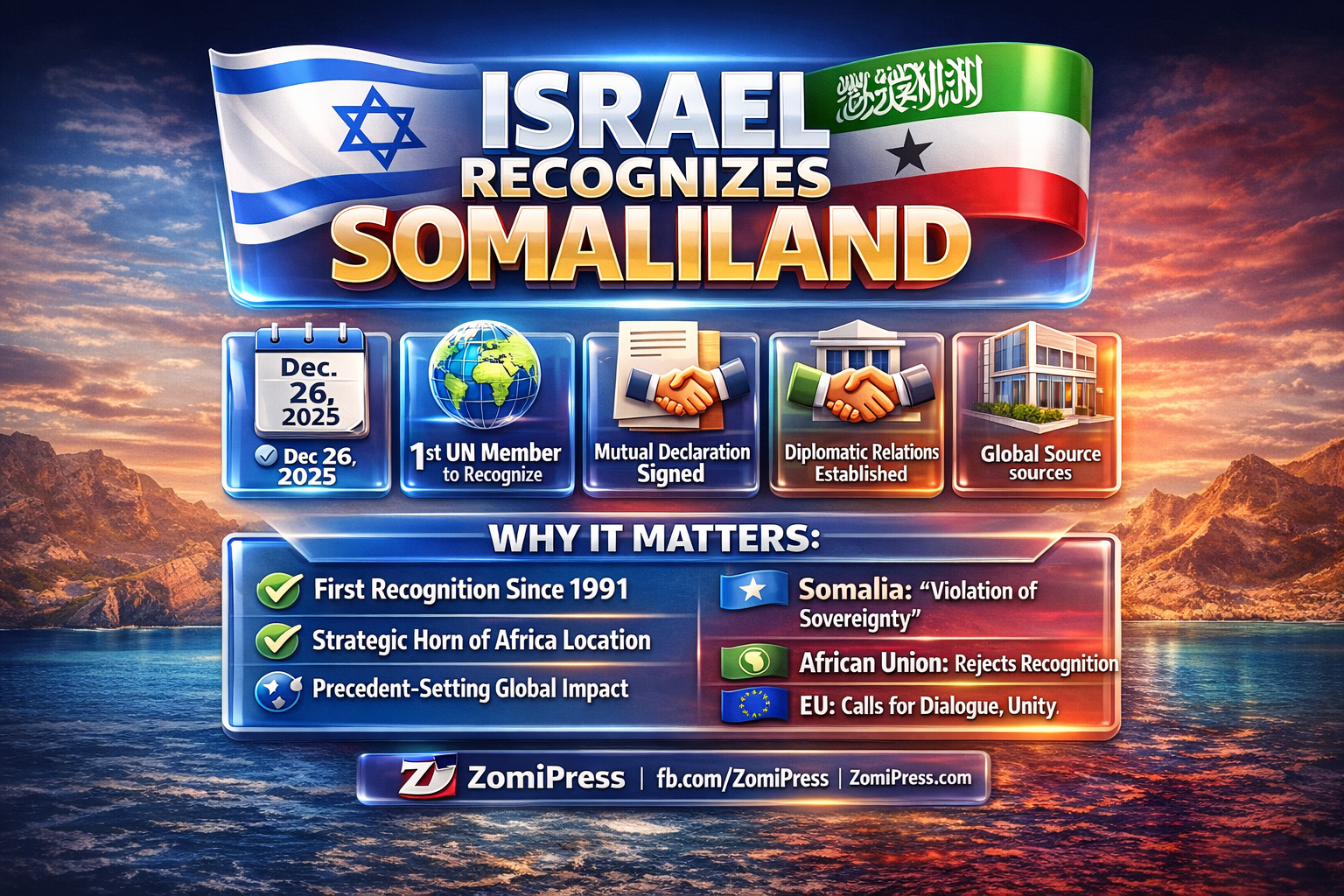
On 26 December 2025, Israel formally recognized the Republic of Somaliland as an independent and sovereign state. With that decision, Israel became the first United Nations member state to extend official recognition to Somaliland since it reasserted its independence in 1991.
The announcement was accompanied by plans to establish mutual diplomatic missions, signaling not merely symbolic recognition but the beginning of formal bilateral relations. Celebrations erupted in Somaliland’s capital, Hargeisa, where citizens marked what many described as the end of a 34-year diplomatic isolation.
This move has generated sharp reactions from Somalia, the African Union, and several international actors, while simultaneously reshaping strategic calculations in the Horn of Africa, the Red Sea, and beyond.
What Is Somaliland?
Somaliland occupies the territory of the former British Somaliland Protectorate, which gained independence on 26 June 1960. Five days later, it voluntarily united with the former Italian Somaliland to form the Somali Republic. That union, however, collapsed following decades of political marginalization, civil war, and the total breakdown of the Somali state.
In May 1991, Somaliland withdrew from the union and reasserted its sovereignty within its colonial-era borders.
Since then, Somaliland has:
- Maintained effective territorial control
- Built functioning democratic institutions
- Held competitive, peaceful elections
- Preserved internal security in a volatile region
- Operated its own executive, legislature, judiciary, currency, and security forces
Despite meeting the practical criteria of statehood, Somaliland remained unrecognized for more than three decades, largely due to international reluctance to challenge Somalia’s territorial claims.
Why Israel’s Recognition Matters
Israel’s decision breaks a long-standing international stalemate and introduces a new principle into the recognition debate: governance over inertia.
For decades, many states privately acknowledged Somaliland’s stability and democratic record while publicly deferring recognition in favor of preserving existing diplomatic norms. Israel’s move transformed that quiet acknowledgment into official policy.
According to Israeli officials, the recognition reflects a reality-based foreign policy—one that prioritizes stability, security, and functional governance over prolonged diplomatic paralysis.
Strategic Geography: The Bab el-Mandeb Factor
Somaliland’s importance extends far beyond its borders. It sits adjacent to the Bab el-Mandeb Strait, one of the world’s most critical maritime passages, linking the Red Sea to the Indian Ocean.
Approximately 10–12 percent of global maritime trade, including energy shipments, passes through this corridor. Instability in this zone directly affects:
- Global supply chains
- Energy markets
- East–West shipping routes
- Regional and international security
For years, regional tensions and proxy conflicts—particularly involving Iran—have threatened the security of this corridor. Israeli–Somaliland cooperation introduces new dynamics in intelligence sharing, maritime security, and early-warning capabilities, shifting the strategic balance in the Red Sea.
Regional and Global Reactions
Somalia’s Objection
The Federal Republic of Somalia strongly condemned Israel’s recognition, calling it a violation of Somalia’s sovereignty and territorial integrity. Mogadishu maintains that Somaliland remains an integral part of Somalia under international law.
African Union’s Position
The African Union reiterated its long-standing policy of preserving colonial-era borders to prevent fragmentation across Africa. AU officials warned that recognizing Somaliland could set a precedent for other separatist movements.
European Union and Others
The European Union acknowledged Israel’s decision while reaffirming its support for Somalia’s territorial integrity and encouraging dialogue between Hargeisa and Mogadishu.
Several Middle Eastern and Islamic states criticized the move, framing it as geopolitically motivated. However, beyond diplomatic statements, no coordinated punitive action has followed.
The Legal and Political Debate: Secession or Dissolution?
A central dispute lies in how Somaliland’s claim is characterized.
- Somalia’s view: Somaliland is a secessionist region.
- Somaliland’s view: It is reclaiming independence after the collapse of a voluntary union between two sovereign states.
Under the Montevideo Convention criteria—defined territory, permanent population, effective government, and capacity to conduct foreign relations—Somaliland satisfies all requirements of statehood. International law, however, does not compel recognition; it remains a political decision exercised by individual states.
Israel’s recognition does not rewrite international law, but it challenges the assumption that effective governance can be indefinitely ignored.
Broader Geopolitical Implications
For Israel
- Strategic depth near a vital maritime corridor
- Enhanced Red Sea and Horn of Africa security cooperation
- Expansion of pragmatic diplomacy similar to the Abraham Accords model
- Strengthened counter-proxy deterrence
For Somaliland
- First formal international recognition
- Increased diplomatic leverage
- Greater access to trade, technology, and investment
- Momentum toward broader international engagement
For the Region
- Renewed debate over governance-based legitimacy
- Pressure on international institutions to reassess long-frozen positions
- Potential recalibration of Horn of Africa security partnerships
Risks and Challenges
The recognition also carries risks:
- Heightened diplomatic tension between Somalia and Somaliland
- Institutional resistance within the African Union
- Fear of precedent among fragile states
- Increased rhetorical exploitation by extremist actors
Whether these risks materialize into instability will depend largely on how regional and global actors respond in practice, not merely in statements.
A Turning Point in Recognition Politics
Israel’s recognition of Somaliland represents more than a bilateral decision. It marks a turning point in how sovereignty, legitimacy, and governance are debated in international affairs.
For over three decades, Somaliland existed in a diplomatic limbo—recognized in practice but not in law. Israel’s move forces the international community to confront a long-avoided question:
Should sovereignty be preserved as a matter of diplomatic convenience, or acknowledged when it is demonstrably exercised?
Reality Enters the Room
Israel did not create Somaliland’s legitimacy. It acknowledged it.
Whether other states follow remains uncertain. What is clear, however, is that the conversation has shifted. The recognition of Somaliland has moved the debate from silence to scrutiny, from avoidance to engagement.
In a world increasingly shaped by security challenges, trade vulnerabilities, and institutional fatigue, the Somaliland case underscores a simple but uncomfortable truth: reality does not disappear because it is diplomatically inconvenient.
For Somaliland, this moment represents long-delayed validation.
For Israel, a strategic and pragmatic step forward.
For the world, a test of whether international diplomacy can adapt to facts on the ground.
Zomi Press will continue to monitor developments, regional responses, and the long-term implications of this historic decision.
All factual claims in this article are based on official government statements, international organizations, and globally recognized news agencies. Zomi Press adheres to strict editorial standards emphasizing accuracy, verification, and responsible reporting.
Sources
- Government of Israel.
“Israel Recognizes the Republic of Somaliland and Establishes Diplomatic Relations.”
Prime Minister’s Office, December 26, 2025.
https://www.gov.il/en/pages/event-somaliland261225 - Ministry of Foreign Affairs of Israel.
“Statement on the Establishment of Diplomatic Relations with Somaliland.”
December 26, 2025.
https://www.gov.il/en/departments/ministry_of_foreign_affairs - Government of the Republic of Somaliland.
“History of Somaliland.”
Official Web Portal of the Republic of Somaliland.
https://www.govsomaliland.org/article/history-of-somaliland - Government of the Republic of Somaliland.
“Challenges and Opportunities.”
Official Web Portal of the Republic of Somaliland.
https://www.govsomaliland.org/article/challenges-and-opportunities - Government of the Republic of Somaliland.
“Somaliland Has Also Its Own.”
Official Web Portal of the Republic of Somaliland.
https://www.govsomaliland.org/article/somaliland-has-also-its-own - Federal Government of Somalia.
“Somalia Condemns Israel’s Recognition of Somaliland.”
Somali National News Agency (SONNA), December 2025.
https://sonna.so/
Regional & Multilateral Organizations
- African Union Commission.
“Statement on the Preservation of the Territorial Integrity of Somalia.”
Addis Ababa, December 2025.
https://au.int/en/pressreleases - European External Action Service (EEAS).
“Statement by the Spokesperson on Israel’s Recognition of Somaliland and Somalia’s Territorial Integrity.”
December 27, 2025.
https://www.eeas.europa.eu/ - United Nations.
Montevideo Convention on the Rights and Duties of States (1933).
United Nations Treaty Series.
https://legal.un.org/ilc/texts/instruments/english/conventions/3_1_1933.pdf
Strategic & Maritime Context
- International Maritime Organization (IMO).
“Strategic Importance of the Bab el-Mandeb Strait.”
IMO Maritime Security Reports.
https://www.imo.org/ - U.S. Energy Information Administration (EIA).
“World Oil Transit Chokepoints: Bab el-Mandeb.”
https://www.eia.gov/international/analysis/regions-of-interest - Council on Foreign Relations (CFR).
“Why the Bab el-Mandeb Strait Matters.”
Backgrounder.
https://www.cfr.org/backgrounder
Reputable International News Agencies (Fact Verification)
- Reuters.
“Israel Becomes First UN Member State to Recognize Somaliland.”
December 26, 2025. - Associated Press (AP).
“Somalia and African Union Reject Israel’s Recognition of Somaliland.”
December 2025. - BBC News.
“Somaliland: Why Recognition Has Eluded the De Facto State.”
https://www.bbc.com/news/world-africa